

SECTION 1
Historical Context & Motivation
Humanity has observed objects falling toward the Earth since antiquity, yet a coherent explanation of gravitational force eluded natural philosophers for millennia. Aristotle proposed that heavier objects fall faster than lighter ones—a claim that went largely unchallenged for nearly two thousand years. The scientific revolution of the sixteenth and seventeenth centuries upended this view, replacing qualitative speculation with quantitative experimentation and mathematical rigor. Understanding the historical arc of gravitational theory provides essential context for appreciating both the power and the limitations of Newton's formulation, which remains the foundation of AP Physics 1.
1589 • Galileo's Free-Fall Experiments
1687 • Newton's Principia Mathematica
1798 • Cavendish Measures G
1915 • Einstein's General Relativity
The central question this lesson addresses is deceptively simple: What determines the magnitude and direction of the gravitational attraction between any two masses? Newton's law of universal gravitation provides a precise, testable answer, and understanding its application is essential for solving force and motion problems throughout AP Physics 1.
SECTION 2
Core Principles & Definitions
Gravitational force is one of the fundamental interactions you will encounter in AP Physics 1. Before diving into equations, it is important to build a firm conceptual foundation. The following principles capture the essential qualitative features of gravity that guide every quantitative calculation you will perform.
Universality
Mutual Interaction (Newton's Third Law)
Inverse-Square Dependence
Proportionality to Mass
Acts at a Distance Along the Line of Centers
KEY TAKEAWAY
SECTION 3
Visual Explanation
Gravitational Force Between Two Masses
The diagram above captures the essential geometry of Newton's law of universal gravitation. Notice that the force vectors point inward along the line of centers, reflecting the purely attractive nature of gravity. The two force arrows are drawn with equal length to emphasize Newton's third law: regardless of how different m₁ and m₂ may be, each mass experiences the same magnitude of gravitational pull. What differs is the resulting acceleration, because a = F/m; the smaller mass accelerates more. This distinction between force magnitude and acceleration is a common source of errors on the AP exam, so keep the diagram firmly in mind whenever you analyze gravitational interactions.
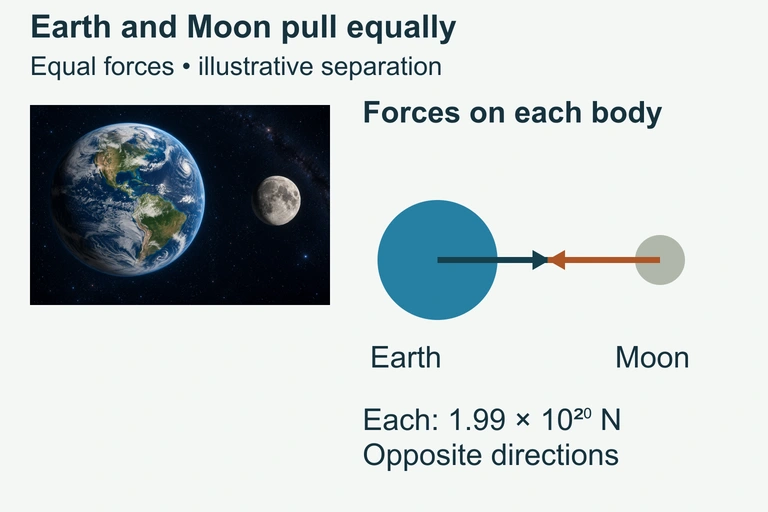 Earth and Moon exert equal and opposite gravitational forces, approximately 1.99 × 10²⁰ N, along their center line. Use center-to-center separation 3.84 × 10⁸ m; the depicted bodies are not to scale.
SECTION 4
Mathematical Framework
Newton's law of universal gravitation is one of the most elegant equations in classical physics. In this section we develop the mathematical framework you need for AP Physics 1, including the universal gravitation equation itself, the relationship between gravitational force and weight near Earth's surface, and the concept of gravitational field strength.
NEWTON'S LAW OF UNIVERSAL GRAVITATION
Fg = magnitude of the gravitational force (N); G = universal gravitational constant ≈ 6.674 × 10⁻¹¹ N·m²/kg²; m₁ and m₂ = masses of the two objects (kg); r = center-to-center distance between the objects (m).
WEIGHT NEAR EARTH'S SURFACE
W = weight, the gravitational force on an object near Earth's surface (N); m = mass of the object (kg); g ≈ 9.8 m/s², the free-fall acceleration near Earth's surface.
DERIVING SURFACE GRAVITY
By setting Fg = m × g and recognizing that the relevant distance is Earth's radius RE ≈ 6.37 × 10⁶ m, one obtains g = G × ME / RE², where ME ≈ 5.97 × 10²⁴ kg. This shows that surface gravity is a property of the planet, not of the falling object.
A critical conceptual point connects these equations: W = mg is a special case of the universal gravitation law that applies only when one mass is a planet and the object is near its surface. The value g = 9.8 m/s² is not a universal constant—it depends on ME and RE. On the Moon, for instance, gMoon ≈ 1.6 m/s² because the Moon's mass and radius differ from Earth's. The AP exam frequently tests whether students recognize this distinction between the general law and its near-surface approximation.
AP Exam Tip
SECTION 5
The Inverse-Square Relationship in Detail
The inverse-square law is the most consequential feature of Newton's gravitational equation. It dictates how rapidly the force weakens as the separation between two masses increases. Grasping this relationship at a quantitative level is essential, because the AP exam often asks students to predict how gravitational force changes when distance or mass is scaled by a given factor.
| Distance (multiple of r₀) | Force (multiple of F₀) | Ratio to F₀ |
|---|---|---|
| r₀ | F₀ | 1 |
| 2r₀ | F₀ / 4 | 1/4 |
| 3r₀ | F₀ / 9 | 1/9 |
| 4r₀ | F₀ / 16 | 1/16 |
| 5r₀ | F₀ / 25 | 1/25 |
Gravitational force scaling with distance
A useful mental shortcut for proportional-reasoning questions: if the distance changes by a factor of n, the force changes by a factor of 1/n². If the mass of one object changes by a factor of k, the force changes by a factor of k. These scaling arguments allow you to answer many AP multiple-choice questions without plugging in a single number.
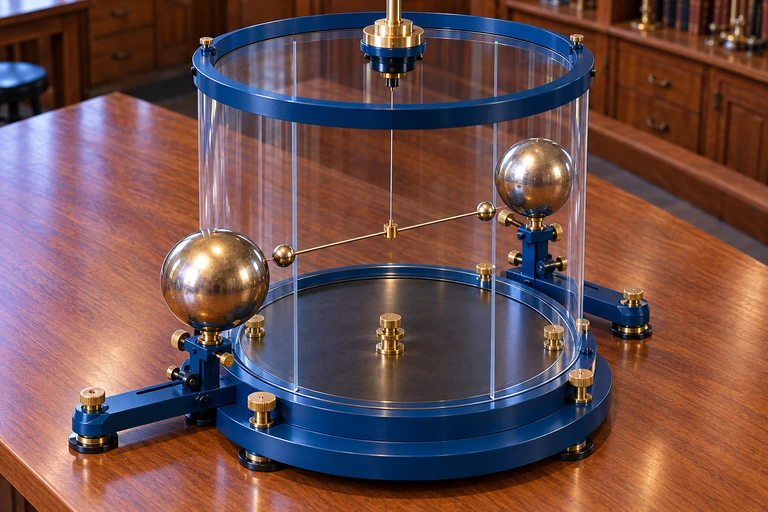 A torsion balance measures a tiny gravitational torque through a calibrated fiber’s angular deflection. Use center-to-center mass distances and include both source masses.
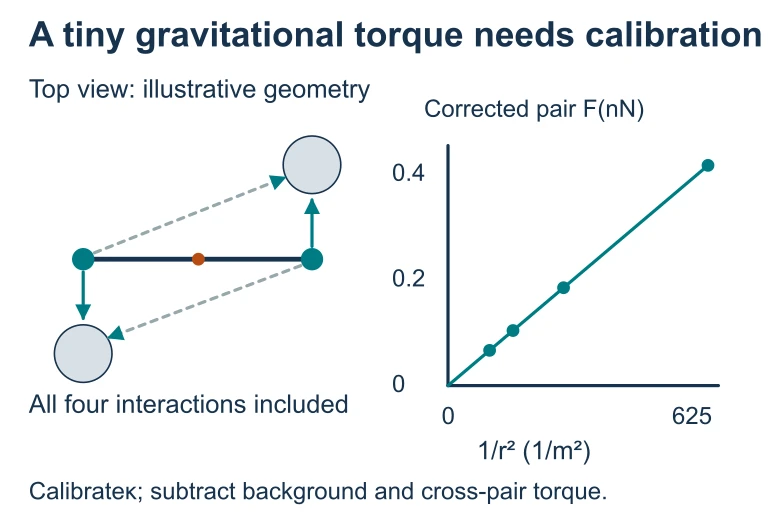 A torsion balance measures a tiny gravitational torque through a calibrated fiber’s angular deflection. Use center-to-center mass distances and include both source masses.
SECTION 6
Worked Example
Calculating the Gravitational Force Between Earth and the Moon
Let us apply Newton's law of universal gravitation to a real-world system: the Earth–Moon gravitational interaction. This example walks through every step so you can see how to handle the large exponents and verify the reasonableness of your answer.
Earth–Moon Gravitational Force
- 1
Step 1 — Identify Given Values
Mass of Earth: ME = 5.97 × 10²⁴ kg. Mass of Moon: MM = 7.35 × 10²² kg. Center-to-center distance: r = 3.84 × 10⁸ m. Universal gravitational constant: G = 6.674 × 10⁻¹¹ N·m²/kg². - 2
Step 2 — Write the Equation
Fg = G × ME × MM / r² - 3
Step 3 — Substitute Values
Fg = (6.674 × 10⁻¹¹)(5.97 × 10²⁴)(7.35 × 10²²) / (3.84 × 10⁸)² - 4
Step 4 — Evaluate the Numerator
Numerator = 6.674 × 5.97 × 7.35 × 10⁻¹¹⁺²⁴⁺²² = 6.674 × 5.97 × 7.35 × 10³⁵. Computing the coefficient: 6.674 × 5.97 ≈ 39.84, and 39.84 × 7.35 ≈ 292.8. So the numerator ≈ 2.928 × 10³⁷ N·m².Numerator ≈ 2.928 × 10³⁷ - 5
Step 5 — Evaluate the Denominator
r² = (3.84 × 10⁸)² = 3.84² × 10¹⁶ = 14.75 × 10¹⁶ = 1.475 × 10¹⁷ m².Denominator ≈ 1.475 × 10¹⁷ - 6
Step 6 — Divide and State the Answer
Fg = 2.928 × 10³⁷ / 1.475 × 10¹⁷ ≈ 1.985 × 10²⁰ N.≈ 1.98 × 10²⁰ N - 7
Step 7 — Reasonableness Check
This enormous force—on the order of 10²⁰ newtons—is what keeps the Moon in orbit around the Earth. The published value is approximately 1.98 × 10²⁰ N, confirming that our calculation is consistent. The fact that the result is very large is expected: both masses are enormous. Notice that Newton's third law tells us Earth experiences a force of this same magnitude directed toward the Moon.
SECTION 7
Common Misconceptions & Pitfalls
Students approaching gravitational force for the first time often carry intuitions that are either incomplete or incorrect. Addressing these misconceptions head-on will help you avoid losing points on the AP exam and will deepen your physical intuition.
| Misconception | Reality | Why It Matters on the AP Exam |
|---|---|---|
| "The Earth pulls on me, but I don't pull on the Earth." | By Newton's third law, you pull on the Earth with exactly the same force magnitude. The Earth barely accelerates because its mass is enormous. | FRQs often require you to identify Newton's third-law pairs; misidentifying gravitational forces is a common deduction. |
| "Heavier objects fall faster." | In the absence of air resistance, all objects near Earth's surface accelerate at g ≈ 9.8 m/s² regardless of mass, because a = F/m = mg/m = g. | Qualitative-quantitative translation FRQs test this directly. |
| "There is no gravity in space." | Gravitational force never becomes zero; it merely decreases with distance. Astronauts in orbit experience "weightlessness" because they are in free fall, not because gravity is absent. | MCQs may ask why astronauts float; the correct answer involves free fall, not zero gravity. |
| "Distance r is measured surface to surface." | The distance r in Newton's law is always measured from center of mass to center of mass. | Calculation problems that specify altitude above a planet's surface test whether you add the planet's radius. |
Common misconceptions about gravitational force
KEY TAKEAWAY
SECTION 8
Connection to Advanced Theory
Newton's law of universal gravitation is extraordinarily accurate for the vast majority of scenarios encountered in everyday life and in the AP Physics 1 curriculum. However, it is an approximation of a more complete theory—Einstein's general theory of relativity (1915). Understanding the boundary between Newtonian gravity and general relativity gives you valuable perspective on why Newton's model works so well within its domain and where its predictions begin to break down.
| Feature | Newton's Gravitation | Einstein's General Relativity |
|---|---|---|
| Nature of gravity | Force acting at a distance between masses | Curvature of spacetime caused by mass-energy |
| Speed of propagation | Instantaneous (action at a distance) | Finite—travels at the speed of light c |
| Accuracy for weak fields | Excellent (e.g., Earth, planets) | Reduces to Newton's law in the weak-field limit |
| Strong-field phenomena | Fails (e.g., Mercury's orbital precession) | Predicts correctly; also predicts black holes, gravitational waves |
| Mathematical complexity | Algebra-based; suitable for AP Physics 1 | Tensor calculus; typically graduate-level |
Newton's gravitation vs. general relativity
For AP Physics 1, you will never need to invoke general relativity—Newton's formulation is entirely sufficient. Nonetheless, recognizing that Newton's law is a limiting case of a more general framework deepens your appreciation of how physics progresses: new theories don't discard old ones but rather show that the old theory is an accurate approximation within a specific domain. This idea—called the correspondence principle—is a recurring theme throughout physics.
SECTION 9
Practice Problems
Question 1: CONCEPTUAL
- A. on B = 3 × on A
- B. on B = on A
- C. on B = (1/3) × on A
- D. on B = 9 × on A
Show answer (B)
Question 2: BASIC CALCULATION
- A. 4.2 × 10⁻⁸ N
- B. 8.3 × 10⁻⁸ N
- C. 1.7 × 10⁻⁷ N
- D. 4.2 × 10⁻⁹ N
Show answer (A)
Question 3: INTERMEDIATE
- A. W/2
- B. W/3
- C. W/4
- D. W/8
Show answer (C)
Question 4: APPLIED
5 ptsShow answer
Question 5: CRITICAL THINKING
4 ptsShow answer
SUMMARY
Lesson Summary
Summary
Gravitational force is a universal, always-attractive interaction between any two objects that possess mass. Its magnitude is given by Newton's law of universal gravitation: Fg = Gm₁m₂/r², where G ≈ 6.674 × 10⁻¹¹ N·m²/kg² is the universal gravitational constant, and r is the center-to-center distance between the objects. The force obeys an inverse-square law, decreasing to one-quarter when distance is doubled, and it acts equally on both objects in accordance with Newton's third law.
Near Earth's surface, the gravitational force on an object simplifies to W = mg with g ≈ 9.8 m/s², a value that itself derives from Earth's mass and radius via g = GME/RE². For the AP exam, remember to distinguish between the general law (used when distances are large or when computing surface gravity on other planets) and the near-surface approximation, always measure r from center to center, and apply proportional reasoning for scaling questions involving changes in mass or distance.