

SECTION 1
Historical Context & Motivation
The study of fluids is one of the oldest branches of physics, predating even the formalization of mechanics. Ancient civilizations in Mesopotamia, Egypt, and Rome developed sophisticated hydraulic engineering—aqueducts, irrigation canals, and dams—long before anyone articulated the underlying principles. Yet these accomplishments were empirical; builders worked from experience rather than theory. The breakthrough came when natural philosophers began asking why a submerged object feels lighter, or why water rises in a pump. The answers, it turned out, lie in the same force and equilibrium concepts that govern blocks on ramps and planets in orbit: Newton's laws of motion applied to continuous media rather than rigid bodies.
c. 250 BCE • Archimedes' Principle
1586 • Stevin's Law of Hydrostatic Pressure
1653 • Pascal's Law
1687 • Newton's Principia
1738 • Bernoulli's Hydrodynamica
The central question this lesson addresses is straightforward yet profound: how do Newton's laws—originally formulated for point masses and rigid bodies—apply to substances that flow and deform? When you draw a free-body diagram for a small parcel of fluid, you discover that familiar ideas like net force, equilibrium, and acceleration yield powerful results including pressure-depth relations, buoyant forces, and constraints on fluid flow. These ideas are not separate from mechanics—they are mechanics, applied to a new and beautifully deformable medium.
SECTION 2
Core Principles & Definitions
Before applying Newton's laws to fluids, you need a vocabulary shift. In rigid-body mechanics, you track individual objects with definite shapes and masses. In fluid mechanics, the medium is continuous and deformable, so the relevant quantities become density and pressure rather than mass and force alone. A fluid is any substance—liquid or gas—that cannot sustain a shear stress at rest; it yields and flows instead. This single property explains why fluids conform to their containers and transmit forces in all directions.
Density (ρ)
Pressure (P)
Newton's Second Law for Fluids
Buoyancy (Archimedes' Principle)
Pascal's Law
KEY TAKEAWAY
SECTION 3
Visual Explanation: Free-Body Diagram of a Fluid Parcel
The single most illuminating exercise in fluid statics is drawing a free-body diagram for an imaginary rectangular parcel of fluid inside a larger body of liquid at rest. The diagram below shows a small parcel at depth h beneath the surface. The parcel has cross-sectional area A and height Δy. Three forces act on it: the downward pressure from fluid above, the upward pressure from fluid below, and the downward gravitational force (weight). Because the parcel is in static equilibrium, Newton's second law requires the vector sum of these forces to be zero, which leads directly to the hydrostatic pressure equation.
Notice how the derivation requires nothing beyond Newton's second law in the y-direction and the definition of pressure. The green upward arrow represents the force exerted by the fluid below the parcel, which is larger than the red downward force from the fluid above because the lower face sits at greater depth and therefore higher pressure. The difference between these two pressure forces exactly balances the parcel's weight—this is the origin of buoyancy. If you replace the fluid parcel with a solid object of the same dimensions, the surrounding fluid still pushes with the same pressure distribution, so the net upward force remains ρfluidgV—Archimedes' principle.
SECTION 4
Mathematical Framework
The equations of fluid statics and buoyancy follow directly from Newton's second law applied to carefully chosen fluid parcels. Each equation below can be derived by drawing a free-body diagram, summing forces, and applying the equilibrium condition ΣF = 0 (for statics) or ΣF = ma (for dynamics). Mastering these derivations—not just memorizing the results—is essential for the AP Physics 1 exam.
HYDROSTATIC PRESSURE
P = absolute pressure at depth h, P₀ = pressure at the surface (often atmospheric), ρ = fluid density (kg/m³), g = gravitational acceleration (9.8 m/s²), h = depth below the surface (m). This follows from ΣFy = 0 on a horizontal fluid parcel.
GAUGE PRESSURE
Gauge pressure is the pressure relative to atmospheric pressure. Many instruments (tire gauges, blood pressure cuffs) measure gauge pressure. The absolute pressure at a point is the gauge pressure plus atmospheric pressure.
BUOYANT FORCE (ARCHIMEDES' PRINCIPLE)
Fb = buoyant force (N, directed upward), ρfluid = density of the surrounding fluid, Vdisplaced = volume of fluid displaced by the object. Derived by integrating the pressure difference between the top and bottom surfaces of the submerged object.
PASCAL'S LAW (HYDRAULIC SYSTEMS)
In a confined incompressible fluid, pressure changes are transmitted equally. A small force F₁ on a small piston of area A₁ creates the same pressure as a large force F₂ on a large piston of area A₂. This is a direct application of Newton's third law across the fluid medium.
Connecting to Newton's Laws
SECTION 5
Buoyancy and Floating: A Detailed Breakdown
Whether an object sinks, floats, or hovers in a fluid depends on the relationship between the buoyant force and the object's weight. Because both forces depend on volume and density, the outcome reduces to a simple density comparison. An object denser than the fluid sinks because its weight exceeds the maximum buoyant force (achieved when fully submerged). An object less dense than the fluid floats at the surface, submerging just enough volume to generate a buoyant force equal to its weight. An object whose density equals the fluid's density is neutrally buoyant and will remain at rest wherever you place it—a condition exploited by submarines adjusting their ballast.
| Condition | Density Relation | Net Force | Behavior |
|---|---|---|---|
| Floating | ρobj < ρfluid | ΣF = 0 (equilibrium at surface) | Partially submerged; fraction submerged = ρobj / ρfluid |
| Neutrally buoyant | ρobj = ρfluid | ΣF = 0 (equilibrium anywhere) | Fully submerged, remains at any depth |
| Sinking | ρobj > ρfluid | ΣF ≠ 0 (net downward) | Fully submerged, accelerates downward until reaching the bottom or a denser layer |
Summary of buoyancy conditions determined by comparing object and fluid densities
SECTION 6
Worked Example: Buoyancy and Apparent Weight
A solid aluminum cube with side length 0.10 m is suspended by a string and fully submerged in water. Determine (a) the buoyant force on the cube, (b) the tension in the string, and (c) the apparent weight of the cube. Use ρAl = 2700 kg/m³, ρwater = 1000 kg/m³, and g = 9.8 m/s².
Aluminum Cube in Water
- 1
Step 1 — Identify the Given Values
Side length s = 0.10 m, so V = s³ = (0.10)³ = 1.0 × 10⁻³ m³. The cube is fully submerged, so Vdisplaced = V = 1.0 × 10⁻³ m³. We also know ρAl = 2700 kg/m³ and ρwater = 1000 kg/m³. - 2
Step 2 — Calculate the Buoyant Force
Apply Archimedes' principle: Fb = ρwater × g × Vdisplaced = (1000)(9.8)(1.0 × 10⁻³).= 9.8 N - 3
Step 3 — Calculate the Weight of the Cube
W = m × g = ρAl × V × g = (2700)(1.0 × 10⁻³)(9.8).W = 26.46 N - 4
Step 4 — Apply Newton's Second Law (Equilibrium)
The cube is stationary (a = 0), so ΣFy = 0. Three forces act on the cube: tension T (up), buoyant force Fb (up), and weight W (down). Therefore T + Fb − W = 0, giving T = W − Fb = 26.46 − 9.8.T = 16.66 N ≈ 16.7 N - 5
Step 5 — Determine Apparent Weight
The apparent weight is the reading a scale or string tension would show—effectively the true weight minus the buoyant force. Since the string tension supports the cube against both gravity and the buoyant force, the apparent weight equals the tension.Apparent weight = T = 16.7 N (compared to true weight of 26.5 N)
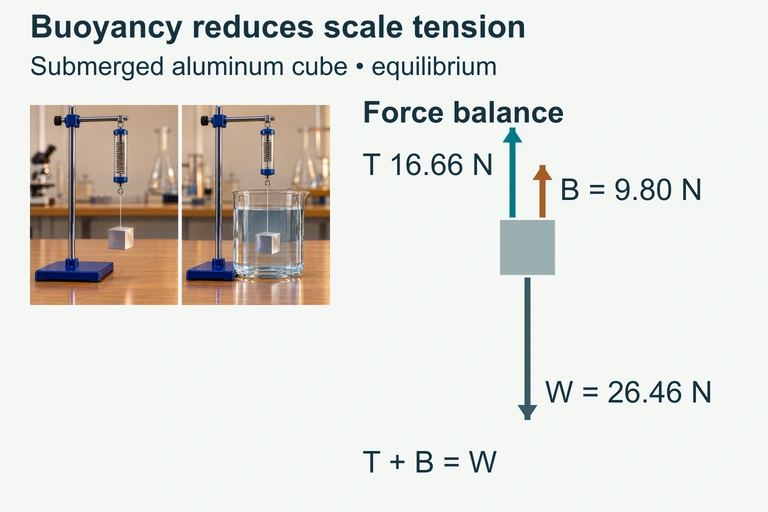 A fully submerged 0.10 m aluminum cube is supported without touching the vessel: weight 26.46 N downward, buoyancy 9.80 N upward and tension 16.66 N upward. T + B = W at equilibrium; arrow lengths are schematic.
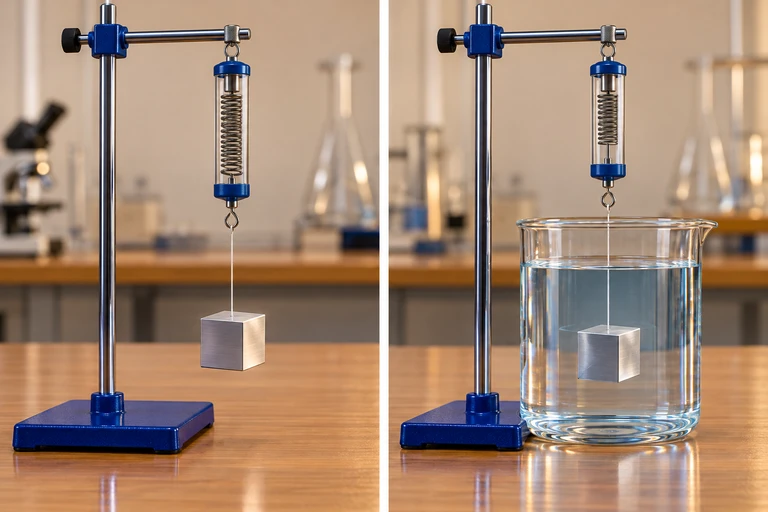 Submersion changes a supporting scale’s tension without changing the object’s gravitational force. At rest, upward tension plus buoyancy balances the weight.
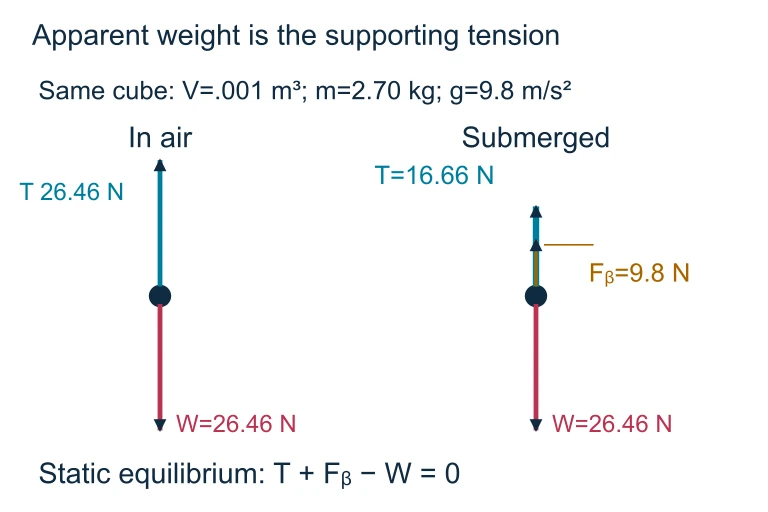 Submersion changes a supporting scale’s tension without changing the object’s gravitational force. At rest, upward tension plus buoyancy balances the weight.
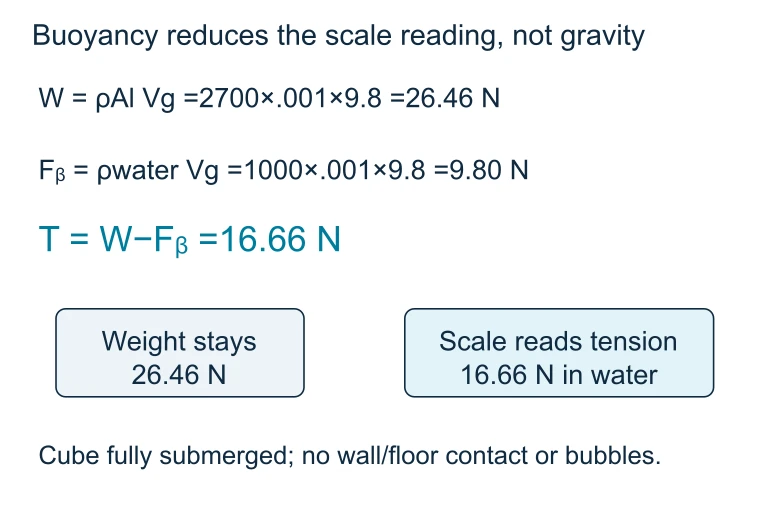 Submersion changes a supporting scale’s tension without changing the object’s gravitational force. At rest, upward tension plus buoyancy balances the weight.
SECTION 7
Strengths, Limitations & Common Pitfalls
The Newtonian approach to fluids is elegant and powerful, but it comes with assumptions and common student errors that are worth cataloging. The AP exam frequently tests your ability to recognize when these assumptions hold and when they break down.
| Strength / Feature | Limitation / Pitfall |
|---|---|
| Hydrostatic equation P = P₀ + ρgh is simple and widely applicable to any static fluid of uniform density. | Assumes constant density ρ. In gases, density changes with altitude; the equation is approximate for tall gas columns. |
| Archimedes' principle applies to objects of any shape—only the displaced volume matters. | Common error: using the object's total volume instead of the displaced volume when the object is only partially submerged. |
| Free-body diagram approach transfers seamlessly from rigid-body mechanics to fluid problems. | Common error: forgetting that the buoyant force uses the fluid's density, not the object's density. Many students accidentally substitute ρ_obj for ρ_fluid. |
| Pascal's law allows enormous mechanical advantage in hydraulic systems. | Pascal's law assumes an incompressible fluid and a closed system. It breaks down for gases under large pressure changes. |
| Pressure at a given depth is independent of container shape (the hydrostatic paradox). | Students often think a wider container creates more pressure at the same depth. The extra weight is supported by the walls, not the fluid at the bottom. |
Key strengths and common pitfalls when applying Newton's laws to fluids
EXAM TIP
SECTION 8
Connection to Advanced Fluid Theory
The static fluid concepts covered in AP Physics 1 are the foundation upon which the full edifice of fluid dynamics is built. While the AP Physics 1 curriculum treats fluids primarily at rest or in simplified steady flow, the underlying Newtonian reasoning extends directly to more advanced formulations. Understanding where AP-level concepts fit within this larger picture can deepen your intuition and prepare you for further study in physics or engineering.
| AP Physics 1 Concept | Advanced Extension | Where You'll See It |
|---|---|---|
| P = P₀ + ρgh (constant ρ) | General hydrostatic equation dP/dy = −ρg, allowing variable density (e.g., atmospheric pressure vs. altitude) | AP Physics 2, introductory engineering courses |
| Archimedes' principle (static buoyancy) | Dynamic lift and drag forces on objects moving through fluids; Navier-Stokes equations | College-level fluid mechanics, aerospace engineering |
| ΣF = 0 on a fluid parcel | ΣF = ma for accelerating fluid parcels → Euler's equation, then add viscosity → Navier-Stokes | Graduate-level fluid dynamics, computational fluid dynamics (CFD) |
| Pascal's law (hydraulics) | Compressible fluid mechanics; thermodynamic equations of state relating P, ρ, and T | Thermodynamics, chemical engineering |
How AP Physics 1 fluid concepts extend into more advanced physics and engineering courses
The key insight is that the Navier-Stokes equations—the governing equations for all fluid motion—are simply Newton's second law (ΣF = ma) applied to an infinitesimally small fluid element, with forces from pressure gradients, viscosity, and gravity. Every fluid phenomenon from ocean currents to airplane lift ultimately traces back to the same free-body diagram reasoning you practice in AP Physics 1. The equations become mathematically more demanding (they involve partial differential equations), but the physical idea never changes: forces cause acceleration, and equilibrium means zero net force.
SECTION 9
Practice Problems
Question 1: CONCEPTUAL
- A. Only the gravitational force acts downward on the ball.
- B. The gravitational force acts downward and a buoyant force acts upward, but the gravitational force is greater in magnitude.
- C. The gravitational force acts downward and a buoyant force acts upward, and they are equal in magnitude.
- D. The gravitational force acts downward and a buoyant force acts upward, but the buoyant force is greater in magnitude.
Show answer (B)
Question 2: BASIC CALCULATION
- A. 1.47 × 10⁵ Pa
- B. 2.48 × 10⁵ Pa
- C. 1.013 × 10⁵ Pa
- D. 2.48 × 10⁶ Pa
Show answer (B)
Question 3: INTERMEDIATE
- A. 75% submerged; = 294 N
- B. 60% submerged; = 235 N
- C. 75% submerged; = 392 N
- D. 80% submerged; = 294 N
Show answer (A)
Question 4: APPLIED
5 ptsShow answer
Question 5: CRITICAL THINKING
5 ptsShow answer
SUMMARY
Lesson Summary
Summary
Fluid statics is not a separate branch of physics but a direct application of Newton's laws of motion to continuous, deformable media. By isolating an imaginary fluid parcel and applying ΣF = ma in the vertical direction, we derived the hydrostatic pressure equation P = P₀ + ρgh, which states that pressure increases linearly with depth in a fluid of uniform density. The net upward pressure force on a submerged object yields Archimedes' principle: = ρ_fluid × g × V_displaced. Whether an object floats, sinks, or is neutrally buoyant depends on comparing the object's average density to the fluid's density.
Pascal's law tells us that pressure changes are transmitted undiminished through a confined incompressible fluid, enabling hydraulic force multiplication. For every AP-style fluid problem, the winning strategy is the same one you use in mechanics: draw a free-body diagram, identify all forces (weight, buoyant force, tension, normal force), set up Newton's second law, and solve. The concepts here form the foundation for more advanced topics such as fluid dynamics, Bernoulli's equation, and the continuity equation, which you will encounter in AP Physics 2 and college-level courses.