

SECTION 1
Historical Context & Motivation
The study of collisions stands among the oldest problems in classical mechanics. Long before Newton formalized the laws of motion, natural philosophers puzzled over what happens when two objects strike each other—whether billiard balls on a table or celestial bodies in space. The concept of momentum as a conserved quantity emerged from decades of debate, experiment, and mathematical refinement in seventeenth-century Europe. Understanding how collisions redistribute momentum and energy remains central to modern physics, engineering, and safety design.
1668 • Royal Society Collision Experiments
1687 • Newton's Principia
1743 • d'Alembert and the Vis Viva Debate
1960s • Particle Collider Era
The central question that collision theory addresses is straightforward yet powerful: given that total momentum is always conserved in an isolated system, how do we determine what happens to the kinetic energy? The answer depends on the type of collision—elastic, inelastic, or perfectly inelastic—and this classification lies at the heart of AP Physics 1 momentum problems.
SECTION 2
Core Principles & Definitions
Before classifying collisions, it is essential to recall the foundational conservation law that governs every collision in an isolated system. The law of conservation of momentum states that the total linear momentum of a system remains constant when no net external force acts on it. This law applies universally—regardless of whether the collision is elastic, inelastic, or perfectly inelastic. What distinguishes these types is the behavior of kinetic energy during the interaction.
Elastic Collision
Inelastic Collision
Perfectly Inelastic Collision
Isolated System Requirement
SECTION 3
Visual Explanation
Before and After: Three Types of Collisions
The diagram above illustrates the fundamental distinction among the three collision types for a one-dimensional scenario in which mass m₁ approaches a stationary mass m₂. Notice that in every case, the total momentum vector before the collision equals the total momentum vector after—the dashed center line separates the initial and final states. What changes is how kinetic energy is partitioned. In the elastic case, the total kinetic energy bar is the same height on both sides; in the perfectly inelastic case, the combined object moves slower, and a significant fraction of the original kinetic energy has been converted into internal energy of the system.
SECTION 4
Mathematical Framework
Conservation of Momentum (All Collisions)
CONSERVATION OF MOMENTUM
Where m₁ and m₂ are the masses of the two objects, v₁ᵢ and v₂ᵢ are the initial velocities, and v₁f and v₂f are the final velocities. This equation holds for every type of collision in an isolated system.
Elastic Collision: Kinetic Energy Conservation
KINETIC ENERGY CONSERVATION (ELASTIC ONLY)
This second equation is available only in elastic collisions. With two equations (momentum and KE), you can solve for two unknowns (v₁f and v₂f).
For the special case of a one-dimensional elastic collision, combining the two conservation equations yields a powerful result: the relative velocity of approach equals the relative velocity of separation. Mathematically, v₁ᵢ − v₂ᵢ = −(v₁f − v₂f). This relation is algebraically equivalent to KE conservation and is often faster to use on the AP exam than manipulating squared velocity terms.
RELATIVE VELOCITY RELATION (ELASTIC, 1-D)
The approach speed equals the separation speed. This replaces the quadratic KE equation with a linear one, simplifying algebra considerably.
Perfectly Inelastic Collision
PERFECTLY INELASTIC COLLISION
Since the objects stick together, v₁f = v₂f = vf. Solving: vf = (m₁v₁ᵢ + m₂v₂ᵢ) / (m₁ + m₂). The lost kinetic energy equals ΔKE = KEᵢ − KEf, and this quantity is always positive.
SECTION 5
Detailed Classification & Energy Analysis
A useful way to classify collisions is by the fraction of kinetic energy retained after the impact. We can define a quantity often called the coefficient of restitution (e), which equals the ratio of relative speed of separation to relative speed of approach: e = |v₂f − v₁f| / |v₁ᵢ − v₂ᵢ|. For a perfectly elastic collision e = 1; for a perfectly inelastic collision e = 0; and for all other inelastic collisions 0 < e < 1. While the AP exam does not explicitly test this coefficient, understanding it clarifies the spectrum of collision behavior.
| Property | Elastic | Inelastic | Perfectly Inelastic |
|---|---|---|---|
| Momentum conserved? | Yes | Yes | Yes |
| KE conserved? | Yes | No | No |
| Objects stick together? | No | No | Yes |
| Coefficient of restitution | e = 1 | 0 < e < 1 | e = 0 |
| # unknowns after collision | 2 (use momentum + KE) | 2 (need extra info) | 1 (use momentum only) |
| Example | Ideal gas molecules, Newton's cradle | Car crash with bounce, tennis ball | Catching a ball, railroad coupling |
Comparison of collision types
 Treat capture and swing as separate stages. Horizontal momentum is conserved during the short impact; mechanical energy is conserved during the subsequent ideal swing.
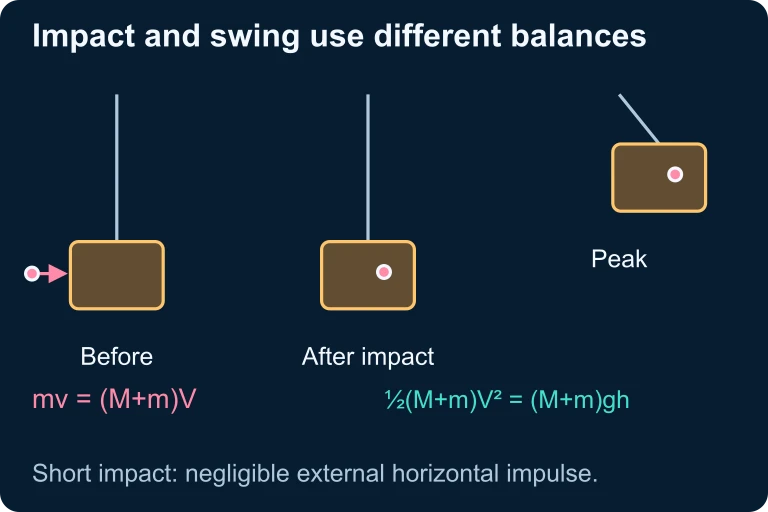 Treat capture and swing as separate stages. Horizontal momentum is conserved during the short impact; mechanical energy is conserved during the subsequent ideal swing.
SECTION 6
Worked Example
Worked example
- 1
Step 1 — Identify Given Values
A 4.0 kg cart moving at 6.0 m/s to the right collides with a 2.0 kg cart initially at rest on a frictionless track. The two carts lock together after the collision. Find (a) the final velocity and (b) the fraction of kinetic energy lost. - 2
Step 2 — Classify the Collision
The carts lock together, so this is a perfectly inelastic collision. We use: m₁v₁ᵢ + m₂v₂ᵢ = (m₁ + m₂)vf. - 3
Step 3 — Apply Conservation of Momentum
Substituting: (4.0 kg)(6.0 m/s) + (2.0 kg)(0 m/s) = (4.0 + 2.0 kg) × vf → 24 kg·m/s = 6.0 kg × vf.vf = 4.0 m/s to the right - 4
Step 4 — Calculate Initial Kinetic Energy
KEᵢ = ½m₁v₁ᵢ² + ½m₂v₂ᵢ² = ½(4.0)(6.0)² + 0 = 72 J.KEᵢ = 72 J - 5
Step 5 — Calculate Final Kinetic Energy
KEf = ½(m₁ + m₂)vf² = ½(6.0)(4.0)² = 48 J.KEf = 48 J - 6
Step 6 — Determine Fraction of KE Lost
ΔKE = 72 − 48 = 24 J. Fraction lost = ΔKE / KEᵢ = 24 / 72 = 1/3 ≈ 0.33. One-third of the kinetic energy was converted into internal energy (heat, sound, deformation). Notice that in any perfectly inelastic collision where one object is initially at rest, the fraction of KE lost equals m₂ / (m₁ + m₂), which here is 2/6 = 1/3.Fraction lost = 1/3 (about 33%)
Worked example
- 1
Step 1 — Identify Given Values
A 3.0 kg ball moving at 5.0 m/s collides head-on and elastically with another 3.0 kg ball at rest. Find the final velocities of both balls. - 2
Step 2 — Apply Momentum Conservation
(3.0)(5.0) + (3.0)(0) = 3.0 v₁f + 3.0 v₂f → 15 = 3v₁f + 3v₂f → v₁f + v₂f = 5.0 m/s. - 3
Step 3 — Apply Relative Velocity Relation
For elastic collisions: v₁ᵢ − v₂ᵢ = −(v₁f − v₂f). Substituting: 5.0 − 0 = −(v₁f − v₂f) → v₂f − v₁f = 5.0 m/s. - 4
Step 4 — Solve the System
Adding the two equations: v₁f + v₂f = 5.0 and v₂f − v₁f = 5.0 → 2v₂f = 10 → v₂f = 5.0 m/s, v₁f = 0 m/s. The moving ball stops completely, and the stationary ball takes on its entire velocity.v₁f = 0 m/s, v₂f = 5.0 m/s
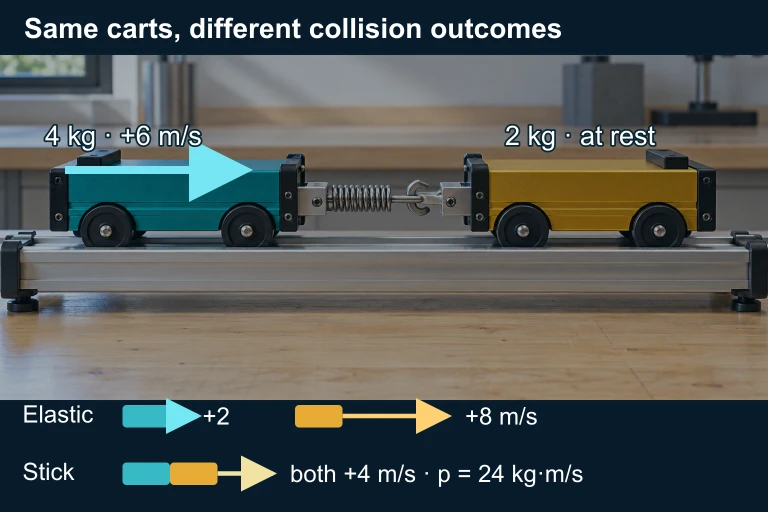 AP Physics 1: a 4 kg cart at 6 m/s strikes a stationary 2 kg cart. An elastic collision gives velocities 2 and 8 m/s; sticking gives both 4 m/s. Momentum remains 24 kg·m/s. The C companion uses different masses.
SECTION 7
Strengths, Limitations & Common Misconceptions
| Aspect | Strengths | Limitations / Pitfalls |
|---|---|---|
| Momentum conservation | Universal—applies to all collision types regardless of internal forces. | Only valid in isolated systems; external forces (friction, gravity during long collisions) violate the assumption. |
| KE conservation (elastic) | Provides a second equation, making two-body elastic problems fully solvable. | Perfectly elastic collisions are idealizations—real macroscopic collisions always lose some KE. |
| Perfectly inelastic model | Simplest to solve—only one unknown (vf). Directly applicable to ballistic pendulums. | Students often incorrectly assume KE is conserved or forget to account for the combined mass. |
| 1-D vs. 2-D | 1-D problems are algebraically clean with scalar equations. | AP Physics 1 may include 2-D glancing collisions; you must apply momentum conservation independently in x and y. |
Strengths and limitations of collision models
SECTION 8
Connections to Advanced Theory
The collision framework you learn in AP Physics 1 extends naturally into more advanced domains. In AP Physics C, you will encounter collisions analyzed through calculus-based impulse integrals, where the force-time profile during impact is modeled explicitly. At the university level, relativistic collisions in special relativity require modifications to the momentum expression (p = γmv) and use the invariant mass-energy relation E² = (pc)² + (mc²)². In nuclear and particle physics, collisions are the primary experimental tool—particles are smashed together at near-light speeds, and conservation of four-momentum determines what new particles can be created.
| Feature | AP Physics 1 Treatment | Advanced Treatment |
|---|---|---|
| Momentum | p = mv (classical) | p = γmv (relativistic); four-momentum in spacetime |
| Collision analysis | Before/after snapshots; algebra | Impulse integrals ∫F dt; Lagrangian/Hamiltonian formulations |
| Energy accounting | KE conserved or lost | Mass-energy equivalence; particle creation/annihilation |
| Dimensions | Primarily 1-D; some 2-D | Full 3-D with center-of-mass reference frames |
AP Physics 1 vs. Advanced collision physics
One particularly elegant extension is the center-of-mass reference frame, in which the total momentum of the system is zero by definition. In this frame, elastic collisions simply reverse the velocities of the two objects, and perfectly inelastic collisions bring both objects to rest. Mastering the AP-level framework gives you the conceptual foundation to work in any reference frame and to appreciate why particle physicists build ever-larger colliders to reach higher center-of-mass energies.
SECTION 9
Practice Problems
Question 1: CONCEPTUAL
- A. Skater A gains twice as much momentum as Skater B.
- B. Both skaters gain equal magnitudes of momentum but in opposite directions.
- C. Both skaters gain equal kinetic energy.
- D. Skater A gains more kinetic energy than Skater B because A has greater mass.
Show answer (B)
Question 2: BASIC CALCULATION
- A. 0.5 m/s to the right
- B. 1.0 m/s to the right
- C. 1.5 m/s to the right
- D. 3.0 m/s to the right
Show answer (B)
Question 3: INTERMEDIATE
- A. 0.50 m/s to the right
- B. 0.50 m/s to the left
- C. 2.0 m/s to the left
- D. 1.0 m/s to the right
Show answer (A)
Question 4: APPLIED
Show answer
Question 5: CRITICAL THINKING