

SECTION 1
Historical Context & Motivation
Long before Newton formalized the laws of motion, natural philosophers wrestled with a deceptively simple question: when two objects collide, what quantity is preserved? The ancient Greeks sensed that some measure of "motion" persisted through interactions, yet lacked the mathematical framework to pin it down. By the seventeenth century, the concept of momentum — the product of an object's mass and velocity — crystallized into one of physics' most powerful conservation laws. Understanding how this idea evolved reveals why conservation of linear momentum stands alongside energy conservation as a cornerstone of classical mechanics, and why the AP Physics 1 exam treats it as an indispensable analytical tool.
1644 • Descartes' Quantity of Motion
1668 • Wallis, Wren & Huygens
1687 • Newton's Principia
1918 • Noether's Theorem
The central question that conservation of momentum addresses is this: given two or more objects interacting through internal forces alone, how can we predict their post-interaction velocities without detailed knowledge of the forces themselves? This question lies at the heart of virtually every collision, explosion, and recoil problem on the AP Physics 1 exam.
SECTION 2
Core Principles & Definitions
Before applying the conservation law, we need precise definitions. Linear momentum is a vector quantity defined as the product of an object's mass and its velocity. Because it carries direction, two objects with identical speeds traveling in opposite directions possess momenta that partially or fully cancel when summed. The system — the set of objects whose momentum we track — must be clearly defined before any analysis begins. An isolated system is one on which no net external force acts; within such a system the total momentum remains constant regardless of how violently the objects interact with each other.
Momentum as a Vector
System & Surroundings
Impulse–Momentum Theorem
Newton's Third Law Connection
KEY TAKEAWAY
SECTION 3
Visual Explanation — Before & After a Collision
The diagram above captures the essence of momentum conservation in its simplest form. Before the collision, the momenta of the two bodies partially oppose one another, yielding a net system momentum of +4 kg·m/s to the right. During the collision, the internal contact forces between the balls are equal in magnitude and opposite in direction at every instant (Newton's Third Law), so the impulses they deliver to each other cancel perfectly. After the collision the individual velocities are quite different — ball 1 has reversed direction — yet the algebraic sum of the momenta is still +4 kg·m/s. This invariance holds regardless of the collision's details: it works for elastic bounces, perfectly inelastic sticks, and everything in between.
SECTION 4
Mathematical Framework
Conservation of linear momentum can be derived directly from Newton's Second and Third Laws. Consider a system of two objects interacting only with each other. By Newton's Third Law, the force on object 1 due to object 2 is equal and opposite to the force on object 2 due to object 1. Applying Newton's Second Law in its momentum form (F = dp/dt) to each object and summing, the internal forces cancel, yielding dptotal/dt = Fext,net. When the net external force is zero, dptotal/dt = 0, and total momentum is constant.
DEFINITION OF MOMENTUM
p⃗ is the momentum vector (kg·m/s), m is the mass (kg), and v⃗ is the velocity vector (m/s). Momentum is always in the same direction as velocity.
CONSERVATION LAW (TWO-OBJECT SYSTEM)
Subscript i = initial (before interaction), f = final (after interaction). This equation applies component-by-component: write separate equations for x and y in two-dimensional problems.
GENERAL FORM (N OBJECTS)
The vector sum of all momenta in the system before the interaction equals the vector sum after, provided no net external force acts on the system.
PERFECTLY INELASTIC COLLISION
When two objects stick together, they share a common final velocity vf. Momentum is still conserved; kinetic energy is not. This is a frequently tested scenario on the AP exam.
AP Exam Tip
SECTION 5
Types of Collisions & Explosions
Interactions governed by momentum conservation fall into several categories, distinguished primarily by what happens to kinetic energy. In every case, the total momentum of the isolated system is conserved. The differences lie in how much kinetic energy survives the interaction. The AP Physics 1 exam expects you to classify collisions and select the appropriate mathematical strategy for each type.
| Interaction Type | Momentum Conserved? | KE Conserved? | Key Feature |
|---|---|---|---|
| Elastic | Yes | Yes | Objects bounce; use two equations (p and KE) |
| Inelastic | Yes | No (KE decreases) | Some KE converted to other forms |
| Perfectly Inelastic | Yes | No (max KE loss) | Objects stick; one unknown (vf) |
| Explosion | Yes | No (KE increases) | Internal energy released; initially one object, splits into fragments |
Summary of collision and explosion types — momentum is always conserved in an isolated system.
SECTION 6
Worked Example — Perfectly Inelastic Collision
A 1200 kg car traveling east at 15 m/s collides with a 900 kg car traveling west at 10 m/s. The cars lock bumpers and slide together after the collision. Determine the velocity of the combined wreckage immediately after impact, and calculate the fraction of kinetic energy lost.
Perfectly Inelastic Collision
- 1
Step 1 — Define the System & Coordinate Axis
The system consists of both cars. Define east as the positive direction. Car 1: m₁ = 1200 kg, v₁ᵢ = +15 m/s. Car 2: m₂ = 900 kg, v₂ᵢ = −10 m/s (west is negative). Since the collision happens quickly and friction during the collision is negligible compared to the enormous internal forces, the system is approximately isolated during the impact. - 2
Step 2 — Write Conservation of Momentum
Because the cars stick together (perfectly inelastic), they share a common final velocity vf. The conservation equation is: m₁v₁ᵢ + m₂v₂ᵢ = (m₁ + m₂)vf. - 3
Step 3 — Substitute and Solve for vf
(1200)(+15) + (900)(−10) = (1200 + 900)vf → 18000 − 9000 = 2100 × vf → 9000 = 2100 × vf → vf = 9000 / 2100 ≈ 4.29 m/s.vf ≈ +4.3 m/s (east) - 4
Step 4 — Calculate Initial and Final Kinetic Energies
KE_initial = ½m₁v₁ᵢ² + ½m₂v₂ᵢ² = ½(1200)(15²) + ½(900)(10²) = 135000 + 45000 = 180000 J. KE_final = ½(2100)(4.29²) ≈ ½(2100)(18.38) ≈ 19300 J. - 5
Step 5 — Determine the Fraction of KE Lost
Fraction lost = (KE_initial − KE_final) / KE_initial = (180000 − 19300) / 180000 ≈ 0.893. Approximately 89% of the original kinetic energy is converted into thermal energy, sound, and permanent deformation of the vehicles. This dramatic energy loss is characteristic of perfectly inelastic collisions, yet momentum is perfectly conserved.≈ 89% of KE is lost
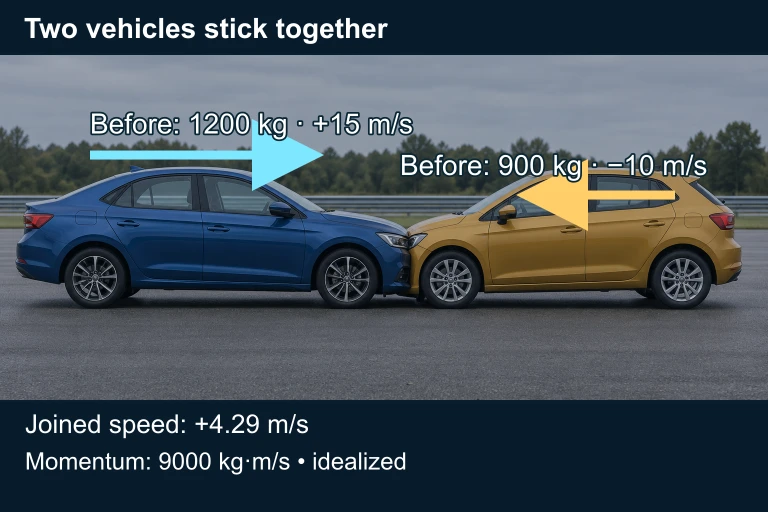 Cars of 1200 kg at +15 m/s and 900 kg at −10 m/s stick together with velocity +30/7 ≈ +4.29 m/s. Momentum remains +9000 kg·m/s; kinetic energy decreases.
SECTION 7
When Momentum Conservation Applies — and When It Doesn't
Momentum conservation is extraordinarily powerful, but students often misapply it. The principle holds only for a system experiencing zero net external force — or, more practically, for a system where external forces are negligible compared to the internal collision forces during the brief interaction time. Understanding when the law applies and when it breaks down is essential for AP Physics 1 success.
| Scenario | Momentum Conserved? | Why / Why Not |
|---|---|---|
| Two billiard balls collide on a frictionless surface | Yes | No net external horizontal force; internal forces cancel by Newton's Third Law. |
| Car collision on a road with friction | Approximately yes | Friction exists but is tiny compared to the enormous collision forces during the brief impact. Momentum is conserved during the collision itself. |
| Ball dropped and hitting the ground | No (ball alone) | Gravity is a large external force on the ball. If you include Earth in the system, momentum is conserved — but Earth's velocity change is immeasurably small. |
| Rocket in deep space firing exhaust | Yes | System = rocket + exhaust. No external forces in deep space. The backward momentum of exhaust equals the forward momentum gained by the rocket. |
| Object sliding to a stop on a rough floor | No | Friction is a sustained external force acting over a long time interval, providing a significant net impulse that changes the system's momentum. |
Common scenarios and whether momentum conservation applies
KEY TAKEAWAY
SECTION 8
Connection to Advanced Theory
The conservation of linear momentum that you master in AP Physics 1 is not merely a classical mechanics result — it extends into every branch of physics, from electromagnetism to quantum field theory. At the AP level, you derive momentum conservation from Newton's Third Law, but at a deeper level, Noether's theorem shows that momentum conservation is a direct consequence of the translational symmetry of space: the laws of physics do not change when you shift your experiment two meters to the left. This symmetry argument remains valid in relativistic mechanics, quantum mechanics, and beyond.
| Feature | AP Physics 1 Treatment | Advanced Treatment |
|---|---|---|
| Momentum definition | p = mv (non-relativistic) | p = γmv (relativistic), includes massless particles (photons: p = E/c) |
| Origin of conservation | Newton's Third Law | Noether's theorem: translational symmetry of space |
| Dimensions | Primarily 1-D; some 2-D problems | Full 3-D vector treatment, including fields that carry momentum |
| Center of mass | Introduced qualitatively | Center-of-mass reference frame simplifies collision analysis; invariant mass calculations |
| Mathematical tools | Algebra-based, no calculus | Lagrangian / Hamiltonian mechanics; four-vectors in special relativity |
AP Physics 1 vs. advanced physics treatment of momentum conservation
Although the AP course uses only algebra, the conceptual groundwork you build here — choosing a system, identifying external forces, applying conservation laws — transfers directly into university-level analytical mechanics. Momentum conservation also plays a starring role in particle physics: when protons collide at the Large Hadron Collider, physicists use conservation of four-momentum (the relativistic generalization) to identify new particles produced in the debris.
SECTION 9
Practice Problems
Question 1: CONCEPTUAL
- A. Both skaters have the same speed because momentum is conserved.
- B. Both skaters have the same magnitude of momentum but move in opposite directions.
- C. Skater B has greater momentum because of the larger mass.
- D. The total momentum of the system increases because internal energy was converted to kinetic energy.
Show answer (B)
Question 2: BASIC CALCULATION
- A. 1.7 m/s east
- B. 2.5 m/s east
- C. 3.0 m/s east
- D. 3.5 m/s east
Show answer (A)
Question 3: INTERMEDIATE
- A. 1.8 m/s
- B. 2.7 m/s
- C. 3.6 m/s
- D. 3.0 m/s
Show answer (B)
Question 4: APPLIED
5 ptsShow answer
Question 5: CRITICAL THINKING
4 ptsShow answer
SUMMARY
Summary — Conservation of Linear Momentum
Summary
Linear momentum (p⃗ = mv⃗) is a vector quantity whose total is conserved in any isolated system — one experiencing no net external force. This principle, rooted in Newton's Third Law and ultimately in the translational symmetry of space, applies universally to collisions, explosions, and any interaction where internal forces dominate. The conservation equation, m₁v₁ᵢ + m₂v₂ᵢ = m₁v₁f + m₂v₂f, is written component-by-component in two dimensions and holds whether kinetic energy is conserved or not.
Collisions are classified by their kinetic energy behavior: elastic collisions conserve both momentum and KE; inelastic collisions conserve momentum but not KE, with perfectly inelastic collisions (objects stick) yielding maximum KE loss; and explosions increase KE from internal energy while still conserving momentum. On the AP Physics 1 exam, always begin by defining the system, justifying that it is approximately isolated, choosing a sign convention, and then applying the conservation law component by component.