

SECTION 1
Historical Context & Motivation
The idea that rotating systems obey their own conservation principle has roots stretching back to the earliest mathematical treatments of planetary motion. Johannes Kepler observed in 1609 that planets sweep out equal areas in equal times as they orbit the Sun, a geometric statement that would later be recognized as a direct consequence of angular momentum conservation. Over the next three centuries, physicists formalized the concept, moving from empirical observation to a deep symmetry principle that governs everything from spinning neutron stars to subatomic particles.
1609 • Kepler's Second Law
1687 • Newton's Principia
1788 • Lagrange's Analytical Mechanics
1918 • Noether's Theorem
The core question that angular momentum conservation answers is straightforward yet powerful: when a rotating system is free from external torques, what quantity remains constant, and how does it constrain the system's behavior? Understanding this principle allows us to predict how spinning objects speed up, slow down, or change orientation without solving complicated differential equations — a central skill on the AP Physics 1 exam.
SECTION 2
Core Principles & Definitions
Before tackling the conservation law itself, you need a firm grasp of the quantities it relates. Angular momentum is the rotational analogue of linear momentum: just as a moving object resists changes to its linear velocity, a spinning object resists changes to its rotational state. The following foundational ideas form the backbone of every angular-momentum problem you will encounter on the AP exam.
Angular Momentum (L)
Moment of Inertia (I)
Torque (τ) and Its Role
The Conservation Statement
KEY TAKEAWAY
SECTION 3
Visual Explanation
The diagram captures the essence of conservation of angular momentum in the most familiar classroom example. When the skater extends her arms, the distributed mass increases the moment of inertia about the vertical axis through her body. Because no external torque acts on her in the horizontal plane (friction at the skate blade is along the axis, not perpendicular to it), pulling her arms inward is an internal rearrangement that cannot change the total angular momentum. The only way for L = Iω to remain constant while I decreases is for ω to increase proportionally. This same logic applies to any isolated system: collapsing gas clouds, merging galaxies, or a diver tucking into a somersault.
 With negligible external torque about the rotation axis, pulling mass inward reduces rotational inertia and increases angular speed. Internal work can increase kinetic energy while angular momentum stays constant.
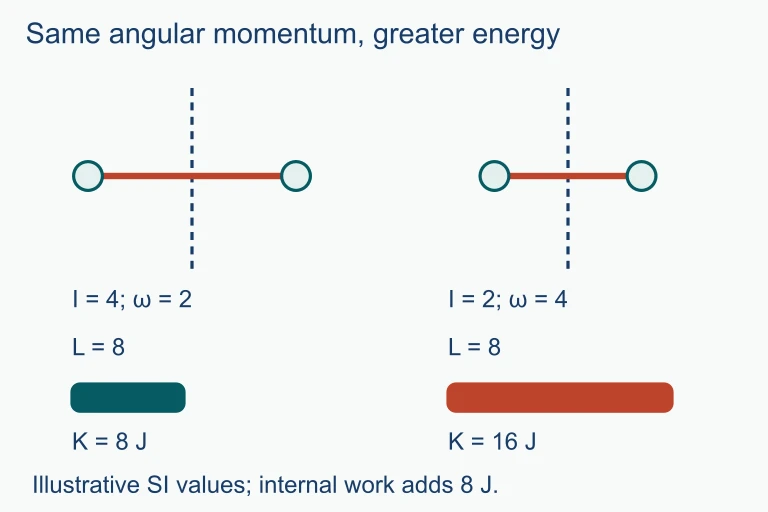 With negligible external torque about the rotation axis, pulling mass inward reduces rotational inertia and increases angular speed. Internal work can increase kinetic energy while angular momentum stays constant.
SECTION 4
Mathematical Framework
The mathematics underlying angular momentum conservation parallels the linear case but uses rotational quantities. The following equations form the quantitative toolkit you need for the AP Physics 1 exam, where all problems involve fixed-axis rotation (no precession or three-dimensional vector cross products are required).
ANGULAR MOMENTUM OF A RIGID BODY
L = angular momentum (kg·m²/s), I = moment of inertia (kg·m²), ω = angular velocity (rad/s). The direction of L is along the rotation axis, determined by the right-hand rule.
ANGULAR MOMENTUM OF A POINT PARTICLE
m = mass (kg), v = speed (m/s), r = distance from axis or pivot (m), θ = angle between r and v. For circular motion, θ = 90° so sin θ = 1 and L = mvr.
CONSERVATION OF ANGULAR MOMENTUM
Valid when τnet, ext = 0. Subscripts 1 and 2 refer to initial and final states. For a system of multiple objects: ΣIiωi = ΣIfωf.
ANGULAR IMPULSE–MOMENTUM THEOREM
τnet = net external torque (N·m), Δt = time interval (s), ΔL = change in angular momentum. When τnet = 0, ΔL = 0 and angular momentum is conserved.
AP Exam Tip
SECTION 5
Detailed Applications & Classification
Angular momentum conservation manifests in several distinct physical scenarios that appear on the AP exam. The most common situations involve a single object changing its mass distribution, two objects coupling together (a rotational "collision"), or a point particle moving in a gravitational or tension-based central force. Understanding how to classify a problem guides your choice of equation and system boundary.
| Scenario | System Definition | Why τ_ext = 0 | Key Equation |
|---|---|---|---|
| Mass redistribution | Single rotating body (skater, collapsing star) | Internal muscles or gravity do not exert external torque about the spin axis | I₁ω₁ = I₂ω₂ |
| Rotational collision | Two objects coupling (disk dropped on turntable) | Friction between disks is internal to the system; axle supports exert no torque about the axis | I₁ω₁ + I₂ω₂ = (I₁ + I₂)ω_f |
| Central force orbit | Point mass orbiting a center (planet, ball on string) | Force is radial → torque τ = rF sin 0° = 0 about the center | mv₁r₁ = mv₂r₂ |
Classification of angular momentum conservation scenarios
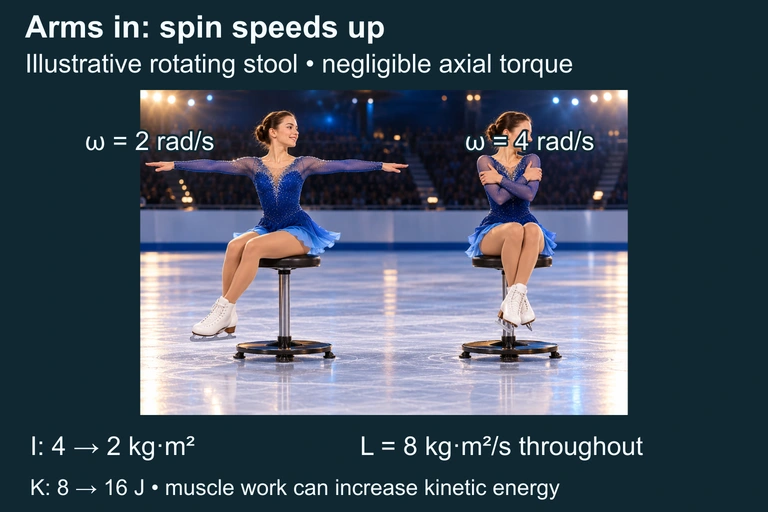 Illustrative arms-in rotation: I decreases from 4 to 2 kg·m² while ω increases from 2 to 4 rad/s, keeping L = 8 kg·m²/s. K increases from 8 to 16 J through internal work.
SECTION 6
Worked Example
Consider a classic AP Physics 1 problem involving a rotational collision. A solid disk is spinning freely on a frictionless axle when a second, initially stationary disk is dropped onto it and they rotate together.
Rotational Collision: Two Disks
- 1
Step 1 — State the Problem
A uniform solid disk of mass M = 4.0 kg and radius R = 0.30 m rotates at ω₁ = 12 rad/s about its central axis. A second uniform solid disk of mass m = 2.0 kg and radius R = 0.30 m, initially at rest, is dropped coaxially onto the first. The two disks stick together due to friction. Find the final angular velocity ωf and determine whether kinetic energy is conserved. - 2
Step 2 — Identify the System and Justify Conservation
Define the system as both disks. The axle is frictionless and exerts no torque about the rotation axis; gravity acts along the axis and produces no torque about it either. The friction between the disks is internal to the system. Therefore, the net external torque about the axis is zero, and angular momentum is conserved. - 3
Step 3 — Calculate Moments of Inertia
For a uniform solid disk, I = ½MR². The first disk: I₁ = ½(4.0)(0.30)² = ½(4.0)(0.09) = 0.18 kg·m². The second disk: I₂ = ½(2.0)(0.30)² = ½(2.0)(0.09) = 0.09 kg·m².I₁ = 0.18 kg·m², I₂ = 0.09 kg·m² - 4
Step 4 — Apply Conservation of Angular Momentum
Li = Lf gives I₁ω₁ + I₂(0) = (I₁ + I₂)ωf. Substituting: (0.18)(12) = (0.18 + 0.09)ωf → 2.16 = 0.27 ωf → ωf = 8.0 rad/s.ω_f = 8.0 rad/s - 5
Step 5 — Check Kinetic Energy
KEi = ½I₁ω₁² = ½(0.18)(12)² = ½(0.18)(144) = 12.96 J. KEf = ½(I₁ + I₂)ωf² = ½(0.27)(8.0)² = ½(0.27)(64) = 8.64 J. Since KEf < KEi, kinetic energy is not conserved. The lost energy (4.32 J) was converted to thermal energy by the friction between the disks as they reached the same angular velocity. This is analogous to a perfectly inelastic linear collision.ΔKE = −4.32 J (lost to friction/heat)
SECTION 7
Linear vs. Angular Momentum Conservation
One of the most powerful study strategies for AP Physics 1 is recognizing the structural parallelism between translational and rotational physics. Every translational quantity has a rotational analogue, and the conservation laws for linear and angular momentum share the same logical structure. However, there are critical differences in how each applies, particularly regarding the conditions that must be met and the nature of the quantities involved.
| Feature | Linear Momentum | Angular Momentum |
|---|---|---|
| Definition | p = mv | L = Iω or L = mvr |
| Inertia quantity | Mass (m) — scalar, fixed | Moment of inertia (I) — depends on mass distribution and axis choice |
| Conservation condition | Net external force = 0 | Net external torque = 0 |
| Inelastic collision | p conserved, KE not conserved | L conserved, rotational KE not conserved |
| Can inertia change? | Mass is constant for a closed system | I can change internally (redistribute mass) — this is the key distinguishing feature |
| Direction | Along the velocity vector | Along the rotation axis (right-hand rule) |
Comparison of linear and angular momentum conservation
KEY TAKEAWAY
SECTION 8
Connection to Advanced Theory
While AP Physics 1 restricts angular momentum problems to fixed-axis rotation, the concept extends far beyond this simplified framework. In a full three-dimensional treatment (covered in AP Physics C and college mechanics courses), angular momentum is a vector L = r × p defined via the cross product, and the moment of inertia generalizes to a 3 × 3 tensor. Furthermore, in quantum mechanics, angular momentum is quantized — particles can only possess discrete values of angular momentum measured in units of ℏ (the reduced Planck constant).
| Feature | AP Physics 1 Treatment | Advanced Treatment |
|---|---|---|
| Dimensionality | Scalar L about a fixed axis (sign indicates CW or CCW) | Full vector L = r × p; components along x, y, z |
| Moment of inertia | Scalar I = Σmᵢrᵢ² about a single axis | Inertia tensor (3×3 matrix); principal axes; precession and nutation |
| Quantization | Not addressed; L is continuous | L is quantized: L = √(l(l+1)) ℏ; component quantization Lz = mₗℏ |
| Symmetry connection | Conservation justified by τ_ext = 0 | Noether's theorem: rotational symmetry → conserved angular momentum |
AP Physics 1 vs. advanced angular momentum
Understanding the AP-level treatment thoroughly is the foundation for all of these extensions. The conceptual core — no net external torque means constant angular momentum — survives every level of sophistication. Mastering the algebra of I₁ω₁ = I₂ω₂ and building strong physical intuition about internal versus external torques will serve you not only on the AP exam but throughout your physics career.
SECTION 9
Practice Problems
Question 1: CONCEPTUAL
- A. Her angular velocity increases because the net external torque from her muscles accelerates her rotation.
- B. Her angular velocity increases because her moment of inertia decreases while angular momentum is conserved.
- C. Her angular velocity stays the same because angular momentum is conserved.
- D. Her angular velocity decreases because pulling the masses inward requires work that is taken from rotational kinetic energy.
Show answer (B)
Question 2: BASIC CALCULATION
- A. 3.3 rad/s
- B. 5.0 rad/s
- C. 6.7 rad/s
- D. 10 rad/s
Show answer (C)
Question 3: INTERMEDIATE
- A. 1.7 rad/s
- B. 1.9 rad/s
- C. 2.2 rad/s
- D. 2.7 rad/s
Show answer (C)
Question 4: APPLIED
4 ptsShow answer
Question 5: CRITICAL THINKING
4 ptsShow answer
SUMMARY
Lesson Summary
Summary
Angular momentum (L = Iω for rigid bodies, L = mvr for point particles) is the rotational analogue of linear momentum. The conservation of angular momentum states that when the net external torque on a system is zero, the total angular momentum remains constant. This principle applies to three major scenario types: mass redistribution (a single body changing its moment of inertia), rotational collisions (two objects coupling on a shared axis), and central-force orbits (where radial forces produce zero torque).
The critical distinction from linear momentum conservation is that moment of inertia can change internally, allowing a system to trade between I and ω while keeping L fixed. In inelastic rotational collisions, angular momentum is conserved but rotational kinetic energy is not — energy is lost to friction and heat, exactly as in translational inelastic collisions. On the AP exam, always begin by defining your system, verifying that external torques are absent (or negligible), and applying I₁ω₁ = I₂ω₂ or the appropriate multi-object form. Explicitly stating the justification for conservation is required for full credit on free-response questions.