

SECTION 1
Historical Context & Motivation
The quest to connect linear and rotational motion stretches back to antiquity, when Greek philosophers first pondered why wheels rolled and levers multiplied force. For centuries, scholars treated translation (straight-line motion) and rotation (spinning motion) as entirely separate phenomena, each requiring its own set of rules. The breakthrough came when physicists realized that angular displacement, angular velocity, and angular acceleration are not merely analogies for their linear counterparts—they are directly linked through the radius of the circular path. This unification simplified mechanics enormously and remains one of the most elegant results in classical physics.
~250 BCE • Archimedes and the Lever
1687 • Newton's Principia
1736 • Euler's Rigid Body Dynamics
1834 • Hamilton's Generalized Coordinates
The central question this lesson addresses is deceptively simple: if you know how fast a wheel spins, can you determine how fast a point on its rim moves in a straight line? The answer is yes, and the bridge between these two descriptions is the radius of the circular path. Understanding this connection is essential for analyzing rolling objects, belt-and-pulley systems, gears, and any scenario where rotation produces (or results from) linear motion.
SECTION 2
Core Principles & Definitions
Every kinematic variable you have encountered in linear motion has a direct rotational analog. The key insight is that rotation and translation are not separate physics—they are the same physics viewed from different vantage points. A point on a rotating object simultaneously possesses angular quantities (measured relative to the axis of rotation) and linear quantities (measured as tangential motion along the arc). The radius r serves as the conversion factor between the two descriptions.
Angular Displacement ↔ Arc Length
Angular Velocity ↔ Tangential Speed
Angular Acceleration ↔ Tangential Acceleration
Rolling Without Slipping
KEY TAKEAWAY
SECTION 3
Visual Explanation
The diagram above encapsulates the central theme of this lesson: every row in the correspondence table follows the same pattern. Multiplying (or dividing) by r converts between the linear and angular descriptions. The tangential velocity vector is always perpendicular to the radius—this is crucial because it means the tangential speed changes the magnitude of the velocity, while the centripetal acceleration changes its direction. Both components are necessary to describe the full motion of any point on a rotating body, but only the tangential component connects directly to angular acceleration through at = rα.
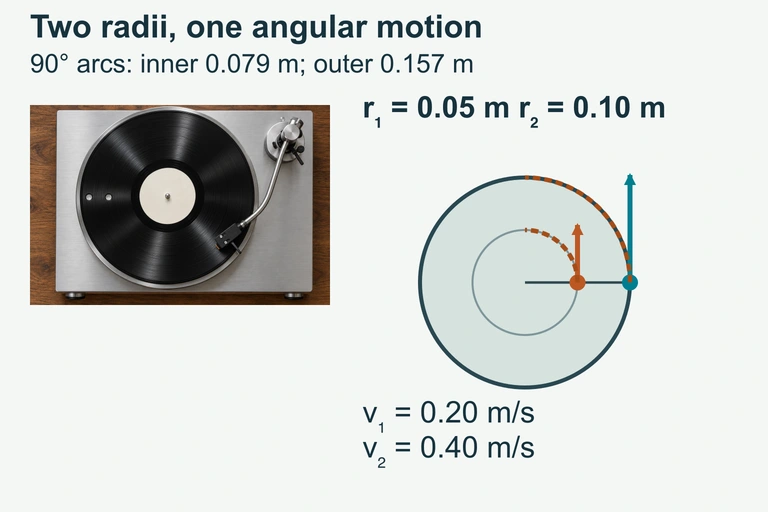 At the illustrated instant, ω = 4 rad/s. Points at radii 0.05 m and 0.10 m move at 0.20 m/s and 0.40 m/s. A shared 90° rotation traces arcs of 0.0785 m and 0.1571 m. The required companion adds the instantaneous tangential accelerations.
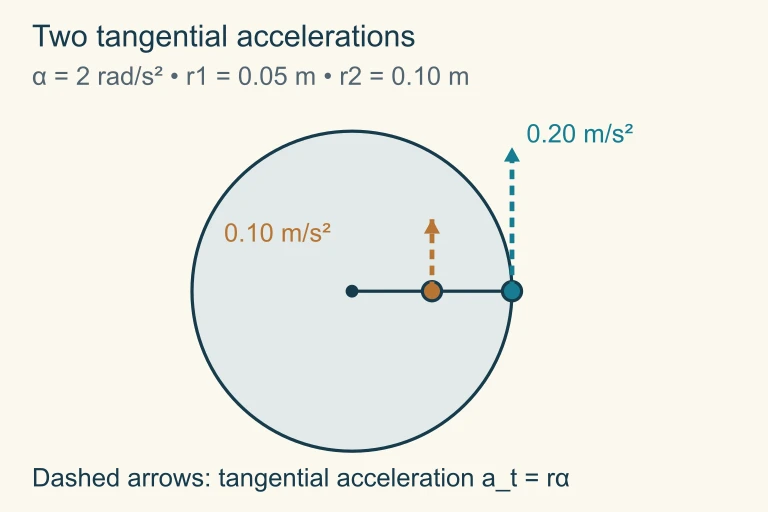 At the instant shown, ω = 4 rad/s and α = 2 rad/s². Both points share angular motion; v = rω and a_t = rα, so the outer point has twice the speed and twice the tangential acceleration. The 90° arc lengths are 0.0785 m and 0.1571 m.
SECTION 4
Mathematical Framework
The relationships between linear and rotational kinematics all derive from the definition of the radian. One radian is the angle subtended when the arc length equals the radius. This seemingly simple definition yields a powerful set of conversion equations that work for any rigid body rotating about a fixed axis.
ARC LENGTH – ANGULAR DISPLACEMENT
Where s is the arc length (m), r is the radius from the axis of rotation (m), and θ is the angular displacement (rad). This equation is the foundation from which all other connections are derived by taking time derivatives.
TANGENTIAL SPEED – ANGULAR VELOCITY
Differentiating s = rθ with respect to time (and noting r is constant for a point on a rigid body) yields v = ds/dt = r(dθ/dt) = rω. Here v is the tangential (linear) speed (m/s) and ω is the angular velocity (rad/s).
TANGENTIAL ACCELERATION – ANGULAR ACCELERATION
Differentiating v = rω with respect to time gives at = rα. This is the component of linear acceleration tangent to the circular path. The centripetal (radial) acceleration ac = v²/r = rω² acts inward and does not connect to α.
ROLLING WITHOUT SLIPPING CONSTRAINT
For a round object of radius R rolling without slipping on a surface, the center-of-mass velocity vcm equals Rω, and the center-of-mass acceleration equals Rα. The contact point has zero instantaneous velocity relative to the surface.
Why Radians?
SECTION 5
Rolling Motion & Physical Constraints
Rolling without slipping is perhaps the most important physical application of the linear–rotational connection in AP Physics 1. When a cylinder, sphere, or wheel rolls along a surface without sliding, a geometric constraint locks together the translational and rotational motions: the arc length unrolled by the rim exactly equals the distance traveled by the center of mass. This constraint has profound consequences for energy analysis, force analysis, and kinematics.
The diagram reveals a powerful result: the velocity of any point on a rolling object is the vector sum of the translational velocity of the center of mass and the rotational velocity about the center. At the contact point these two contributions are equal in magnitude but opposite in direction, yielding zero net velocity—which is precisely the no-slip condition. At the top, they add constructively, giving twice the center-of-mass speed. Understanding this decomposition is essential for solving AP exam problems involving rolling on inclines, where you must simultaneously apply Newton's second law for translation (Fnet = macm) and the rotational analog (τnet = Iα) with the constraint acm = Rα.
Energy in Rolling Motion
 For bodies rolling without slipping from the same initial center-of-mass height, mass distribution determines acceleration and the partition of kinetic energy. Equal elapsed time and equal height loss are separate comparisons.
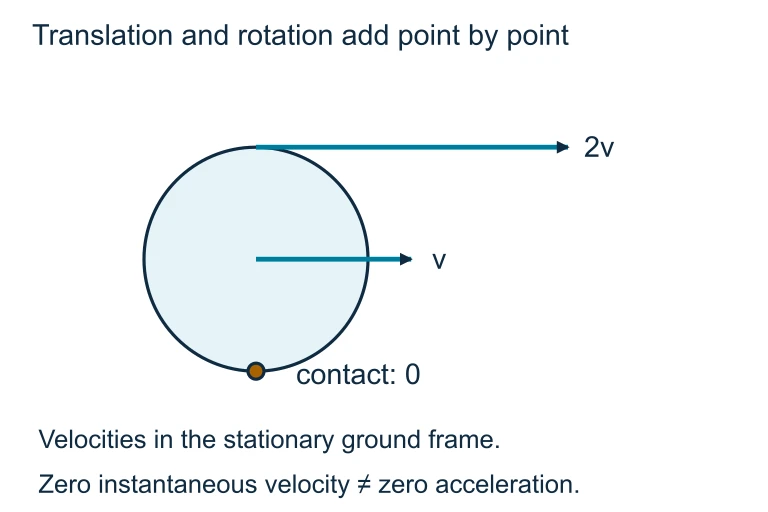 In the stationary ground frame, translation and rotation combine to give zero velocity at the contact point, v at the center and 2v at the top. Zero instantaneous velocity does not imply zero acceleration.
SECTION 6
Worked Example
Solid Cylinder Rolling Down an Incline
- 1
Step 1 — Identify the Problem
A solid cylinder of mass m = 4.0 kg and radius R = 0.10 m starts from rest at the top of an incline of height h = 2.0 m. It rolls without slipping down the incline. Determine the speed of its center of mass at the bottom and the angular velocity at that point. - 2
Step 2 — Choose an Energy Approach
Since the cylinder rolls without slipping, static friction does no work. We apply conservation of mechanical energy: mgh = ½mv²cm + ½Iω². For a solid cylinder, I = ½mR². Using the rolling constraint vcm = Rω, we substitute ω = vcm/R. - 3
Step 3 — Substitute and Simplify
mgh = ½mv²cm + ½(½mR²)(vcm/R)² = ½mv²cm + ¼mv²cm = ¾mv²cm. Therefore v²cm = (4/3)gh.v²cm = (4/3)(9.8)(2.0) = 26.13 m²/s² - 4
Step 4 — Calculate v_cm
vcm = √(26.13) ≈ 5.11 m/s. Note that this is less than the speed of a frictionless sliding block, √(2gh) ≈ 6.26 m/s, because some gravitational PE is converted to rotational KE.v_cm ≈ 5.1 m/s - 5
Step 5 — Find Angular Velocity
Using ω = vcm/R = 5.11/0.10 = 51.1 rad/s. This is the direct application of the linear–rotational connection: once you know the linear speed, the rolling constraint immediately gives the angular speed.ω ≈ 51 rad/s
SECTION 7
Strengths, Limitations & Common Pitfalls
| Aspect | Strength | Common Pitfall / Limitation |
|---|---|---|
| Unit Consistency | The relations s = rθ, v = rω, aₜ = rα are dimensionally clean and easy to memorize. | Only valid when θ is in radians. Using degrees is the most frequent error on the AP exam. |
| Rolling Constraint | v_cm = Rω powerfully links two unknowns into one, simplifying energy and force problems. | Only applies when the object rolls without slipping. If skidding occurs, v_cm ≠ Rω and kinetic friction does work. |
| Energy Partitioning | Allows KE_total = ½mv²_cm + ½Iω² to be written in terms of one variable using the constraint. | Students often forget to include rotational KE. A rolling object is always slower at the bottom of a ramp than a sliding one. |
| Acceleration Components | Separating tangential (aₜ = rα) and centripetal (aᶜ = rω²) acceleration clarifies force diagrams. | Confusing tangential and centripetal acceleration. Only aₜ is linked to angular acceleration α; centripetal acceleration exists even at constant ω. |
Summary of strengths and pitfalls in connecting linear and rotational motion
KEY TAKEAWAY
SECTION 8
Connection to Advanced Theory
The linear–rotational correspondence you have mastered in this lesson is actually a special case of a more general principle that appears throughout advanced physics. In Lagrangian mechanics, linear and angular coordinates are treated as generalized coordinates, and the equations of motion for both types emerge from a single energy function (the Lagrangian). The constraint vcm = Rω is classified as a holonomic constraint, meaning it can be expressed as an equation relating coordinates and integrated. These ideas become central in courses beyond AP Physics 1.
| AP Physics 1 Treatment | Advanced (College Physics / Engineering) |
|---|---|
| v = rω derived from arc-length definition | Vector cross product: v = ω × r with direction from right-hand rule |
| Rolling on flat surfaces only | Rolling on curved surfaces with non-inertial frames and constraint forces |
| Rotation about a fixed axis | Three-dimensional rotation using Euler angles and inertia tensors |
| Energy conservation: mgh = ½mv² + ½Iω² | Lagrangian mechanics: L = T − V with generalized coordinates and constraints |
Comparison of AP-level and advanced treatments
For now, take confidence in the fact that the algebra-based relationships you are learning—s = rθ, v = rω, at = rα—are not approximations or simplifications. They are exact results that carry over unchanged into more advanced frameworks. The vector formalism simply adds directional information that is not needed for the fixed-axis problems on the AP exam.
SECTION 9
Practice Problems
Question 1: CONCEPTUAL
- A. Point B has twice the tangential speed and twice the angular velocity of Point A.
- B. Point B has twice the tangential speed and the same angular velocity as Point A.
- C. Point B has the same tangential speed and the same angular velocity as Point A.
- D. Point B has twice the tangential speed and half the angular velocity of Point A.
Show answer (B)
Question 2: BASIC CALCULATION
- A. 0.029 m/s
- B. 4.2 m/s
- C. 34.3 m/s
- D. 12.35 m/s
Show answer (B)
Question 3: INTERMEDIATE
- A. The solid sphere, because a larger fraction of its gravitational PE converts to translational KE.
- B. The hollow sphere, because its larger moment of inertia gives it more angular momentum.
- C. They arrive at the same time because they have the same mass and radius.
- D. The solid sphere, because it has a smaller radius.
Show answer (A)
Question 4: APPLIED
5 ptsShow answer
Question 5: CRITICAL THINKING
4 ptsShow answer
SUMMARY
Summary
Summary
This lesson unified linear (translational) motion and rotational motion through three foundational equations: s = rθ connects arc length to angular displacement, v = rω connects tangential speed to angular velocity, and aₜ = rα connects tangential acceleration to angular acceleration. In every case, the radius r serves as the conversion factor, and all angles must be in radians for the equations to hold.
The most important physical application is rolling without slipping, where the constraint v_cm = Rω locks translational and rotational kinematics together. This constraint enables you to write the total kinetic energy as ½mv²cm + ½Iω² and reduce it to a single variable. Remember that objects with greater moment of inertia (relative to mR²) roll more slowly down an incline because a larger fraction of gravitational PE feeds rotational KE. Mastering these connections will prepare you for a wide range of AP exam questions involving wheels, pulleys, gears, and rolling bodies.