

SECTION 1
Historical Context & Motivation
The study of circular motion lies at the heart of classical mechanics, connecting terrestrial dynamics to the cosmic ballet of planets and moons. Ancient Greek thinkers believed uniform circular motion was the "perfect" form of movement, reserved for celestial bodies, yet they lacked the mathematical tools to explain why objects travel in curves rather than straight lines. It was not until the Scientific Revolution that physicists formulated the force laws governing curved paths. The progression from Copernicus's heliocentric model to Newton's universal gravitation relied critically on understanding what keeps an object moving in a circle—and what happens when that constraint is removed.
1543 • Copernican Revolution
1609 • Kepler's Elliptical Orbits
1659 • Huygens and Centripetal Acceleration
1687 • Newton's Principia
The central question that circular motion answers is deceptively simple: why does an object follow a curved path instead of traveling in a straight line? Newton's first law tells us that an object in motion continues in a straight line at constant speed unless acted upon by a net force. A curved trajectory therefore requires a continuously acting force—directed inward—that changes the direction of the velocity without necessarily changing its magnitude. Mastering this idea is essential for understanding everything from banked roadways to satellite orbits on the AP Physics 1 exam.
SECTION 2
Core Principles & Definitions
Before diving into equations, it is critical to internalize several foundational ideas that distinguish circular motion from straight-line kinematics. Although an object moving at constant speed around a circle might appear "unchanging," its velocity vector is rotating continuously, which means the object is accelerating at every instant. This acceleration demands a real, identifiable net force. The concepts below form the backbone of every AP-level circular motion problem.
Uniform Circular Motion
Centripetal Acceleration
Centripetal Force
Period and Frequency
Non-Uniform Circular Motion
SECTION 3
Visual Explanation — Forces in Circular Motion
The diagram above captures the essential geometry of uniform circular motion. At every instant, the velocity vector is tangent to the path—perpendicular to the radius—while the centripetal acceleration vector points directly inward along the radius. Because these two vectors are always perpendicular, the acceleration does no work on the object: it changes only the direction of motion, not the kinetic energy. If the centripetal force were suddenly removed at position A, the object would not spiral outward; it would fly off along the tangent line at the speed it had at the moment of release. This tangential departure is a direct consequence of Newton's first law and is a frequently tested concept on the AP exam.
SECTION 4
Mathematical Framework
The quantitative description of circular motion rests on a few tightly interconnected equations. Because the AP Physics 1 exam is algebra-based, we derive these relationships from geometry and Newton's second law without resorting to calculus. The key insight is that the change in the velocity vector over a small time interval points toward the center, yielding an inward acceleration whose magnitude depends on speed and radius.
CENTRIPETAL ACCELERATION
where a꜀ is centripetal acceleration (m/s²), v is the tangential speed (m/s), r is the radius of the circular path (m), and T is the period of revolution (s). The second form follows from substituting v = 2πr/T.
NEWTON'S SECOND LAW (RADIAL)
The net radial force ΣF꜀ equals the mass times the centripetal acceleration. This is simply Newton's second law applied in the radial direction—no new physics is introduced. The centripetal force is provided by real forces: tension, gravity, friction, normal force, or some combination.
SPEED–PERIOD RELATIONSHIP
The circumference of the circle is 2πr. Dividing by the period T gives the constant tangential speed for uniform circular motion.
A powerful strategy for solving circular motion problems is to choose a coordinate system with one axis pointing radially inward (positive toward the center) and one tangent to the path. Apply Newton's second law along the radial axis: the net inward force equals mv²/r. Along the tangential axis, the net force equals mat (which is zero for uniform circular motion). This decomposition converts a two-dimensional vector problem into two manageable scalar equations—one of the most efficient techniques you can deploy on exam day.
SECTION 5
Common Applications & Scenarios
Circular motion appears across a rich variety of AP Physics 1 contexts. Each scenario uses the same underlying principle—ΣF꜀ = mv²/r—but the identity of the centripetal force changes. Recognizing which force (or combination of forces) plays the centripetal role is the single most important step in setting up these problems.
| Scenario | Centripetal Force Provider | Key Equation (radial) |
|---|---|---|
| Car on flat curve | Static friction fs | fs = mv²/r |
| Banked curve (no friction) | Horizontal component of normal force N sin θ | N sin θ = mv²/r |
| Conical pendulum | Horizontal component of tension T sin θ | T sin θ = mv²/r |
| Vertical loop (top) | Gravity + Normal force (both inward) | N + mg = mv²/r |
| Satellite in orbit | Gravitational force | GMm/r² = mv²/r |
Summary of centripetal force sources for common AP scenarios
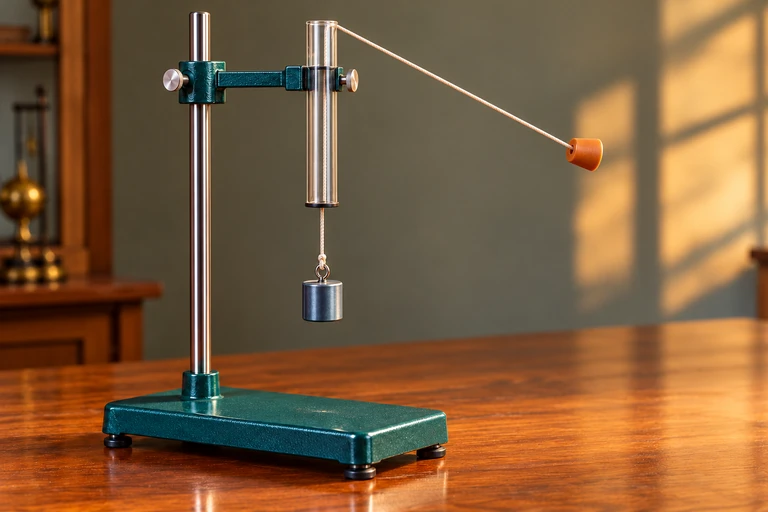 In a steady conical orbit, tension has an upward component that balances weight and an inward component that produces centripetal acceleration. The horizontal radius is r = ℓ sin θ.
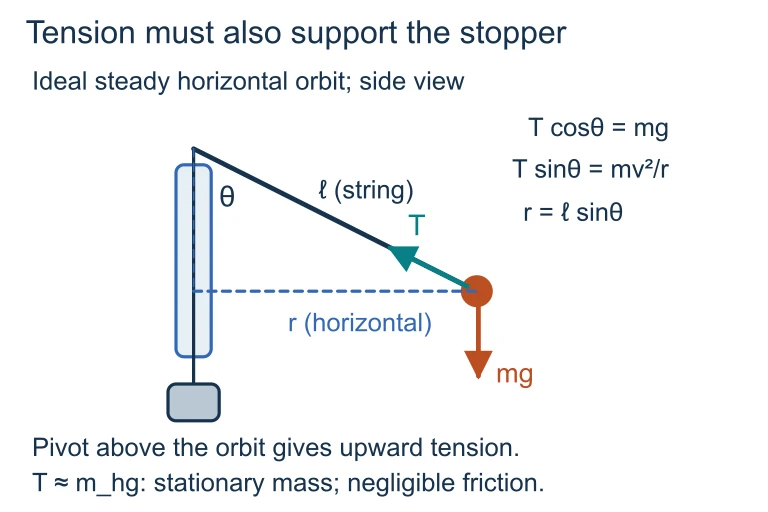 In a steady conical orbit, tension has an upward component that balances weight and an inward component that produces centripetal acceleration. The horizontal radius is r = ℓ sin θ.
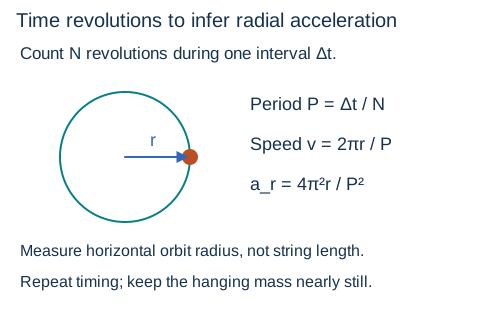 Time N complete revolutions over Δt to find period P = Δt/N. For steady circular motion, use the horizontal orbit radius r to calculate v = 2πr/P and inward acceleration 4π²r/P².Open full diagram
SECTION 6
Worked Example — Car on a Banked Curve
A car of mass 1200 kg travels around a banked circular curve with radius 80 m. The banking angle is 20° and the road surface is frictionless. Determine the speed at which the car can negotiate the curve without sliding up or down the bank.
Worked example
- 1
Step 1 — Draw Free-Body Diagram & Identify Forces
Only two forces act on the car: the gravitational force mg directed downward and the normal force N directed perpendicular to the banked surface. Because there is no friction, the only force with a horizontal component is the normal force. - 2
Step 2 — Choose Coordinate System & Decompose
Use a radial-vertical coordinate system. The radial direction (horizontal, toward center) is positive inward. Decompose N into components: N sin θ (radial, inward) and N cos θ (vertical, upward). Gravity has no radial component. - 3
Step 3 — Apply Newton's Second Law (vertical)
In the vertical direction, the car is in equilibrium (no vertical acceleration): N cos θ − mg = 0, so N = mg / cos θ.N = mg / cos θ - 4
Step 4 — Apply Newton's Second Law (radial)
The net inward force equals the centripetal force: N sin θ = mv²/r. Substitute N from Step 3: (mg / cos θ) × sin θ = mv²/r, which simplifies to mg tan θ = mv²/r.mg tan θ = mv²/r - 5
Step 5 — Solve for Speed
Cancel m from both sides: g tan θ = v²/r, so v = √(rg tan θ). Substituting values: v = √(80 × 9.8 × tan 20°) = √(80 × 9.8 × 0.364) = √(285.4) ≈ 16.9 m/s. Converting to more intuitive units, this is roughly 38 mph or 61 km/h.v ≈ 16.9 m/s - 6
Step 6 — Check the Result
Note that mass canceled entirely—the design speed depends only on r, g, and θ. This makes physical sense: a heavier car needs more centripetal force but also has a larger normal force component, and these scale identically with mass. The result ~17 m/s for a 20° bank is reasonable for a highway exit ramp.
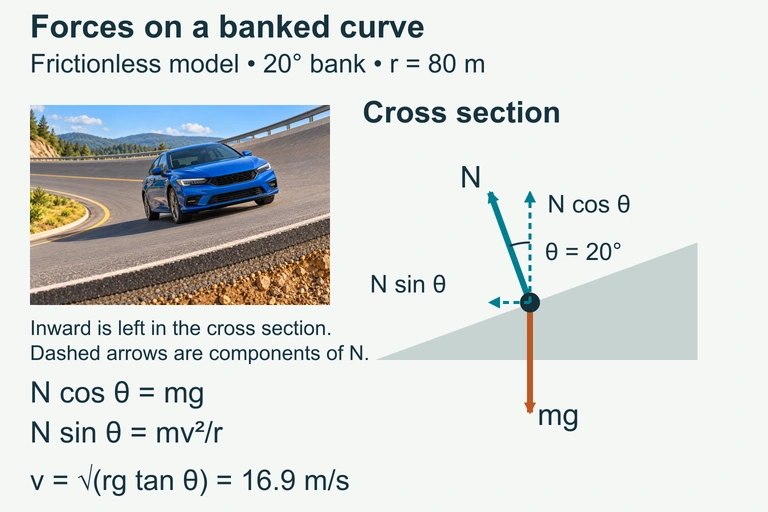 On a frictionless 20° bank of radius 80 m, the normal force has upward component N cos θ = mg and inward component N sin θ = mv²/r. Dashed arrows are components of N, not additional forces. The ideal speed is 16.9 m/s.
SECTION 7
Common Pitfalls & Exam Tips
| Common Mistake | Why It's Wrong | Correct Approach |
|---|---|---|
| Drawing a centrifugal force on the FBD | No outward force exists in an inertial frame; this violates Newton's laws as applied on the AP exam. | Only draw real contact or field forces. The net inward force is the centripetal force. |
| Setting a꜀ = 0 because speed is constant | Constant speed ≠ zero acceleration. Velocity direction is changing, producing centripetal acceleration. | Use a꜀ = v²/r for the radial acceleration, even when speed is constant. |
| Using the wrong radius | The radius must be the distance from the object to the center of the circular path, not the length of a string or ramp. | Identify the circular path first, then measure r as the horizontal distance to the axis of rotation. |
| Forgetting that normal force varies in a vertical loop | At the top, both N and mg point inward; at the bottom, N points inward while mg points outward. N changes with position. | Write ΣF꜀ = mv²/r separately at each position and solve for N. |
Frequent student errors and corrections
Key takeaway
SECTION 8
Connection to Rotational Dynamics & Beyond
Circular motion as treated in the Force and Translational Dynamics unit focuses on point-like objects and Newton's second law. As you progress into the Torque and Rotational Dynamics unit, the same principles extend to rigid bodies that both rotate and translate. The concept of angular velocity ω = 2π/T, introduced here through v = ωr, becomes the primary kinematic variable for rotation. Torque replaces force, moment of inertia replaces mass, and angular acceleration replaces linear acceleration—the structure of Newton's second law carries over directly as τnet = Iα.
| Concept | Circular Motion (This Unit) | Rotational Dynamics (Future) |
|---|---|---|
| Kinematic variable | Tangential speed v | Angular velocity ω |
| Inertia measure | Mass m | Moment of inertia I |
| Cause of acceleration | Net radial force ΣF꜀ | Net torque τnet |
| Newton's 2nd law form | ΣF꜀ = mv²/r | τnet = Iα |
| Conservation law | Energy (KE = ½mv²) | Angular momentum L = Iω |
How circular motion concepts map to rotational dynamics
Beyond AP Physics 1, the mathematics of circular motion extends into centripetal-force problems involving calculus-based derivations (AP Physics C), orbital mechanics, and the general theory of relativity where curved spacetime replaces the Newtonian concept of gravitational force. Even at the algebra-based level, mastering ΣF꜀ = mv²/r gives you a template that recurs in electrostatics (charged particles in magnetic fields), engineering (centrifuge design), and astrophysics (stellar orbits). The investment you make now in understanding radial force analysis pays compounding returns across every subsequent physics course.
SECTION 9
Practice Problems
Question 1: CONCEPTUAL
- A. The ball continues in a circle of larger radius.
- B. The ball spirals outward from the center.
- C. The ball moves in a straight line to the right.
- D. The ball moves radially outward from the center.
Show answer (C)
Question 2: BASIC CALCULATION
- A. 3.3 m/s²
- B. 6.7 m/s²
- C. 13.3 m/s²
- D. 16.0 m/s²
Show answer (C)
Question 3: INTERMEDIATE
- A. v = √(gR)
- B. v = √(2gR)
- C. v = √(gR/2)
- D. v = gR
Show answer (A)
Question 4: APPLIED
Show answer
Question 5: CRITICAL THINKING