AP Physics 1 • Linear Momentum

Change in Momentum and Impulse

Understanding how forces applied over time intervals produce changes in an object's momentum.

An orbit with symbols for force and motion.
Inside this lesson 10 sections 5 questions 8 figures

SECTION 1

Historical Context & Motivation

Long before the language of modern physics was formalized, natural philosophers grappled with a deceptively simple question: what really happens when one object strikes another? The intuitive sense that a heavier, faster-moving cannonball inflicts more damage than a slow-rolling pebble demanded rigorous quantification. Over several centuries, thinkers refined the concept of momentum — the product of mass and velocity — and the related idea of impulse, which captures how a force acting over a time interval changes that momentum. These twin concepts became cornerstones of classical mechanics and remain essential tools in modern engineering, sports science, and vehicle safety design.

1644 • Descartes and Quantity of Motion

René Descartes introduced the idea of "quantity of motion" as the product of size and speed, arguing that God conserves the total quantity of motion in the universe. While his scalar formulation was incomplete, it planted the seed for a formal momentum concept.

1668 • Wallis, Wren, and Huygens on Collisions

The Royal Society solicited papers on collision laws. John Wallis, Christopher Wren, and Christiaan Huygens independently showed that the vector product of mass and velocity — not Descartes' scalar version — is conserved in collisions.

1687 • Newton's Principia Mathematica

Isaac Newton formalized his Second Law in terms of the change of "quantity of motion" (momentum), writing that the applied force equals the rate of change of momentum. This formulation naturally introduces the impulse concept.

1743 • Euler's Analytical Mechanics

Leonhard Euler reformulated Newton's laws in modern algebraic notation, writing F = dp/dt explicitly and providing the framework used in physics courses today. His work made impulse calculations routine for engineers.

1952 • Automobile Crash Testing Begins

Systematic crash testing by automakers made the impulse-momentum theorem a practical engineering tool. Crumple zones and airbags, designed to extend collision time and reduce peak force, owe their design logic directly to the impulse concept.

The central question this lesson addresses is straightforward but powerful: given a net force that acts on an object for some duration, how do we calculate the resulting change in that object's momentum, and how does the impulse-momentum theorem connect force, time, and motion in a single elegant relationship? Mastering this connection is essential for analyzing collisions, designing safety systems, and solving a wide variety of AP Physics 1 problems.

SECTION 2

Core Principles & Definitions

Before diving into calculations, it is important to establish the foundational ideas that underpin the impulse-momentum framework. Each principle builds on the preceding one, and together they form a coherent toolkit for analyzing how forces alter an object's state of motion.

1

Linear Momentum (p⃗)

The linear momentum of an object is the product of its mass and velocity: p⃗ = mv⃗. It is a vector quantity whose direction matches the velocity. SI unit: kg·m/s.
2

Change in Momentum (Δp⃗)

The change in momentum equals the final momentum minus the initial momentum: Δp⃗ = p⃗_f − p⃗_i. Because momentum is a vector, direction matters — a reversal of velocity produces a larger Δp⃗ than simply stopping.
3

Impulse (J⃗)

Impulse is the product of the net force acting on an object and the time interval during which it acts: J⃗ = F⃗_net Δt. For variable forces, impulse equals the area under the force-vs-time graph.
4

Impulse-Momentum Theorem

The net impulse delivered to an object equals its change in momentum: J⃗ = Δp⃗. This is equivalent to Newton's Second Law integrated over time, and it is especially useful when forces are not constant.
5

Average vs. Instantaneous Force

When the force varies during an interaction, we often use the average force F̄ such that F̄ Δt = Δp⃗. Extending Δt (e.g., via airbags) reduces the average force for the same momentum change — the key safety insight.
✦

KEY TAKEAWAY

Think of momentum as a financial account balance and impulse as a deposit or withdrawal. The impulse-momentum theorem says the net transaction (force × time) equals the change in balance (Δp). A larger force is like a higher payment rate, while a longer time interval is like making payments for more months — both change the balance by the same amount if their product is the same. This is precisely why a baseball catcher pulls their glove back (extending the time) to reduce the sting (the force) of a fast pitch.

SECTION 3

Visual Explanation

Force vs. Time Graph and Impulse as Area

Impulse = Area Under Force vs. Time CurveTime (s)Force (N)80060040020000.020.040.06Peak Force ≈ 800 NShaded Area = Impulse JJ = ∫F dt ≈ F̄ × ΔtIMPULSEJ ≈ 24 N·s= Δp of object
The shaded region under the force-vs-time curve represents the impulse delivered to the object. Even when the force varies throughout the collision, the total area (and thus the impulse) equals the object's change in momentum. The peak force occurs near 0.03 s, but the average force multiplied by the total contact time Δt gives the same impulse value.

The force-vs-time graph above illustrates a typical collision profile — the force rises rapidly, peaks during maximum deformation, and then drops as the objects separate. The crucial insight is that impulse equals the total area under the curve, regardless of the curve's shape. For a constant force, this area is simply a rectangle (F × Δt); for a variable force, you must integrate or estimate the area geometrically. On the AP exam, force-vs-time graphs frequently appear as triangles or trapezoids, and you will be expected to calculate the area to find the impulse. Because the impulse-momentum theorem guarantees J⃗ = Δp⃗, knowing the impulse immediately gives you the change in the object's momentum.

SECTION 4

Mathematical Framework

The mathematical structure connecting impulse and momentum change is elegant and follows directly from Newton's Second Law. We begin with the familiar F⃗_net = ma⃗ and rewrite it in a form that is more natural for analyzing collisions and other short-duration interactions.

MOMENTUM DEFINITION

p⃗=mv⃗p⃗ = mv⃗

where p⃗ is the linear momentum (kg·m/s), m is the mass (kg), and v⃗ is the velocity (m/s). Momentum is a vector with the same direction as velocity.

IMPULSE-MOMENTUM THEOREM

J⃗=Δp⃗=p⃗f−p⃗i=mv⃗f−mv⃗iJ⃗ = Δp⃗ = p⃗_f − p⃗_i = mv⃗_f − mv⃗_i

The net impulse J⃗ equals the change in momentum. If mass is constant, this simplifies to J⃗ = m(v⃗_f − v⃗_i) = mΔv⃗.

IMPULSE FROM CONSTANT FORCE

J⃗=F⃗net×ΔtJ⃗ = F⃗_net × Δt

When the net force is constant, the impulse is simply the force multiplied by the time interval Δt (s) during which it acts. The SI unit of impulse is N·s, which is dimensionally identical to kg·m/s.

DERIVATION FROM NEWTON'S SECOND LAW

F⃗net=ma⃗=m(Δv⃗/Δt)→F⃗netΔt=mΔv⃗=Δp⃗F⃗_net = ma⃗ = m(Δv⃗/Δt) → F⃗_net Δt = mΔv⃗ = Δp⃗

Starting from F⃗_net = ma⃗ and substituting a⃗ = Δv⃗/Δt, we multiply both sides by Δt to obtain the impulse-momentum theorem. This derivation reveals that the theorem is not a separate law — it is Newton's Second Law expressed in terms of momentum change rather than acceleration.

💡

Units Check

Impulse (N·s) and momentum (kg·m/s) share the same units because 1 N = 1 kg·m/s². Therefore: N·s = (kg·m/s²)(s) = kg·m/s. On the AP exam, verifying dimensional consistency is a quick way to catch algebraic errors.

A critical subtlety for AP problems involves the vector nature of momentum change. When an object reverses direction — for example, a ball bouncing off a wall — the change in momentum is not simply the difference in speeds. You must assign a sign convention (typically positive to the right) and compute Δp = mv_f − mv_i with correct signs. If a 0.2 kg ball moving at +5 m/s bounces back at −5 m/s, the change in momentum is 0.2(−5) − 0.2(+5) = −2.0 kg·m/s, which has a magnitude of 2.0 kg·m/s — twice what you would compute if you ignored direction. This factor-of-two distinction is a very common source of errors.
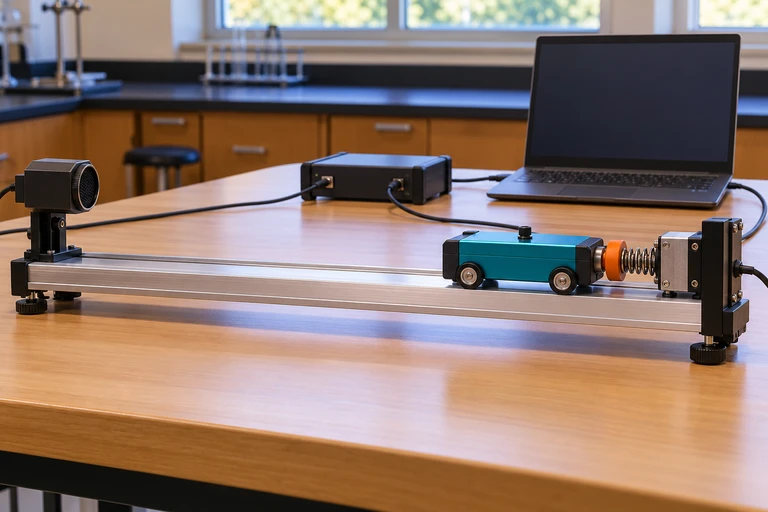
A cart on a straight track faces a spring contact and fixed force sensor,with a motion detector opposite and cables to a logger.The signed area under force versus time gives impulse. Compare that area with the cart’s measured momentum change, using one force-sign convention and including measurement uncertainty.
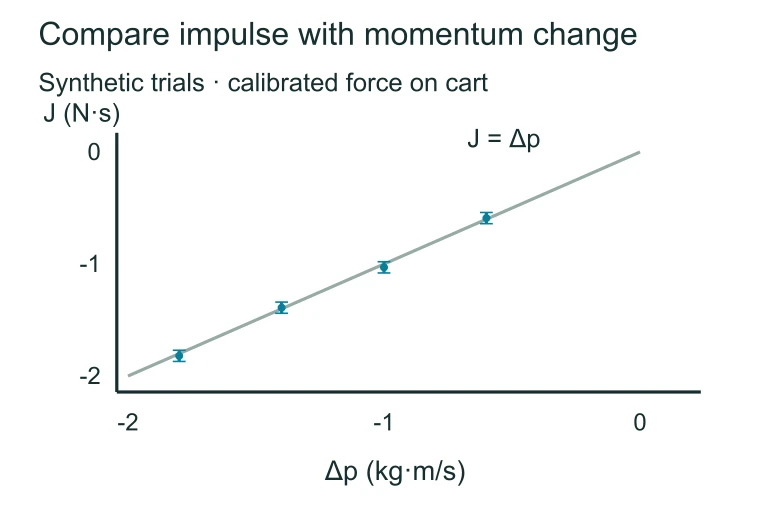
Force-sensor experiment links measured area and momentum change. The signed area under force versus time gives impulse. Compare that area with the cart’s measured momentum change, using one force-sign convention and including measurement uncertainty.The signed area under force versus time gives impulse. Compare that area with the cart’s measured momentum change, using one force-sign convention and including measurement uncertainty.
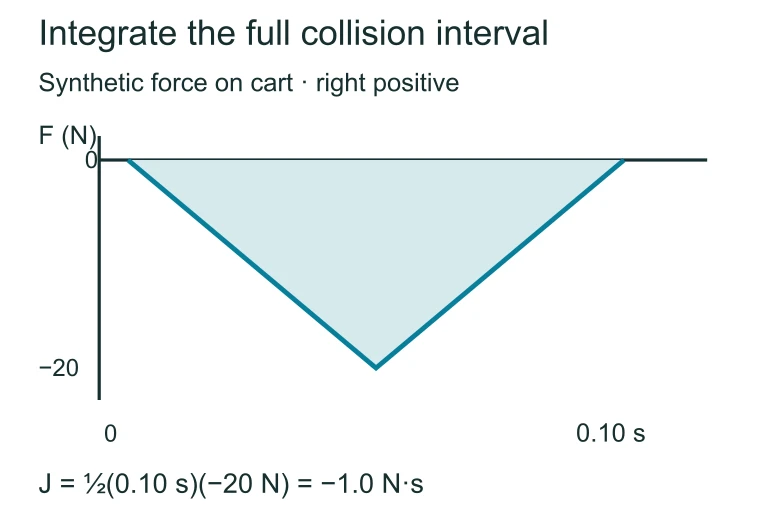
Impulse from a force trace. A triangular pulse lasting 0.10 s with peak force −20 N has signed area −1.0 N·s. With right positive, the negative impulse reduces the cart’s rightward momentum.A triangular pulse lasting 0.10 s with peak force −20 N has signed area −1.0 N·s. With right positive, the negative impulse reduces the cart’s rightward momentum.

SECTION 5

Applications & Force–Time Profiles

Same Impulse, Different Forces: The Safety Principle

One of the most practically important consequences of the impulse-momentum theorem is that the same change in momentum can be achieved with very different force profiles. A large force over a short time and a small force over a long time can deliver identical impulses. This principle is the physical basis for essentially all automotive and athletic safety equipment. Airbags, crumple zones, foam padding, and even the technique of bending your knees when landing from a jump all exploit the same idea: extend the interaction time to reduce the average force magnitude for a given momentum change.

Hard Surface (Short Δt) vs. Soft Surface (Long Δt): Same ImpulseTime (ms)Force (N)6000450030001500515253545Hard: F_peak ≈ 6000 NSoft: F_peak ≈ 3000 NBOTH TRIANGLESArea = ½ × b × hSame area → Same impulseSame Δp for object
Two force-vs-time profiles delivering the same impulse (equal shaded areas). The red triangle represents impact with a hard surface — high peak force over a short duration. The green trapezoid represents impact with a cushioned surface — lower peak force over a longer duration. Both produce the same change in momentum, but the cushioned impact dramatically reduces the risk of injury.

The diagram above compares two collisions in which an object undergoes the same momentum change. On the hard surface, the contact time is roughly 15 ms, and the peak force reaches about 6000 N. With a cushioned surface, the contact time stretches to about 35 ms, and the peak force drops to approximately 3000 N. The areas under both curves — their respective impulses — are equal, consistent with the fact that both collisions bring the object from the same initial momentum to the same final momentum. On the AP exam, you may be given a triangular or trapezoidal force-vs-time graph and asked to calculate the impulse by computing the geometric area. Practice recognizing these shapes and applying the appropriate area formulas (½ × base × height for a triangle, ½ × (b₁ + b₂) × h for a trapezoid).

💡

AP Exam Tip

When a force-vs-time graph is given, always check whether the shape is a rectangle, triangle, or trapezoid before attempting to calculate impulse. Count grid squares if the shape is irregular. Remember: impulse has the same units as momentum (N·s = kg·m/s), and it always equals Δp.

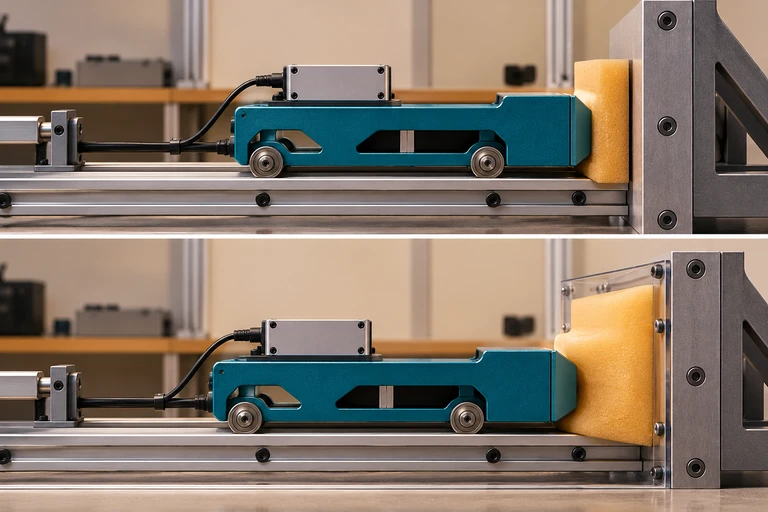
Two matched sled bays show thinner and thicker cushions compressing against rigid supports.For the same momentum change, a longer contact interval reduces the magnitude of the average force. Comparing peak forces additionally requires the pulse shapes to be specified.
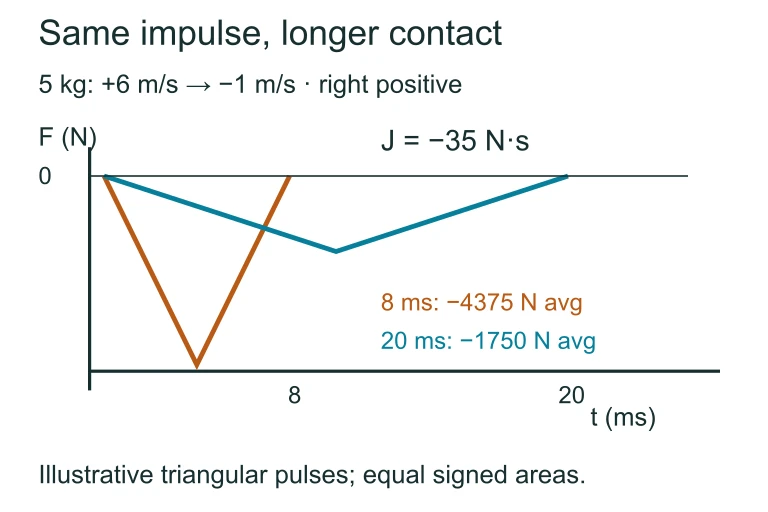
Equal impulse over different times. A 5 kg object changes velocity from +6 to −1 m/s, giving J = −35 N·s. Spreading that impulse over 8 ms or 20 ms gives average forces of −4375 N or −1750 N.A 5 kg object changes velocity from +6 to −1 m/s, giving J = −35 N·s. Spreading that impulse over 8 ms or 20 ms gives average forces of −4375 N or −1750 N.
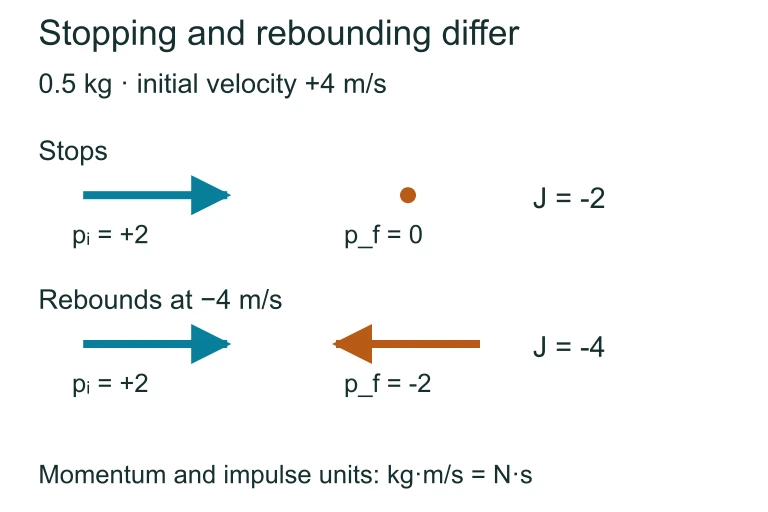
Stopping versus rebounding. A 0.5 kg object initially moves at +4 m/s. Stopping gives an impulse of −2 N·s; rebounding at −4 m/s gives −4 N·s. The final momentum determines the difference.A 0.5 kg object initially moves at +4 m/s. Stopping gives an impulse of −2 N·s; rebounding at −4 m/s gives −4 N·s. The final momentum determines the difference.

SECTION 6

Worked Example

A Tennis Serve: Calculating Impulse and Average Force

A tennis player serves a 0.058 kg ball. The ball is essentially at rest at the top of the toss (viv_i = 0 m/s) and leaves the racket strings at vfv_f = 55 m/s in the horizontal direction. High-speed video shows the ball is in contact with the racket for 4.0 ms (0.004 s). Find (a) the impulse delivered to the ball, and (b) the average force exerted by the racket on the ball.

Solution

  1. 1

    Step 1 — Identify Known Quantities

    Mass of the ball: m = 0.058 kg. Initial velocity: viv_i = 0 m/s. Final velocity: vfv_f = +55 m/s (taking the serve direction as positive). Contact time: Δt = 0.004 s.
  2. 2

    Step 2 — Calculate the Change in Momentum

    Using the definition Δp = mv_f − mv_i, we compute: Δp = (0.058 kg)(55 m/s) − (0.058 kg)(0 m/s) = 3.19 kg·m/s.
    Δp = 3.19 kg·m/s in the direction of the serve
  3. 3

    Step 3 — Apply the Impulse-Momentum Theorem

    By the impulse-momentum theorem, the impulse equals the change in momentum: J = Δp = 3.19 N·s.
    J = 3.19 N·s
  4. 4

    Step 4 — Calculate the Average Force

    Since J = F̄ × Δt, we solve for the average force: F̄ = J / Δt = 3.19 N·s / 0.004 s = 797.5 N ≈ 800 N. This is roughly the weight of an 80 kg person — a tremendous force applied over a tiny time interval.
    F̄ ≈ 800 N
  5. 5

    Step 5 — Interpret the Result

    Despite the ball's small mass, the very short contact time requires a large average force to produce the observed velocity change. This illustrates why the force experienced during a collision is strongly influenced by the collision duration. If a softer racket increased contact time to 8 ms, the same impulse would require only about 400 N of average force.

SECTION 7

Impulse vs. Related Concepts

Students frequently confuse impulse with closely related quantities such as force, momentum itself, and work. The following table clarifies the distinctions and helps you choose the correct approach on exam problems.

QuantitySymbol & FormulaUnitsVector / ScalarKey Idea
Momentump⃗ = mv⃗kg·m/sVectorState quantity — how much "motion" an object has
ImpulseJ⃗ = F⃗_net Δt = Δp⃗N·s (= kg·m/s)VectorProcess quantity — the action that changes momentum
ForceF⃗ = ma⃗ = dp⃗/dtN (= kg·m/s²)VectorRate of momentum change at an instant
WorkW = F⃗ · d⃗ = ΔKEJ (= kg·m²/s²)ScalarChanges kinetic energy — depends on displacement, not time
Kinetic EnergyKE = ½mv²J (= kg·m²/s²)ScalarState quantity — energy of motion; always positive

Comparison of momentum, impulse, force, work, and kinetic energy

⚡

KEY DISTINCTION

Impulse and work are both "process" quantities that describe how an interaction changes an object's motion, but they operate through different "channels." Impulse (force × time) changes momentum; work (force × displacement) changes kinetic energy. On the AP exam, the choice of which framework to use depends on whether the problem gives you time or displacement information. If the problem provides a collision duration, impulse-momentum is the natural tool. If it provides a distance, work-energy is more efficient.

SECTION 8

Connection to Advanced Theory

The impulse-momentum theorem as presented in AP Physics 1 uses an algebraic, constant-mass framework that assumes Δt is finite. In more advanced physics courses, this framework extends in several powerful directions. The table below previews these connections so you can appreciate where your current understanding fits within the broader landscape of mechanics.

AP Physics 1 VersionAdvanced Version
J = F_net × Δt (constant force)J = ∫F(t) dt (calculus-based impulse for variable forces)
Δp = mΔv (constant mass)F = dp/dt = m(dv/dt) + v(dm/dt) (variable mass systems, e.g., rockets)
1D collisions with signed velocities2D and 3D impulse vectors with component analysis
F_avg estimated from Δp/ΔtInstantaneous force reconstruction from high-speed force sensor data
Classical momentum p = mvRelativistic momentum p = γmv, where γ = 1/√(1 − v²/c²)

AP Physics 1 impulse-momentum concepts and their advanced extensions

Even in the calculus-based extension, the core principle remains identical: the net impulse delivered to a system equals its change in momentum. The integral form J⃗ = ∫F⃗(t) dt simply allows for the force to vary continuously over time, which is always the case in real-world collisions. The algebra-based area-under-the-curve approach you use in AP Physics 1 is the conceptual equivalent of this integral. Additionally, in many-body systems the impulse-momentum theorem extends naturally to conservation of momentum: when the net external impulse on a system is zero, the system's total momentum is conserved. This conservation law is one of the most fundamental principles in all of physics, from particle collisions to astrophysical phenomena.

SECTION 9

Practice Problems

Question 1: CONCEPTUAL

A 0.5 kg ball moving to the right at 4 m/s strikes a wall and bounces back to the left at 4 m/s. A 0.5 kg ball of clay moving to the right at 4 m/s strikes the same wall and sticks (vfv_f = 0). Which object experiences the greater magnitude of impulse from the wall?
  • A. The bouncing ball, because it undergoes a larger change in momentum.
  • B. The clay ball, because it experiences a greater force during impact.
  • C. They experience equal impulses because they have the same initial momentum.
  • D. The clay ball, because all of its kinetic energy is absorbed.
Show answer (A)
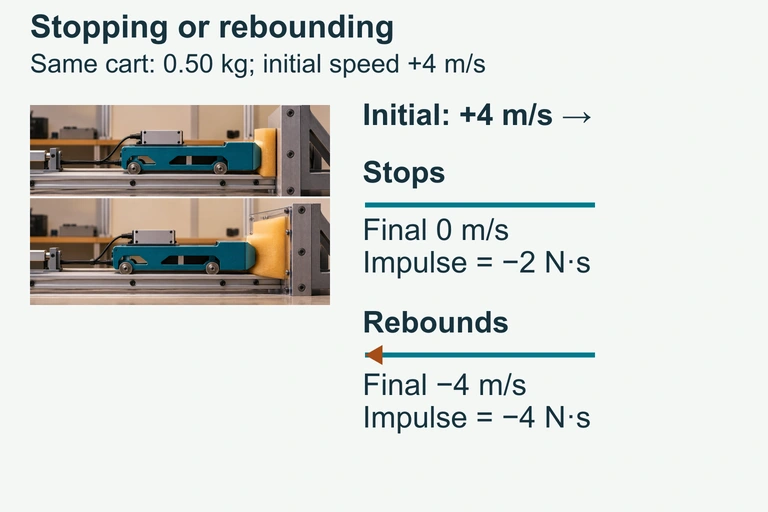
A is correct. Impulse equals change in momentum. For the bouncing ball: Δp = m(vfv_f − viv_i) = 0.5(−4 − 4) = −4.0 kg·m/s, so |Δp| = 4.0 kg·m/s. For the clay: Δp = 0.5(0 − 4) = −2.0 kg·m/s, so |Δp| = 2.0 kg·m/s. The bouncing ball's velocity reversal means its momentum change is twice as large. B is incorrect because impulse depends on Δp, not the magnitude of the force alone. C is incorrect because having the same initial momentum does not guarantee the same change — the final momenta differ. D is incorrect because kinetic energy absorbed relates to work and energy, not impulse; impulse is a momentum concept.The same 0.50 kg cart starts at +4 m/s. Stopping requires −2 N·s; rebounding at −4 m/s requires −4 N·s. These cart trials illustrate the AP Physics 1 ball-and-clay comparison; the calculus force-time companion is a separate model.The same 0.50 kg cart starts at +4 m/s. Stopping requires −2 N·s; rebounding at −4 m/s requires −4 N·s. These cart trials illustrate the AP Physics 1 ball-and-clay comparison; the calculus force-time companion is a separate model.

Question 2: BASIC CALCULATION

A constant horizontal force of 12 N is applied to a 3.0 kg cart initially at rest on a frictionless surface for 5.0 s. What is the final momentum of the cart?
  • A. 15 kg·m/s
  • B. 36 kg·m/s
  • C. 60 kg·m/s
  • D. 180 kg·m/s
Show answer (C)
C is correct. The impulse delivered is J = FΔt = (12 N)(5.0 s) = 60 N·s. Since the cart starts at rest (pip_i = 0), the impulse-momentum theorem gives Δp = J = 60 kg·m/s, so pfp_f = 60 kg·m/s. A (15) likely comes from dividing force by mass and then by time incorrectly. B (36) may arise from the erroneous calculation 12 × 3.0 = 36, confusing mass with time. D (180) results from multiplying all three given values (12 × 3.0 × 5.0), which has no physical meaning.

Question 3: INTERMEDIATE

A force-vs-time graph for a collision shows a triangular profile: the force rises linearly from 0 N at t = 0 ms to 1200 N at t = 3 ms, then decreases linearly back to 0 N at t = 6 ms. What is the impulse delivered to the object during this collision?
  • A. 1.8 N·s
  • B. 3.6 N·s
  • C. 7.2 N·s
  • D. 7200 N·s
Show answer (B)
B is correct. The triangular force-time profile has base = 6 ms = 0.006 s and height = 1200 N. The area of a triangle is ½ × base × height = ½ × 0.006 s × 1200 N = 3.6 N·s. This equals the impulse and hence the change in momentum. A (1.8 N·s) results from using only half the base (3 ms), treating the triangle as having a base of 3 ms instead of 6 ms. C (7.2 N·s) comes from computing the full rectangle (base × height) rather than the triangle (½ × base × height). D (7200 N·s) results from forgetting to convert milliseconds to seconds before multiplying.

Question 4: APPLIED

5 pts
A research team is designing a new helmet material to protect against head impacts. In a standard drop test, a 5.0 kg headform strikes a rigid surface at 6.0 m/s and rebounds at 1.0 m/s. The team's new padding extends the impact duration from 8.0 ms (standard) to 20.0 ms. (a) Calculate the magnitude of the impulse on the headform. (b) Determine the average force with the standard material and with the new padding. (c) By what factor does the new padding reduce the average force?
Show answer
Point 1 (1 pt): Correctly identify the change in momentum using sign conventions. Taking downward as positive: viv_i = +6.0 m/s, vfv_f = −1.0 m/s (rebound upward). Δp = m(vfv_f − viv_i) = 5.0(−1.0 − 6.0) = −35.0 kg·m/s. Magnitude of impulse: |J| = |Δp| = 35.0 N·s. Point 2 (1 pt): Correctly account for the direction reversal (rebound) when computing Δp, recognizing that the magnitude is m(viv_i + |vfv_f|) = 5.0(6.0 + 1.0) = 35 N·s, not m(viv_i − |vfv_f|) = 25 N·s. Point 3 (1 pt): Calculate the average force with standard material: F̄_standard = |J|/Δt = 35.0 N·s / 0.008 s = 4375 N ≈ 4400 N. Point 4 (1 pt): Calculate the average force with new padding: F̄_new = |J|/Δt = 35.0 N·s / 0.020 s = 1750 N. Point 5 (1 pt): Determine the reduction factor: 4375/1750 = 2.5. The new padding reduces the average force by a factor of 2.5 (equivalently, Δt increased by a factor of 2.5). A correct statement that the force reduction factor equals the ratio of the time intervals earns this point.

Question 5: CRITICAL THINKING

6 pts
A student wants to experimentally verify the impulse-momentum theorem using a dynamics cart on a low-friction track. The cart can be launched at various speeds toward a force sensor mounted at one end of the track. A motion sensor at the other end records the cart's velocity before and after it rebounds from the force sensor. The force sensor records force as a function of time during the collision. (a) Describe an experimental procedure the student should follow, including what quantities to measure and how to vary the experiment to collect multiple data points. (b) Describe how the student should analyze the data to verify the impulse-momentum theorem. Include what should be graphed and what the expected result is. (c) Identify one potential source of systematic error and explain whether it would cause the measured impulse to be greater than, less than, or equal to the measured change in momentum.
Show answer
Point 1 — Procedure (1 pt): The student should measure the mass of the cart (using a balance), launch it toward the force sensor at a known speed, and record the cart's velocity immediately before (viv_i) and immediately after (vfv_f) the collision using the motion sensor, as well as the force-vs-time data from the force sensor during the collision. Point 2 — Multiple Trials (1 pt): To collect multiple data points, the student should vary the launch speed of the cart (e.g., 5 different initial speeds) while keeping the mass constant, or alternatively add mass to the cart while keeping the launch speed constant. Each trial yields one impulse value and one Δp value. Point 3 — Impulse Calculation (1 pt): For each trial, the student should calculate the impulse by finding the area under the force-vs-time graph (using numerical integration or the software's built-in integration tool). The student should also calculate Δp = m(vfv_f − viv_i), being careful to use correct signs. Point 4 — Graphing (1 pt): The student should plot impulse (from the force sensor, on the y-axis) versus change in momentum (from the motion sensor, on the x-axis) for all trials. If the impulse-momentum theorem holds, the data should fall along a straight line with slope equal to 1 and y-intercept equal to 0. Point 5 — Expected Result (1 pt): A best-fit line through the data with a slope of approximately 1.0 (within experimental uncertainty) confirms the impulse-momentum theorem. The student can calculate the percent difference between the slope and 1.0 to quantify agreement. Point 6 — Systematic Error (1 pt): Friction between the cart and the track is a systematic error source. Friction exerts an additional backward force on the cart during its approach and departure, which the force sensor does not measure. The motion sensor would detect a velocity reduction from friction, making the measured |Δp| slightly larger than it would be from the collision force alone. Meanwhile, the impulse from the force sensor only captures the collision force, not friction. Therefore, friction would cause the measured impulse (from the force sensor) to be less than the measured change in momentum (from the motion sensor).

SUMMARY

Summary

Summary

Linear momentum (p⃗ = mv⃗) is a vector quantity that measures the "quantity of motion" of an object, while impulse (J⃗ = F⃗_net × Δt) measures the effect of a force acting over a time interval. The impulse-momentum theorem states that the net impulse on an object equals its change in momentum: J⃗ = Δp⃗ = mv⃗_f − mv⃗_i. This relationship is derived directly from Newton's Second Law integrated over time and is especially powerful for analyzing collisions and other short-duration interactions.

For variable forces, the impulse equals the area under the force-vs-time graph. The key practical insight is that for a given momentum change, extending the collision time reduces the average force — the principle behind airbags, crumple zones, and athletic padding. Always remember that momentum is a vector: direction reversals (bounces) produce larger momentum changes than stops, and sign errors on Δp are among the most common mistakes on the AP exam.

Varsity Tutors • AP Physics 1: Algebra-Based • Change in Momentum and Impulse