

SECTION 1
Historical Context & Motivation
The study of rotating objects has fascinated natural philosophers and physicists for centuries. Long before formal equations existed, astronomers observed that the planets maintained remarkably stable orbits, sweeping out equal areas in equal times—a regularity that hinted at a deep conserved quantity lurking within rotational motion. The concept of angular momentum emerged gradually as physicists extended Newton's laws of linear motion into the rotational domain, recognizing that spinning and orbiting systems obey conservation principles every bit as powerful as those governing straight-line collisions.
1609 • Kepler's Second Law
1687 • Newton's Principia
1736 • Euler's Rotational Mechanics
1858 • Foucault's Gyroscope
1915–1920s • Quantum Angular Momentum
The central question that angular momentum answers is deceptively simple: How do we quantify the "rotational inertia in motion" of a spinning or orbiting object, and what causes that quantity to change? Just as linear momentum (p = mv) tracks the "quantity of straight-line motion" and changes only when an external force acts, angular momentum tracks the "quantity of rotational motion" and changes only when an external torque is applied. The relationship between torque and the resulting change in angular momentum—angular impulse—completes the rotational analog of the impulse-momentum theorem and is central to solving AP Physics 1 problems involving figure skaters, collapsing stars, and rotating platforms.
SECTION 2
Core Principles & Definitions
Before diving into equations, it is essential to build a solid conceptual foundation. Angular momentum and angular impulse rest on a handful of key ideas that mirror their linear counterparts. Mastering these definitions will allow you to translate smoothly between linear and rotational problems on the AP exam.
Angular Momentum (L)
Angular Impulse (ΔL)
Conservation of Angular Momentum
Moment of Inertia (I)
Torque (τ)
KEY TAKEAWAY
SECTION 3
Visual Explanation
Linear ↔ Rotational Analogy Map
The diagram above is your Rosetta Stone for translating between linear and rotational physics. Every equation you already know from linear kinematics and dynamics has a direct rotational counterpart. In particular, notice that the bottom row—the impulse-momentum connection—takes the identical logical form in both domains: a net interaction (force or torque) applied over a time interval produces a change in the corresponding momentum. This structural parallel means that problem-solving strategies you have honed for collisions and linear impulse transfer directly to rotational scenarios on the AP exam.
SECTION 4
Mathematical Framework
With the conceptual groundwork laid, we now formalize the mathematics of angular momentum and angular impulse. There are two complementary expressions for angular momentum—one for extended rigid bodies and one for point particles—and the angular impulse-momentum theorem connects torque to changes in this quantity.
ANGULAR MOMENTUM OF A RIGID BODY
L = angular momentum (kg·m²/s), I = moment of inertia (kg·m²), ω = angular velocity (rad/s). The direction of L follows the right-hand rule: curl the fingers of your right hand in the direction of rotation and your thumb points along the angular momentum vector.
ANGULAR MOMENTUM OF A POINT PARTICLE
m = particle mass (kg), v = linear speed (m/s), r⊥ = perpendicular distance from the axis of rotation to the particle's line of motion (m). This form is useful for objects moving in circles or for particles in orbit around a pivot.
ANGULAR IMPULSE–MOMENTUM THEOREM
τ_net = net external torque (N·m), Δt = time interval (s), ΔL = change in angular momentum. For a constant net torque, the angular impulse is simply the product τ_net × Δt. This is the rotational analog of F_net × Δt = Δp.
CONSERVATION OF ANGULAR MOMENTUM
When no net external torque acts on a system, the total angular momentum is conserved. For a system that changes its moment of inertia: × ω_i = × ω_f. This is the principle behind a figure skater's spin and the collapse of a rotating gas cloud into a rapidly spinning star.
It is worth noting that the angular impulse-momentum theorem can also be interpreted graphically. If you plot net torque versus time, the area under the τ-vs-t curve equals the angular impulse, just as the area under an F-vs-t curve equals the linear impulse. This graphical interpretation is frequently tested on AP Physics 1 free-response questions, where you may be asked to estimate the change in angular momentum from a torque-time graph.
SIGN CONVENTION
SECTION 5
Conservation in Action — Before & After Analysis
Conservation of angular momentum is one of the most powerful tools in rotational physics. It allows you to relate the initial and final states of a system without knowing the details of the internal forces. This section presents a visual breakdown of the classic figure-skater scenario and extends the analysis to collisions on turntables—a favorite context on the AP exam.
The figure-skater example illustrates a within-system redistribution of mass. A complementary scenario involves an inelastic rotational collision: imagine a person jumping onto a spinning turntable. Before the collision, the turntable has angular momentum Iturntableωi and the person contributes zero angular momentum (standing still). After the collision they rotate together, so (Iturntable + Iperson)ωf = Iturntableωi. The increased total moment of inertia forces ωf to decrease. Note that while angular momentum is conserved, rotational kinetic energy is not conserved in this inelastic collision—some kinetic energy is transformed into thermal energy by friction between the person's shoes and the turntable.
AP EXAM TIP
 With negligible external torque about the rotation axis, pulling mass inward reduces rotational inertia and increases angular speed. Internal work can increase kinetic energy while angular momentum stays constant.
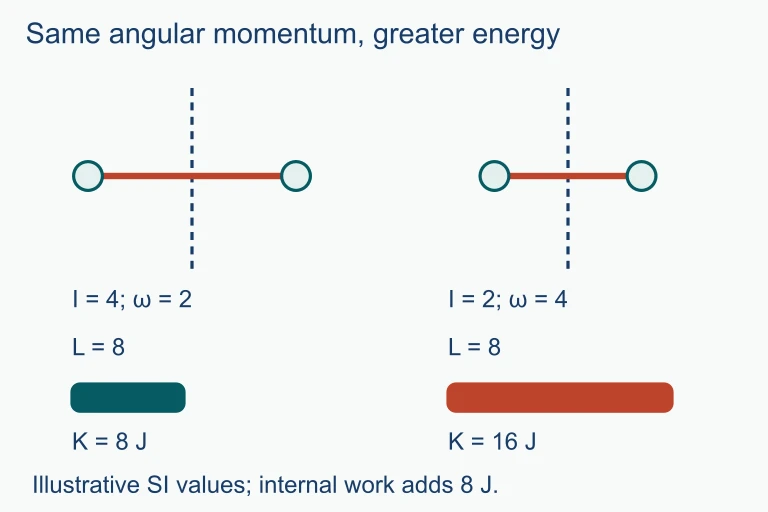 With negligible external torque about the rotation axis, pulling mass inward reduces rotational inertia and increases angular speed. Internal work can increase kinetic energy while angular momentum stays constant.
SECTION 6
Worked Example
Let us walk through a problem that combines angular impulse and conservation of angular momentum—the two major themes of this lesson.
Turntable Collision with Braking Torque
- 1
Step 1 — Read and Identify
A uniform disk turntable (I = 4.0 kg·m²) spins freely at ω_i = 6.0 rad/s. A 2.0-kg lump of clay is dropped vertically onto the rim of the turntable at r = 1.0 m from the center and sticks. (a) Find the angular velocity immediately after the clay sticks. (b) A brake then applies a constant friction torque of 3.0 N·m opposing the rotation. How long does it take to stop? - 2
Step 2 — Part (a): Conservation of Angular Momentum
The clay is dropped vertically, so it has no angular momentum about the turntable's axis before contact. The system is the turntable plus clay. No external torques act during the brief collision (the brake is not yet applied).= I_disk × ω_i = 4.0 × 6.0 = 24.0 kg·m²/s - 3
Step 3 — Find the New Moment of Inertia
After the clay sticks at the rim, the total moment of inertia is I_total = I_disk + m_clay × r².I_total = 4.0 + (2.0)(1.0)² = 6.0 kg·m² - 4
Step 4 — Solve for ω_f after Collision
Applying conservation: = → I_disk × ω_i = I_total × ω_f.ω_f = 24.0 / 6.0 = 4.0 rad/s - 5
Step 5 — Part (b): Angular Impulse to Stop
After the collision, ω = 4.0 rad/s. The brake exerts a constant opposing torque of τ = −3.0 N·m (negative because it opposes the rotation). We want the system to reach ω = 0, so ΔL = − = 0 − I_total × ω = −6.0 × 4.0 = −24.0 kg·m²/s. Using the angular impulse-momentum theorem: τ × Δt = ΔL.Δt = ΔL / τ = (−24.0) / (−3.0) = 8.0 s - 6
Step 6 — Interpret Results
After the inelastic collision, the turntable-clay system spins at 4.0 rad/s—slower than the initial 6.0 rad/s because the moment of inertia increased. A constant braking torque of 3.0 N·m then removes all the remaining angular momentum in 8.0 seconds. Note that in part (a), kinetic energy was lost (you can verify: KE_i = ½ × 4.0 × 36 = 72 J; KE_f = ½ × 6.0 × 16 = 48 J; 24 J was dissipated), but angular momentum was conserved. In part (b), the brake's torque transferred all angular momentum out of the system via angular impulse.
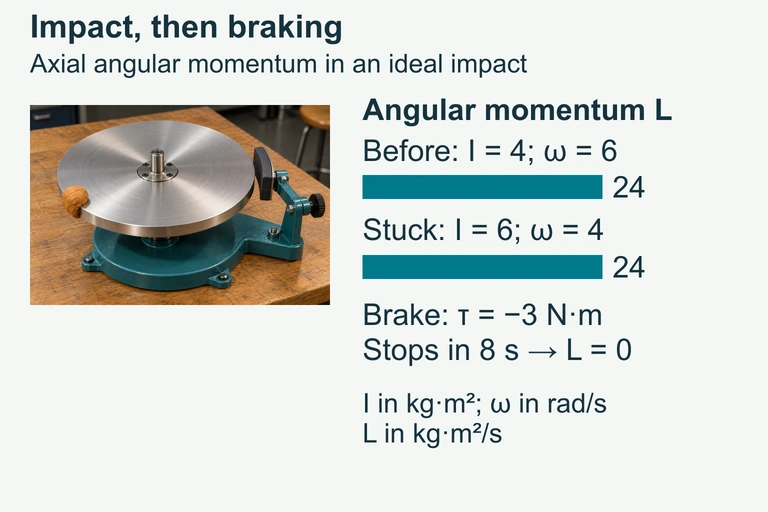 A 2 kg clay mass sticks at radius 1 m: I increases from 4 to 6 kg·m² and ω falls from 6 to 4 rad/s, keeping L = 24 kg·m²/s. A later −3 N·m brake torque stops the system in 8 s.
SECTION 7
Common Pitfalls & Comparisons
Students frequently lose points on angular momentum problems due to predictable errors. The following table contrasts correct reasoning with common mistakes, helping you avoid these traps on the AP exam.
| Scenario | Common Mistake | Correct Approach |
|---|---|---|
| Skater pulls arms in | Assuming KE is conserved—using ½Iω² = ½Iω² before and after | Only angular momentum is conserved (Iω = const). KE increases because the skater does internal work. |
| Object dropped onto turntable | Forgetting to add the object's moment of inertia to the system | I_total = I_turntable + m × r² after the collision. The increased I reduces ω. |
| Angular impulse calculation | Ignoring the sign of torque or mixing up the direction convention | Choose a consistent sign convention (e.g., CCW = +). Apply τ × Δt = ΔL with correct signs. |
| Point mass in orbit | Using L = Iω when the object's mass distribution is unknown | For a point particle, use L = mvr⊥ directly. Only use L = Iω when I is given or easily calculated. |
| Collision on a turntable | Assuming the incoming object contributes zero angular momentum when it has a tangential velocity | If the incoming object has a tangential velocity component, it carries angular momentum L = mvr⊥ that must be included in . |
Common mistakes vs. correct approaches for angular momentum problems
ENERGY VS. MOMENTUM IN ROTATION
SECTION 8
Connection to Advanced Theory
The angular momentum concepts tested on the AP Physics 1 exam form the foundation for more advanced treatments in university physics, engineering, and even quantum mechanics. Understanding how the AP-level treatment connects to these extensions gives you both a deeper appreciation and a head start if you pursue further study.
| AP Physics 1 Treatment | Advanced / University Extension |
|---|---|
| L = Iω (scalar, single fixed axis) | L⃗ = I·ω⃗ (vector, with inertia tensor for 3D rotation; L⃗ = r⃗ × p⃗ for general particle motion) |
| τ_net × Δt = ΔL (constant torque, algebra) | τ⃗_net = dL⃗/dt (calculus-based; torque as time derivative of angular momentum vector) |
| Conservation when τ_ext = 0 | Noether's theorem: angular momentum conservation arises from rotational symmetry of the laws of physics |
| Angular momentum is continuous (any value) | In quantum mechanics, angular momentum is quantized in units of ℏ (reduced Planck constant), with discrete allowed values |
| Applied to rigid bodies and point particles | Extended to fluid vortices, electromagnetic fields (photons carry angular momentum), and gravitational systems (black hole spin) |
AP-level vs. advanced treatment of angular momentum
At the university level, the cross product formulation L⃗ = r⃗ × p⃗ reveals why angular momentum is a pseudovector perpendicular to the plane of rotation, and the inertia tensor generalizes I to account for off-axis contributions. For AP Physics 1, however, you need only the scalar equations along a single axis. What matters most is the reasoning: identify the system, check for external torques, and apply either conservation or the impulse-momentum theorem—a logical framework that carries forward unchanged into every advanced course.
SECTION 9
Practice Problems
Question 1: CONCEPTUAL
- A. Angular momentum increases; rotational kinetic energy increases.
- B. Angular momentum remains constant; rotational kinetic energy increases.
- C. Angular momentum remains constant; rotational kinetic energy remains constant.
- D. Angular momentum decreases; rotational kinetic energy increases.
Show answer (B)
Question 2: BASIC CALCULATION
- A. 0.5 s
- B. 1.0 s
- C. 2.0 s
- D. 5.0 s
Show answer (C)
Question 3: INTERMEDIATE
- A. 0.56 rad/s
- B. 0.74 rad/s
- C. 0.91 rad/s
- D. 1.6 rad/s
Show answer (C)
Question 4: APPLIED
4 ptsShow answer
Question 5: CRITICAL THINKING
4 ptsShow answer
SUMMARY
Lesson Summary
Summary
Angular momentum (L) quantifies the "rotational inertia in motion" of a spinning or orbiting object. For a rigid body about a fixed axis, L = Iω; for a point particle, L = mvr⊥. The angular impulse–momentum theorem states that a net external torque applied over a time interval changes angular momentum: τ_net × Δt = ΔL. This is the rotational analog of F × Δt = Δp.
When the net external torque is zero, angular momentum is conserved: Iiωi = Ifωf. Decreasing the moment of inertia forces an increase in angular velocity (and vice versa). While angular momentum is conserved in such cases, rotational kinetic energy is not necessarily conserved—it may increase (skater pulling arms in) or decrease (inelastic rotational collision). On the AP exam, always identify the system, check for external torques, and select the appropriate tool: conservation of angular momentum or the angular impulse-momentum theorem.