01 / 21

Wind Energy

Explore how kinetic energy from moving air is converted into electricity, the physics behind wind turbines, and the environmental trade-offs of this renewable resource.

AP Environmental Science

What Is Wind Energy?

Wind energy is the process of harnessing the kinetic energy of moving air masses and converting it into mechanical or electrical energy. Wind is caused by uneven solar heating of Earth's surface: warm air rises, cooler air rushes in to replace it, creating air currents.

Key Terms to Know

Kinetic Energy
Energy of motion: \( KE = \frac{1}{2}mv^2 \). Moving air molecules carry kinetic energy proportional to the square of wind speed.
Wind Turbine
A device with rotor blades that converts the kinetic energy of wind into rotational mechanical energy, then into electricity via a generator.
Capacity Factor
The ratio of actual energy output over a period to the maximum possible output if the turbine ran at full capacity 100% of the time.

How a Wind Turbine Works

Wind Nacelle Hub Tower Generator To Grid

Wind lifts a blade and the nacelle reveals the conversion chain
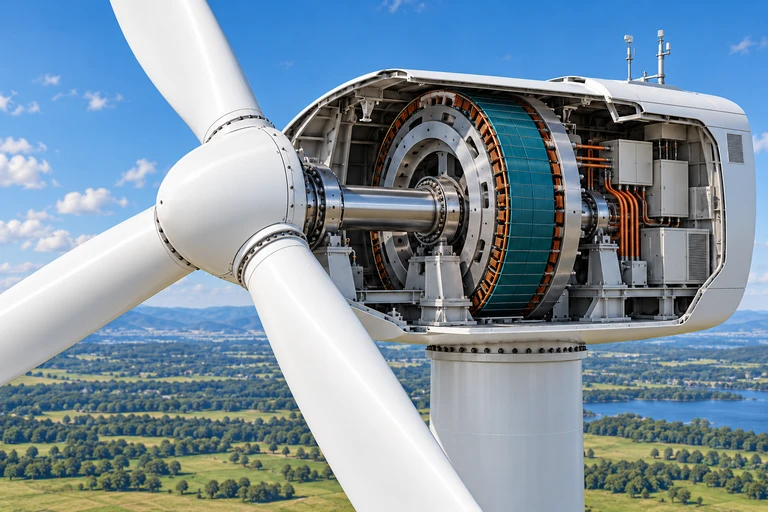
A three-bladed wind turbine on a tower exposes its horizontal shaft, generator ring, bearings and electrical equipment in a nacelle cutaway.A 50 m rotor radius sweeps 7,854 m². At air density 1.225 kg/m³ and wind speed 8 m/s, available kinetic power is 2.463 MW; an assumed 40% overall efficiency gives 0.985 MW of electricity at that operating point.

Available and electrical wind power
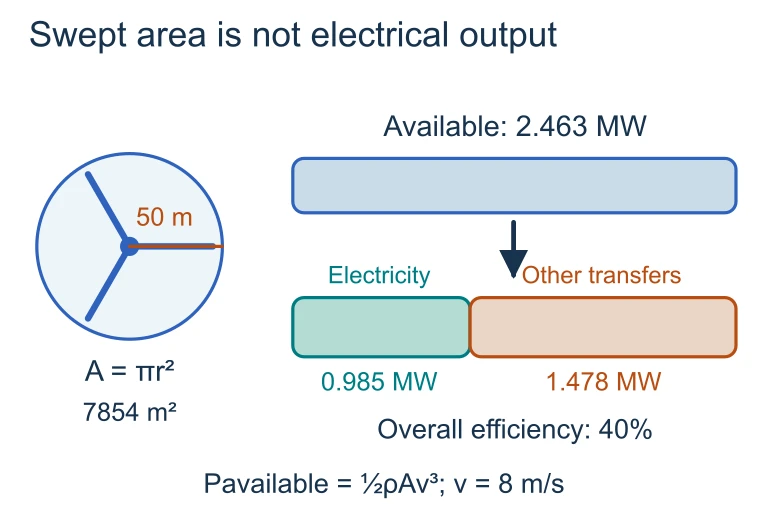
Available and electrical wind power. A 50 m rotor radius sweeps 7,854 m². At air density 1.225 kg/m³ and wind speed 8 m/s, available kinetic power is 2.463 MW; an assumed 40% overall efficiency gives 0.985 MW of electricity at that operating point.A 50 m rotor radius sweeps 7,854 m². At air density 1.225 kg/m³ and wind speed 8 m/s, available kinetic power is 2.463 MW; an assumed 40% overall efficiency gives 0.985 MW of electricity at that operating point.

The Wind Power Equation

The theoretical power available in a column of moving air is:

\( P \)
Power (watts): rate of energy extraction from the wind
\( \rho \)
Air density (\( \approx 1.225 \; \text{kg/m}^3 \) at sea level)
\( A \)
Swept area of rotor blades: \( A = \pi r^2 \)
\( v \)
Wind speed (m/s): the dominant variable since power scales with \( v^3 \)

The Cubic Relationship

Wind Speed (m/s) Power (W) 0 1 2 3 4 5 6 7 8 9 10 v = 3 v = 6 8x power

The Betz Limit

No turbine can capture all the kinetic energy of wind: some air must continue moving past the blades. The Betz Limit sets the theoretical maximum efficiency:

Theoretical Max
\( 59.3\% \) of available wind power can be extracted: the Betz Limit
Real Turbines
Modern turbines achieve \( 35\text{-}45\% \) efficiency due to friction, blade design, and generator losses

Onshore vs Offshore Wind

Onshore Offshore
Location Land-based (plains, ridges) Ocean or large lakes
Wind Speed Lower, more variable Higher, more consistent
Installation Cost Lower 2-3x higher
Capacity Factor 25-35% 40-55%
Visual/Noise Impact Higher Lower (far from shore)
Maintenance Easier access Difficult, expensive

Environmental Benefits

1
Zero direct emissions. No \( \text{CO}_2 \), \( \text{SO}_2 \), or \( \text{NO}_x \) released during operation, unlike fossil fuels.
2
Low water usage. Wind turbines require virtually no water to produce electricity, conserving freshwater resources.
3
Small land footprint. Turbine bases use minimal ground area; surrounding land can still be farmed or grazed.
4
Short energy payback. A turbine typically generates the energy used to manufacture and install it within 6-12 months.

Environmental Drawbacks

1
Bird and bat mortality. Spinning blades can kill migratory birds and bats, especially in flyway corridors.
2
Noise pollution. Low-frequency sound and aerodynamic noise can affect nearby residents.
3
Visual impact. Large turbines on ridgelines or open plains alter scenic landscapes.
4
Intermittency. Wind doesn't blow constantly, requiring backup power or energy storage to maintain grid reliability.

Explain why siting involves resource quality and ecological constraints.

Use this illustration to explore the concept described in its caption.
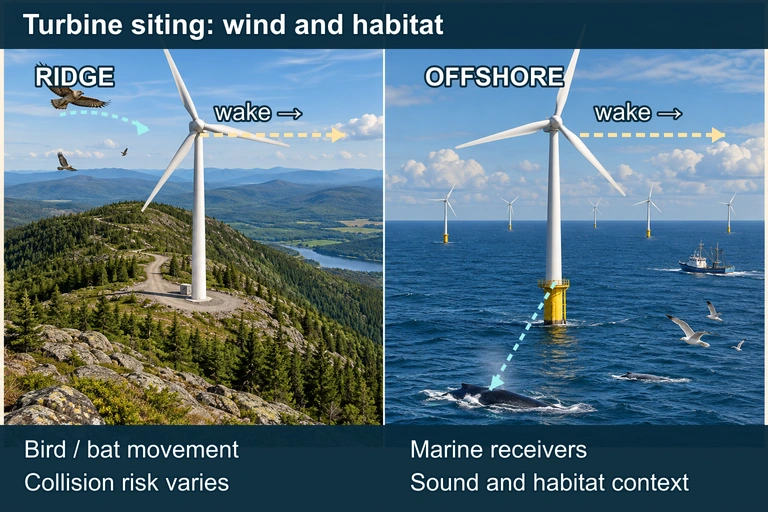
A ridge turbine with birds and an offshore turbine near a whale show conceptual leeward wake arrows. A dashed line marks a possible marine sound or habitat context; no distance is specified.
Wind access, wake conditions, habitats and nearby receivers all affect turbine siting. These schematic alternatives illustrate competing considerations without prescribing a particular site, risk ranking or setback. Effects are species and site dependent.

How to Solve Wind Power Problems

1
Identify the variables. Extract \( \rho \), \( r \) (blade length), and \( v \) (wind speed) from the problem. Use \( \rho = 1.225 \; \text{kg/m}^3 \) if not given.
2
Calculate swept area. \( A = \pi r^2 \). Convert blade length to meters if needed.
3
Apply the power equation. \( P = \frac{1}{2} \rho A v^3 \). This gives theoretical maximum power in watts.
4
Apply efficiency factor. Multiply by turbine efficiency (often \( 0.35 \text{-} 0.45 \)) to get actual output. Remember the Betz Limit caps at \( 0.593 \).
5
Convert units. Divide watts by 1000 for kW or by \( 10^6 \) for MW. For energy over time: \( E = P \times t \).

Example 1: Basic Power Calculation

A wind turbine has blades \( 40 \; \text{m} \) long and operates in winds of \( 8 \; \text{m/s} \). Air density is \( 1.225 \; \text{kg/m}^3 \). What is the theoretical available power?

1
Swept area: \( A = \pi (40)^2 = \pi \times 1600 \approx 5027 \; \text{m}^2 \)
2
Apply formula: \( P = \frac{1}{2}(1.225)(5027)(8^3) \)
3
Compute: \( P = 0.5 \times 1.225 \times 5027 \times 512 \approx 1{,}576{,}000 \; \text{W} \approx 1.58 \; \text{MW} \)

Example 2: Effect of Doubling Wind Speed

Using the same turbine (\( r = 40 \; \text{m} \)), compare power at \( v = 6 \; \text{m/s} \) versus \( v = 12 \; \text{m/s} \).

At \( 6 \; \text{m/s} \)
\( P = \frac{1}{2}(1.225)(5027)(216) \)
\( \approx 665{,}000 \; \text{W} \)
\( = 0.67 \; \text{MW} \)
At \( 12 \; \text{m/s} \)
\( P = \frac{1}{2}(1.225)(5027)(1728) \)
\( \approx 5{,}322{,}000 \; \text{W} \)
\( = 5.32 \; \text{MW} \)

Example 3: Annual Energy Output

A \( 2 \; \text{MW} \) wind turbine has a capacity factor of 35%. How much energy does it produce in one year?

1
Hours in a year: \( 365 \times 24 = 8{,}760 \; \text{hours} \)
2
Maximum possible energy: \( 2 \; \text{MW} \times 8{,}760 \; \text{h} = 17{,}520 \; \text{MWh} \)
3
Apply capacity factor: \( 17{,}520 \times 0.35 = 6{,}132 \; \text{MWh/year} \)

Common Mistakes

✕ Confusing Power and Energy
Power (\( P \)) is the rate of energy transfer (watts). Energy (\( E \)) is power multiplied by time: \( E = P \times t \). Don't forget to multiply by hours.
✕ Ignoring the Cubic Law
Students often assume doubling wind speed doubles power. In reality, it octuples it (\( 2^3 = 8 \)). Always apply \( v^3 \).
✕ Exceeding the Betz Limit
No real turbine can exceed \( 59.3\% \) efficiency. If your calculation gives a higher value, you've likely used theoretical power as actual output.

Wind Energy Summary

Advantages Disadvantages
Emissions Zero during operation Embodied carbon in manufacturing
Cost Low operating cost; no fuel High upfront capital
Reliability Long lifespan (20-30 yrs) Intermittent: depends on wind
Land Use Dual-use with farming Visual and noise impact
Wildlife No water pollution or mining Bird and bat mortality

Question 1 of 5

If wind speed triples, by what factor does the available wind power increase?

Question 2 of 5

The Betz Limit states that a wind turbine can extract at most approximately what percentage of the wind's kinetic energy?

Question 3 of 5

A \( 3 \; \text{MW} \) turbine has a capacity factor of 40%. How much energy (in MWh) does it produce in one year?

Question 4 of 5

Which of the following is the most significant environmental concern associated with wind farms?

Question 5 of 5

Compared to onshore wind farms, offshore wind farms typically have: