Waste Reduction
Methods
Explore the strategies and science behind reducing, reusing, and recycling waste to minimize environmental impact and conserve resources.
What Is Waste?
Waste is any material discarded after primary use that has no further value to the user. In environmental science, waste is categorized by its source, composition, and potential for harm.
The Scale of the Problem
Why Waste Reduction Matters
Waste reduction sits at the top of the waste management hierarchy because it addresses the problem at its source: preventing waste from being created in the first place.
The Waste Management Hierarchy
Source Reduction vs. Recycling
| Source Reduction | Recycling | |
|---|---|---|
| Definition | Preventing waste from being created | Reprocessing used materials into new products |
| Hierarchy rank | 1st (top) | 3rd |
| Energy savings | Highest: no processing needed | Moderate: reprocessing requires energy |
| Example | Using a reusable bag | Melting down aluminum cans |
| Limitation | Requires behavioral change | Not all materials are recyclable; contamination |
Key Reduction Methods
A repair bench opens the circular economy
 Repair and reuse return products to service. Recycling recovers materials for manufacturing. These processes require energy and can produce residual waste.
Keep products useful; recover materials later
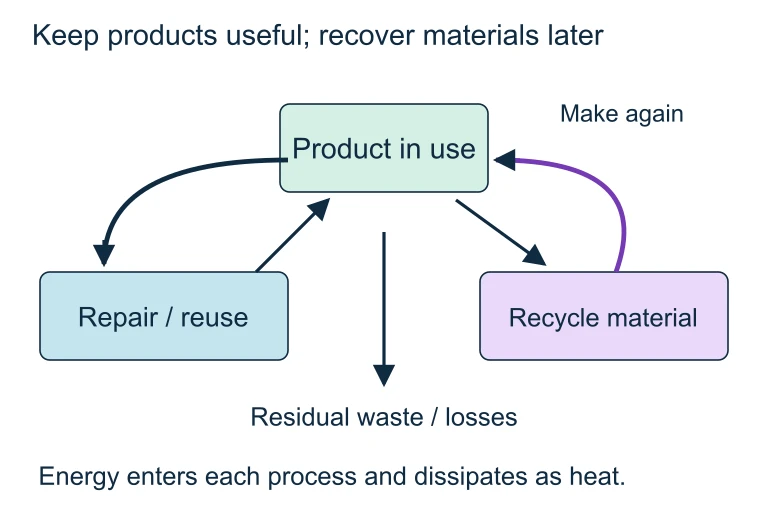 Repair and reuse return products to service. Recycling recovers materials for manufacturing. These processes require energy and can produce residual waste.
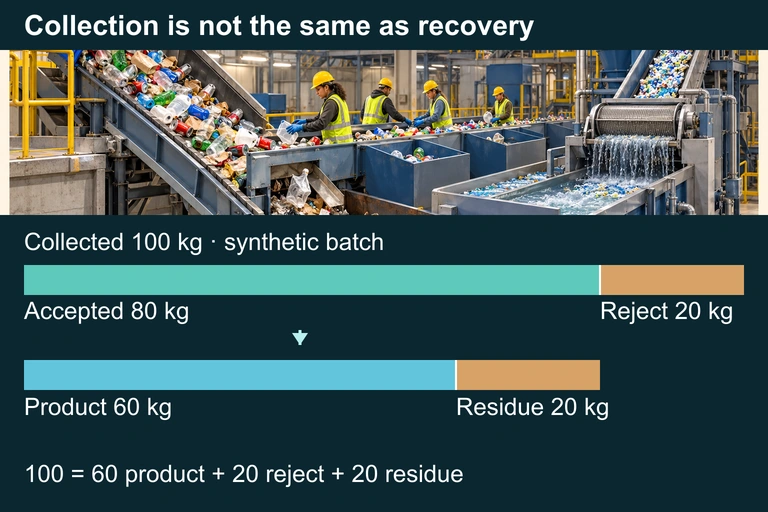
The Recycling Process
Explain diversion versus recovered material and contamination losses.
Use this illustration to explore the concept described in its caption.
How to Apply Waste Reduction
Example: Diversion Rate Calculation
A city generates 500,000 tonnes of MSW per year. Of that, 150,000 tonnes are recycled and 50,000 tonnes are composted. What is the diversion rate?
Example: Landfill Lifespan Extension
A landfill has a remaining capacity of 2,000,000 tonnes. The city currently sends 300,000 tonnes/year to the landfill. If the city achieves a 40% diversion rate, how much longer will the landfill last?
Example: Energy Savings from Recycling
Producing 1 tonne of aluminum from raw bauxite requires approximately 170 million BTU of energy. Recycling 1 tonne of aluminum requires only about 8.5 million BTU.
Composting: Nature's Recycling
Composting is the aerobic decomposition of organic matter by microorganisms. It converts food scraps and yard waste into humus: a nutrient-rich soil amendment that improves soil structure and fertility.
Policy Tools for Waste Reduction
Common Mistakes
Summary Comparison
| Method | Environmental Benefit | Key Challenge | Example |
|---|---|---|---|
| Reduce | Highest: prevents waste entirely | Behavior change | Bulk buying, digital receipts |
| Reuse | High: extends product life | Convenience culture | Thrift stores, refill stations |
| Recycle | Moderate: conserves resources | Contamination, markets | Aluminum, paper, glass |
| Compost | Moderate: diverts organics | Infrastructure, odor | Municipal composting programs |
| Incineration | Low: recovers some energy | Air pollution, ash disposal | Waste-to-energy plants |
Question 1 of 5
According to the waste management hierarchy, which strategy is the most environmentally preferred?
Question 2 of 5
A city generates 800,000 tonnes of waste per year. It recycles 200,000 tonnes and composts 80,000 tonnes. What is the diversion rate?
Question 3 of 5
Which of the following best explains why composting organic waste is environmentally preferable to landfilling it?
Question 4 of 5
A pay-as-you-throw (PAYT) pricing system is most likely to directly incentivize which behavior?
Question 5 of 5
Recycling aluminum saves approximately 95% of the energy needed to produce new aluminum. This is primarily because: