Thermal
Pollution
Understand how excess heat discharge into water bodies disrupts ecosystems, reduces dissolved oxygen, and threatens aquatic biodiversity.
What Is Thermal Pollution?
Thermal pollution is the degradation of water quality caused by any process that changes the ambient water temperature. Most commonly, it occurs when industrial facilities use water as a coolant and return heated water to its natural source.
Major Sources of Thermal Pollution
Why It Matters: Dissolved Oxygen
The solubility of oxygen in water is inversely related to temperature. As water heats up, it holds less dissolved oxygen (DO), which aquatic organisms need to survive.
The Heat Balance Equation
The thermal energy transferred to a water body can be calculated using the fundamental heat transfer equation:
This equation tells us that thermal pollution depends on two controllable factors: the volume of water discharged and the temperature rise \( \Delta T \) imparted to it.
How Thermal Pollution Works
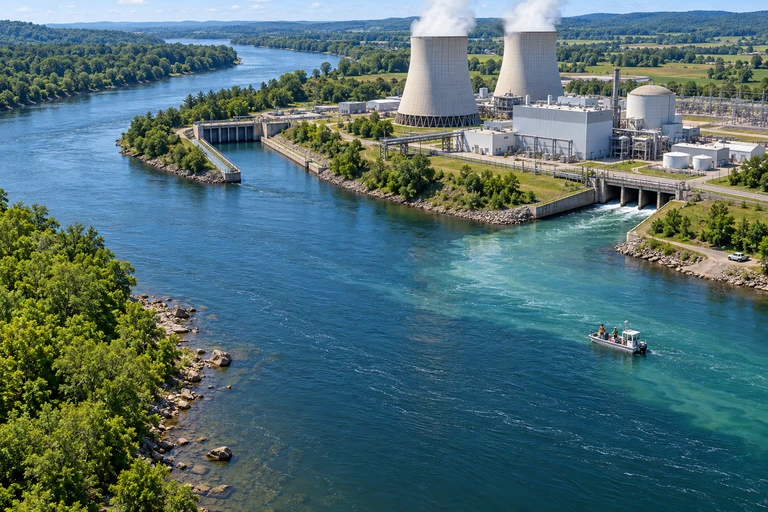
A river heat plume is a place to measure
 Suppose 50 m³/s is diverted from a 200 m³/s river at 15°C and returned 10°C warmer. Under the stated steady mixing balance, the recombined 200 m³/s flow reaches 17.5°C. Oxygen conditions also depend on oxygen demand, reaeration and other site conditions.
Conserve diverted flow when calculating mixed river temperature.
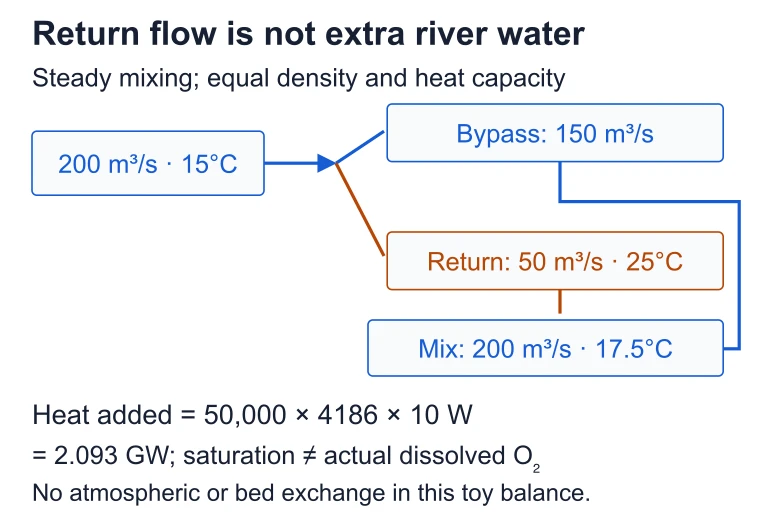 Suppose 50 m³/s is diverted from a 200 m³/s river at 15°C and returned 10°C warmer. Under the stated steady mixing balance, the recombined 200 m³/s flow reaches 17.5°C. Oxygen conditions also depend on oxygen demand, reaeration and other site conditions.
Ecological Impacts
Thermal vs Chemical Pollution
| Thermal Pollution | Chemical Pollution | |
|---|---|---|
| Pollutant | Heat energy (\( \Delta T \)) | Foreign substances (toxins, heavy metals) |
| Persistence | Dissipates over time and distance | May bioaccumulate and persist for years |
| Primary mechanism | Reduces dissolved oxygen | Direct toxicity to organisms |
| Reversibility | Rapid if source is stopped | Often slow or irreversible |
| Regulation | Clean Water Act, Section 316(a) | Clean Water Act, NPDES permits |
Mitigation Strategies
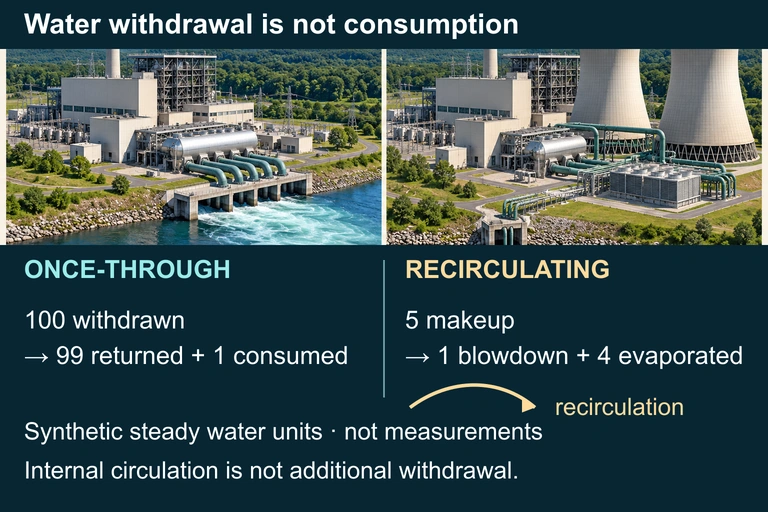
Explain why lower withdrawal can coexist with evaporative water consumption.
Use this illustration to explore the concept described in its caption.
How to Analyze Thermal Pollution
Example 1: Calculating Heat Load
A coal-fired power plant discharges cooling water at a rate of \(500\,\text{kg/s}\). The intake temperature is \(18\,{}^\circ\text{C}\) and the discharge temperature is \(30\,{}^\circ\text{C}\). Calculate the rate of heat added to the river.
Example 2: DO Impact Analysis
A study measures dissolved oxygen at three points along a river near a power plant. Evaluate the ecological significance.
| Location | Temp (\(^\circ\text{C}\)) | DO (mg/L) | Status |
|---|---|---|---|
| Upstream (\(1\,\text{km}\)) | 16 | 10.2 | Healthy |
| Discharge point | 28 | 4.1 | Critical |
| Downstream (\(3\,\text{km}\)) | 21 | 7.5 | Recovering |
Example 3: Cooling Tower Effectiveness
If the power plant from Example 1 installs a cooling tower that reduces \( \Delta T \) from \(12\,{}^\circ\text{C}\) to \(3\,{}^\circ\text{C}\), what is the new heat load?
Feedback Loops and Climate Change
Common Mistakes
Summary at a Glance
| Concept | Key Detail |
|---|---|
| Definition | Water quality degradation from excess heat discharge |
| Primary equation | \( Q = \dot{m} \cdot c_p \cdot \Delta T \) |
| Main sources | Power plants, industrial cooling, urban runoff |
| Key impact | Reduced DO, thermal shock, biodiversity loss |
| Mitigation | Cooling towers, cooling ponds, cogeneration |
| Regulation | Clean Water Act, Section 316(a) |
| Climate link | Positive feedback: warming amplifies thermal stress |
Question 1 of 5
What is the primary mechanism by which thermal pollution harms aquatic organisms?
Question 2 of 5
A factory discharges water at \(200\,\text{kg/s}\) with a \( \Delta T \) of \(8\,{}^\circ\text{C}\). Using \( c_p = 4{,}186 \; \text{J/(kg}\cdot^\circ\text{C)} \), what is the thermal load?
Question 3 of 5
Which of the following is a non-point source of thermal pollution?
Question 4 of 5
How does climate change interact with thermal pollution to create a positive feedback loop?
Question 5 of 5
A cooling tower reduces a plant's discharge \( \Delta T \) from \(15\,{}^\circ\text{C}\) to \(4\,{}^\circ\text{C}\). By what percentage is the thermal load reduced?