The Tragedy of
the Commons
Explore how shared resources become depleted when individuals act in self-interest, and discover the solutions that sustain our environment.
What Is a Common-Pool Resource?
A common-pool resource (CPR) is a natural or human-made resource that is available to everyone but diminishes as people use it. Two key traits define CPRs:
Garrett Hardin's 1968 Insight
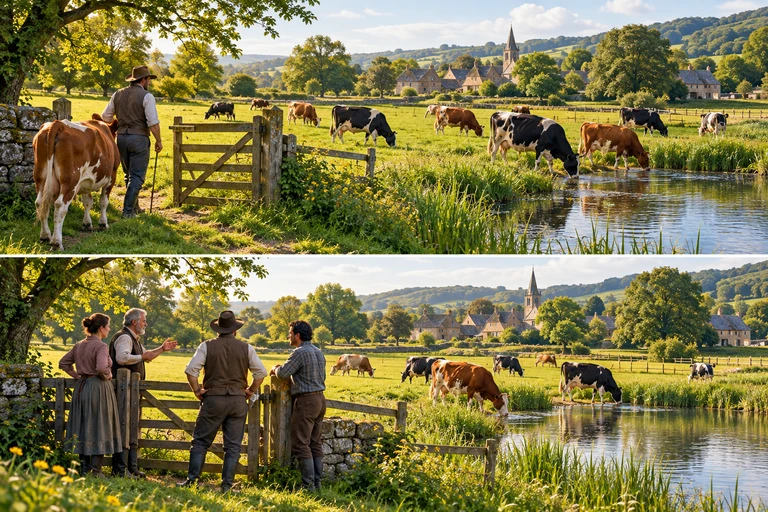
Ecologist Garrett Hardin published "The Tragedy of the Commons" in Science magazine. He used the parable of a shared pasture to illustrate a deep environmental dilemma:
Hardin argued that without regulation or cooperation, rational self-interest leads inevitably to the ruin of shared resources: a situation where everyone loses.
Why Does This Matter Today?
The Core Logic of the Tragedy
The Payoff Structure
We can express the herder's dilemma with a simple payoff model. If a herder adds one more animal to the commons:
The twentieth share of one extra cow
 Suppose twenty users equally share a 20-unit degradation cost while the acting user receives an 8-unit benefit. The private and total costs differ. Rules for a governed commons can change those incentives.
The twentieth share of one extra cow
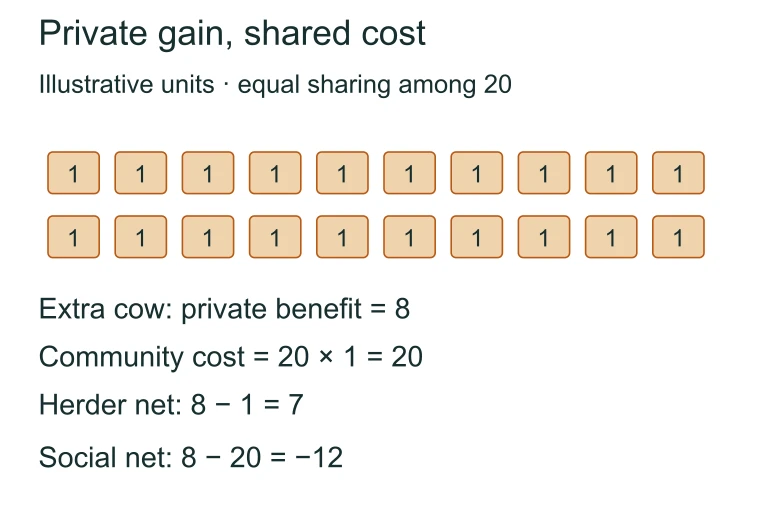 Suppose twenty users equally share a 20-unit degradation cost while the acting user receives an 8-unit benefit. The private and total costs differ. Rules for a governed commons can change those incentives.
Resource Depletion Over Time
Tragedy of the Commons vs. Free Rider Problem
| Tragedy of the Commons | Free Rider Problem | |
|---|---|---|
| Resource Type | Common-pool (rivalrous, non-excludable) | Public good (non-rivalrous, non-excludable) |
| Core Issue | Over-use depletes the resource | Under-contribution to the resource |
| Classic Example | Overfishing in open oceans | Not paying for public radio |
| Result | Resource collapse | Resource under-provision |
| Solution Focus | Limit extraction | Incentivize contribution |
The Four Types of Goods
How to Prevent the Tragedy
Ostrom's Design Principles
Elinor Ostrom (Nobel Prize 2009) showed the tragedy is not inevitable. She identified design principles for successful commons management:
Example: Ocean Fisheries
Example: Groundwater Depletion
The Ogallala Aquifer beneath the U.S. Great Plains supplies 30% of America's irrigation water. It recharges at roughly 25 mm/year, but farmers pump it at several hundred mm/year.
Example: Carbon Emissions and the Atmosphere
Common Mistakes
Summary: Key Concepts
| Concept | Definition | Example |
|---|---|---|
| Common-Pool Resource | Rivalrous + non-excludable | Ocean fisheries |
| Tragedy of the Commons | Overuse of shared resource | Overgrazing a pasture |
| Maximum Sustainable Yield | Highest harvest rate without depletion | 60 tons/year fishery limit |
| ITQ System | Privatized quota to limit extraction | Icelandic cod fishery |
| Ostrom's Principles | Community rules for commons governance | Swiss Alpine meadows |
| Cap-and-Trade | Market-based emission limits | EU Emissions Trading System |
Question 1 of 5
Which two characteristics define a common-pool resource?
Question 2 of 5
In the herder's dilemma, each herder gains full benefit from adding an animal but bears only \( \frac{1}{n} \) of the degradation cost. This illustrates:
Question 3 of 5
Elinor Ostrom's research demonstrated that commons can be managed sustainably through:
Question 4 of 5
A fishery has a maximum sustainable yield of 60 tons per year. Four boats each catch 20 tons. What is the expected long-term outcome?
Question 5 of 5
Which of the following is the best example of the tragedy of the commons?