The Phosphorus
Cycle
Explore how phosphorus moves through rocks, soil, water, and living organisms: the only major biogeochemical cycle with no significant atmospheric phase.
What Is Phosphorus?
Phosphorus (P) is a non-metallic element essential for all life. It is a key component of DNA, RNA, ATP (adenosine triphosphate), and phospholipids in cell membranes. Organisms cannot substitute any other element for phosphorus in these molecules.
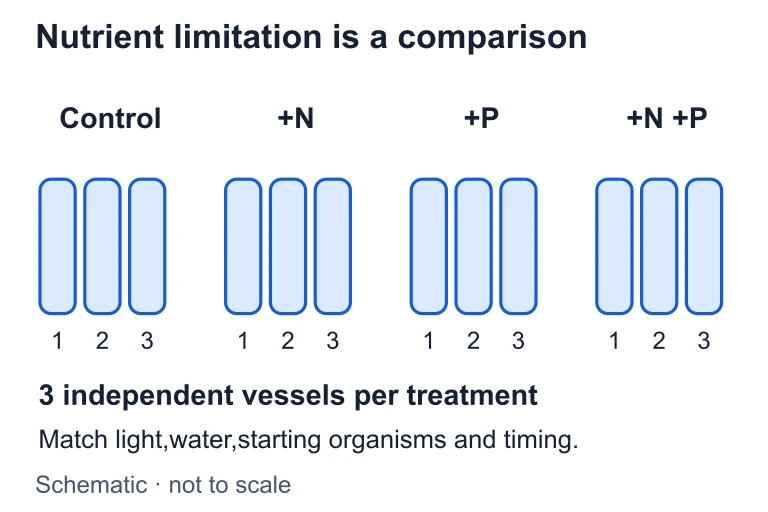
Four bottles test which nutrient is limiting
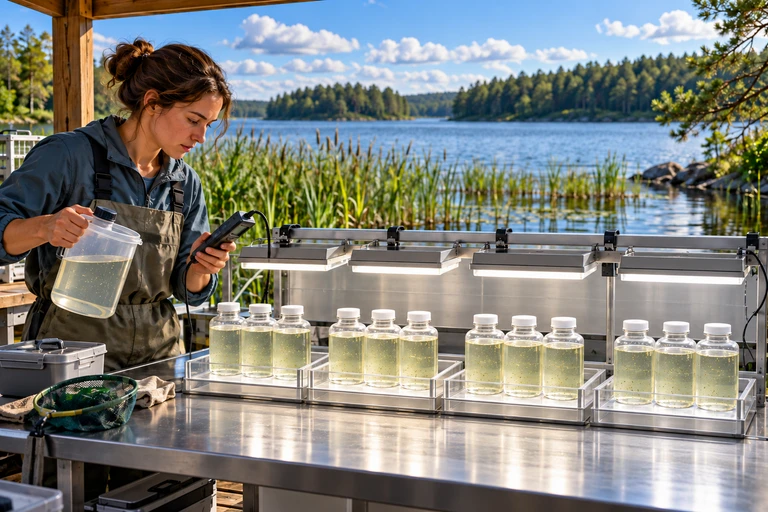
Compare a control, added nitrogen, added phosphorus, and both nutrients, with three independent vessels per treatment. Keep starting conditions, light, handling and measurement time consistent; infer nutrient limitation from measured responses.Nutrient limitation is a comparison
Compare a control, added nitrogen, added phosphorus, and both nutrients, with three independent vessels per treatment. Keep starting conditions, light, handling and measurement time consistent; infer nutrient limitation from measured responses.Why the Phosphorus Cycle Matters
A Cycle With No Gas Phase
Unlike carbon, nitrogen, and sulfur, phosphorus does not form a stable gas under normal Earth conditions. It moves primarily through rock, water, soil, and living organisms. This makes the phosphorus cycle the slowest of the major biogeochemical cycles.
The Phosphorus Cycle Overview
Biological phosphorus recycling nests inside a slower geological cycle
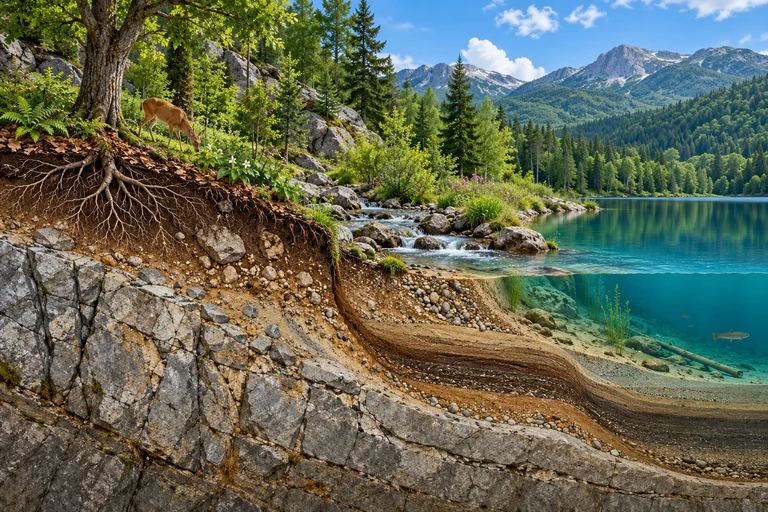
Chemical dissolution releases phosphate, while physical weathering exposes mineral surfaces. Local biological recycling operates within slower burial and uplift pathways. Dissolved material, sediment and atmospheric dust can transport phosphorus.Biological phosphorus recycling is nested within geological transfers.
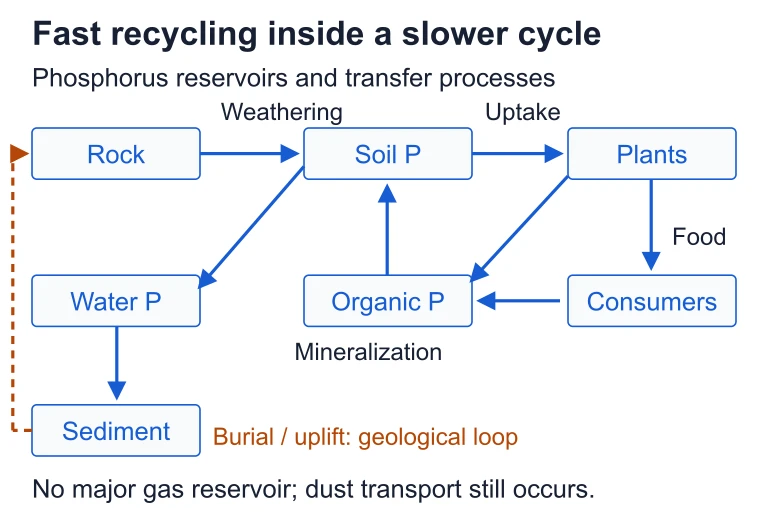
Chemical dissolution releases phosphate, while physical weathering exposes mineral surfaces. Local biological recycling operates within slower burial and uplift pathways. Dissolved material, sediment and atmospheric dust can transport phosphorus.Major Reservoirs of Phosphorus
Key Processes in the Cycle
A soil pore becomes a reversible ion-exchange landscape
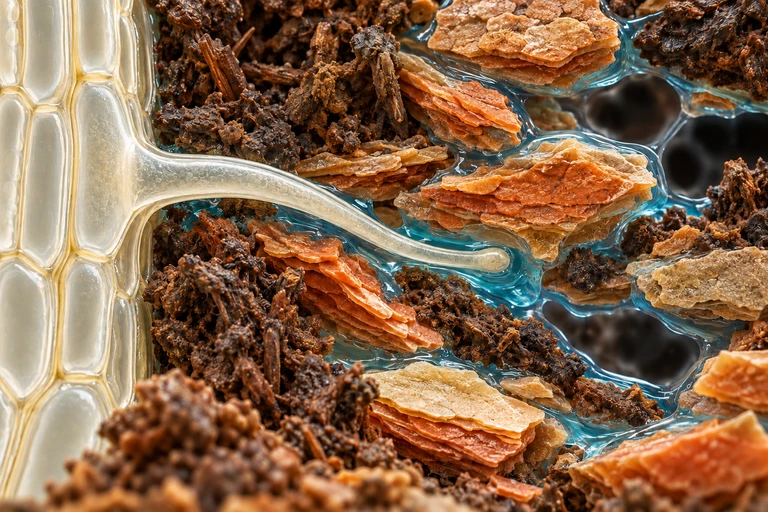
Phosphate can remain dissolved, adsorb to a reactive surface, or enter a new solid phase through precipitation. Solution speciation and the available mineral surfaces help determine which processes occur.Phosphate speciation adsorption and precipitation
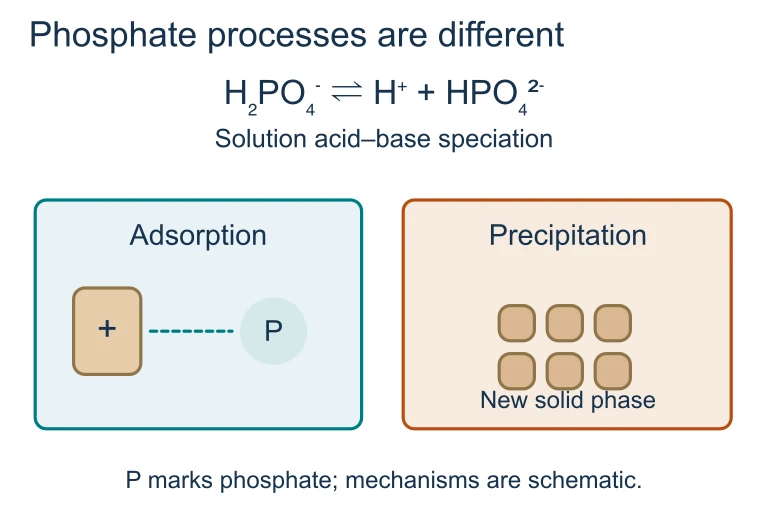
Phosphate solution species include H₂PO₄⁻ and HPO₄²⁻. Adsorption associates phosphate with a suitable reactive surface, while precipitation forms a new solid phase.Phosphorus vs. Nitrogen Cycle
| Feature | Phosphorus Cycle | Nitrogen Cycle |
|---|---|---|
| Atmospheric phase | None | \( \text{N}_2 \) gas (78% of atm.) |
| Main reservoir | Sedimentary rock | Atmosphere |
| Key chemical form | \( \text{PO}_4^{3-} \) | \( \text{NO}_3^- \), \( \text{NH}_4^+ \) |
| Cycle speed | Very slow (geologic) | Moderate (biological + industrial) |
| Limiting in | Freshwater ecosystems | Marine ecosystems |
| Human disruption | Mining, fertilizers, detergents | Haber-Bosch process, fossil fuels |
Human Disruptions
Humans have roughly tripled the annual flow of phosphorus from land to oceans compared to pre-industrial levels. The main drivers include:
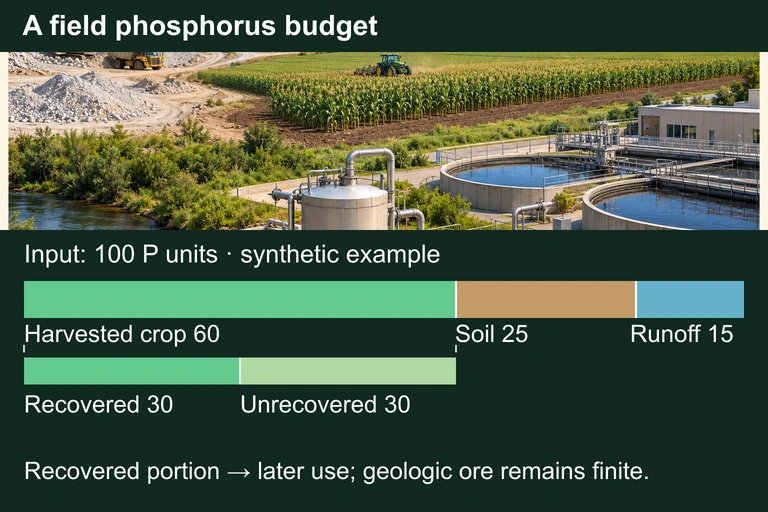
Explain why recycling reduces dependence without making geological stocks renewable.
Use this illustration to explore the concept described in its caption.
Eutrophication: The Chain Reaction
How to Trace the Cycle
Example: Farm Runoff Scenario
A farmer applies phosphate fertilizer to a cornfield adjacent to a lake. Heavy rainfall carries dissolved phosphorus into the lake. Trace the phosphorus through the cycle:
Example: Ocean to Rock
A phosphorus atom reaches the ocean floor via sedimentation. How does it eventually return to land and become available to organisms again?
Example: Guano and Island Ecosystems
Seabirds eat fish containing phosphorus. They nest on islands and deposit guano (droppings rich in \( \text{PO}_4^{3-} \)). This guano fertilizes island soils, supporting lush vegetation. Trace the path:
Common Mistakes
Phosphorus Cycle Summary
| Component | Details |
|---|---|
| Main reservoir | Sedimentary rock (lithosphere) |
| Chemical form | \( \text{PO}_4^{3-} \) (phosphate ion) |
| Atmospheric phase | None |
| Biological role | DNA, RNA, ATP, phospholipids, bones |
| Limiting in | Freshwater ecosystems |
| Release mechanism | Weathering of rock, decomposition |
| Human disruption | Mining, fertilizers, detergents |
| Environmental impact | Eutrophication, dead zones |
| Full cycle time | Tens of millions of years |
Question 1 of 5
What makes the phosphorus cycle unique among major biogeochemical cycles?
Question 2 of 5
Phosphorus is most commonly the limiting nutrient in which type of ecosystem?
Question 3 of 5
A lake near agricultural fields experiences a massive algal bloom after heavy rain. Which process most directly caused this?
Question 4 of 5
Which of the following correctly describes the largest reservoir of phosphorus in the global cycle?
Question 5 of 5
Seabirds transport phosphorus from the ocean to island ecosystems by depositing guano. This is an example of: