01 / 21
N

The Nitrogen
Cycle

Discover how nitrogen moves through the atmosphere, soil, water, and living organisms: the biogeochemical pathway essential to all life on Earth.

AP Environmental Science

Why Nitrogen Matters

Nitrogen is the most abundant gas in the atmosphere, making up roughly 78% of the air we breathe. Yet most organisms cannot use atmospheric \( \text{N}_2 \) directly: the triple bond between the two nitrogen atoms (\( \text{N} \equiv \text{N} \)) is extremely strong.

Key Terms to Know

Nitrogen Fixation
Converting \( \text{N}_2 \) gas into biologically usable \( \text{NH}_3 \) or \( \text{NH}_4^+ \)
Nitrification
Oxidation of \( \text{NH}_4^+ \) to \( \text{NO}_2^- \), then to \( \text{NO}_3^- \)
Assimilation
Plants and animals absorb \( \text{NH}_4^+ \) or \( \text{NO}_3^- \) to build organic molecules
Denitrification
Anaerobic bacteria convert \( \text{NO}_3^- \) back to \( \text{N}_2 \) gas

Nitrogen Reservoirs

Nitrogen exists in multiple reservoirs across Earth's systems. Understanding where nitrogen resides and in what chemical form is essential for tracing the cycle.

Atmosphere
\( \text{N}_2 \) gas: ~78% of air, the largest reservoir
Soil & Water
\( \text{NH}_4^+ \), \( \text{NO}_3^- \), dissolved organic nitrogen
Living Organisms
Proteins, DNA, RNA, chlorophyll, ATP

The Complete Nitrogen Cycle

Atmosphere: \( \text{N}_2 \)
Fixation
Soil: \( \text{NH}_4^+ \)
Nitrification
Soil: \( \text{NO}_3^- \)
Denitrification Assimilation Plants & Animals (Organic N) Ammonification Lightning

Follow a tagged nitrogen atom across changing environments
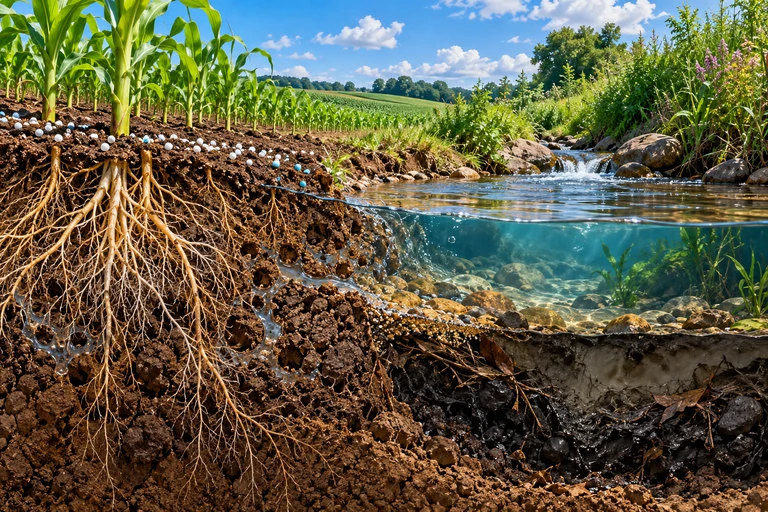
Farm roots and moist soil connect to a stream and darker stream sediment.Aerobic nitrification converts ammonium through nitrite to nitrate. Nitrogen can then enter plant organic matter or follow a low-oxygen denitrification route. These are alternative routes for a tagged atom.

Nitrogen has alternative pathways
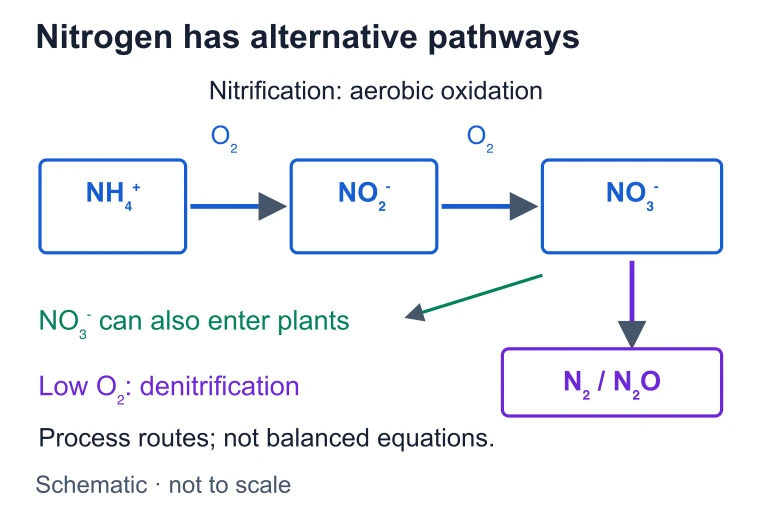
Nitrogen has alternative pathways. Aerobic nitrification converts ammonium through nitrite to nitrate. Nitrogen can then enter plant organic matter or follow a low-oxygen denitrification route. These are alternative routes for a tagged atom.Aerobic nitrification converts ammonium through nitrite to nitrate. Nitrogen can then enter plant organic matter or follow a low-oxygen denitrification route. These are alternative routes for a tagged atom.

One nitrogen tag, alternative histories
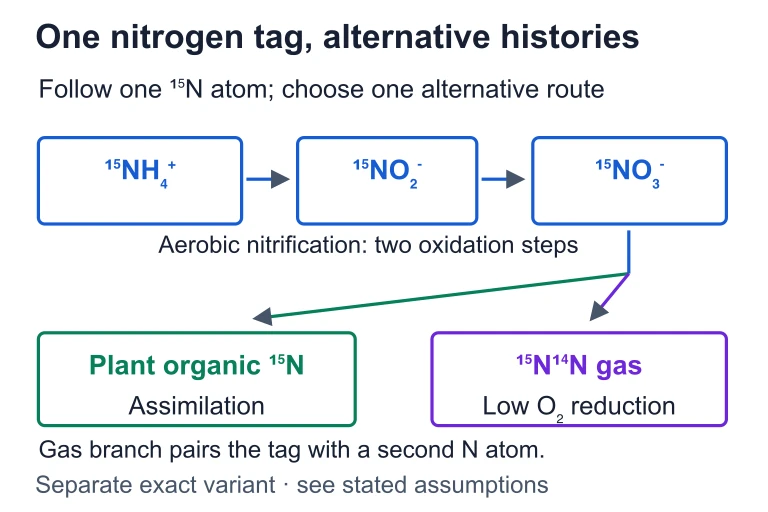
One nitrogen tag, alternative histories. Follow a ¹⁵N tag through ammonium, nitrite and nitrate. Uptake into plant organic nitrogen and denitrification are alternative routes; in the depicted N₂ molecule the tagged atom pairs with a separate ¹⁴N atom.Follow a ¹⁵N tag through ammonium, nitrite and nitrate. Uptake into plant organic nitrogen and denitrification are alternative routes; in the depicted N₂ molecule the tagged atom pairs with a separate ¹⁴N atom.

Step 1: Nitrogen Fixation

Nitrogen fixation converts unreactive \( \text{N}_2 \) into ammonia (\( \text{NH}_3 \)) or ammonium (\( \text{NH}_4^+ \)). There are three main pathways:

1
Biological fixation: Bacteria (e.g., Rhizobium in legume root nodules) use the enzyme nitrogenase to break the triple bond
2
Atmospheric fixation: Lightning provides enough energy to combine \( \text{N}_2 \) and \( \text{O}_2 \) into nitrogen oxides
3
Industrial fixation: The Haber-Bosch process synthesizes \( \text{NH}_3 \) at high temperature and pressure for fertilizer

Root nodules exchange fixed nitrogen for plant carbon under oxygen regulation
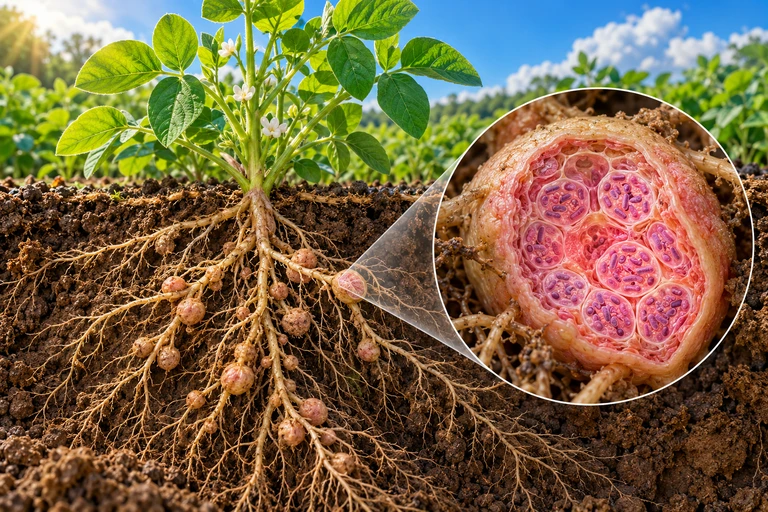
A legume root/nodule cutaway with living cells and bacterial forms accompanies exact carbon and fixed-nitrogen exchange arrows.Legume nodules house living microbial symbionts. Plant carbon supports microbial nitrogen fixation, while oxygen regulation protects nitrogenase and still permits respiration.

A nodule is a living exchange zone
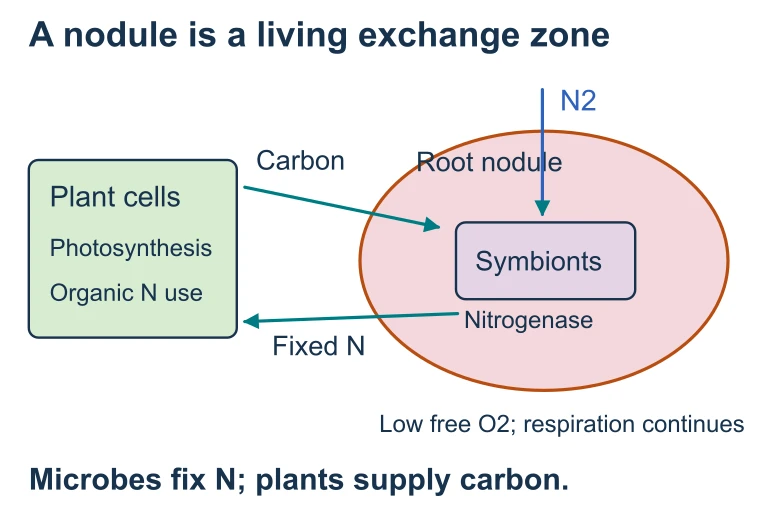
A nodule is a living exchange zone. Legume nodules house living microbial symbionts. Plant carbon supports microbial nitrogen fixation, while oxygen regulation protects nitrogenase and still permits respiration.Legume nodules house living microbial symbionts. Plant carbon supports microbial nitrogen fixation, while oxygen regulation protects nitrogenase and still permits respiration.

Step 2: Nitrification

Nitrification is a two-step aerobic process carried out by specialized soil bacteria, converting ammonium into forms plants can easily absorb.

\( \text{NH}_4^+ \)
Nitrosomonas
\( \text{NO}_2^- \)
Nitrobacter
\( \text{NO}_3^- \)

Assimilation & Ammonification

Assimilation
Plants absorb \( \text{NO}_3^- \) or \( \text{NH}_4^+ \) through their roots and incorporate the nitrogen into organic molecules: amino acids, proteins, and nucleic acids. Animals obtain nitrogen by consuming plants or other animals.
Ammonification
When organisms die or excrete waste, decomposer bacteria and fungi break down the organic nitrogen back into \( \text{NH}_4^+ \). This returns nitrogen to the soil pool, completing the internal loop.

Step 4: Denitrification

Denitrification closes the cycle by returning nitrogen to the atmosphere. Anaerobic bacteria (e.g., Pseudomonas) reduce nitrate in a stepwise process:

\( \text{NO}_3^- \)
\( \text{NO}_2^- \)
\( \text{NO} \)
\( \text{N}_2\text{O} \)
\( \text{N}_2 \)
Each step removes an oxygen atom

Fixation vs. Denitrification

Nitrogen Fixation Denitrification
Direction \( \text{N}_2 \rightarrow \text{NH}_3 \) \( \text{NO}_3^- \rightarrow \text{N}_2 \)
Oxygen? Can be aerobic or anaerobic Anaerobic only
Key organisms Rhizobium, cyanobacteria Pseudomonas, Bacillus
Net effect Adds usable N to ecosystem Removes N from ecosystem
AP exam tip Links to agriculture, legumes Links to wetlands, GHGs

Human Impacts on the Nitrogen Cycle

Humans have approximately doubled the rate of nitrogen entering the biosphere compared to pre-industrial levels. Key drivers include:

1
Haber-Bosch process: Industrial synthesis of \( \text{NH}_3 \) for fertilizers now fixes more nitrogen than all natural processes combined
2
Fossil fuel combustion: Releases \( \text{NO}_x \) gases that contribute to smog and acid rain
3
Agricultural runoff: Excess \( \text{NO}_3^- \) leaches into waterways, causing eutrophication and aquatic dead zones

Differentiate loss pathways and connect fertilizer management to water and air effects.

Use this illustration to explore the concept described in its caption.
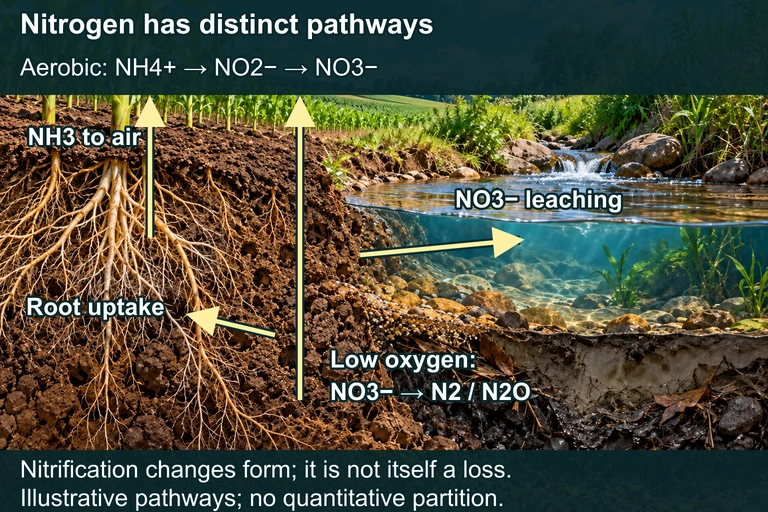
A maize-root and water cutaway shows aerobic ammonium to nitrite to nitrate, ammonia volatilization to air, uptake into roots, nitrate leaching toward water and low-oxygen conversion to nitrogen gases.
Fertilizer nitrogen can enter plants, leach as nitrate, volatilize as ammonia or leave through gaseous nitrogen pathways. Aerobic nitrification changes chemical form; denitrification occurs under suitable low-oxygen conditions. The arrows are qualitative and no loss partition is implied.

The Eutrophication Cascade

Excess fertilizer applied
\( \text{NO}_3^- \) runoff enters waterways
Algal bloom occurs Algae die and decompose
Dissolved \( \text{O}_2 \) drops: hypoxic dead zone

How to Trace the Cycle

When an AP exam question asks you to follow nitrogen through the cycle, use this step-by-step approach:

1
Identify the starting form: Is it \( \text{N}_2 \), \( \text{NH}_4^+ \), \( \text{NO}_3^- \), or organic N?
2
Name the process: Fixation, nitrification, assimilation, ammonification, or denitrification?
3
Identify the organism or mechanism: Bacteria genus, lightning, or industrial process
4
Determine the ending form: What chemical form does nitrogen take after this step?
5
Check the environment: Aerobic or anaerobic? Soil, water, or atmosphere?

Example 1: Legume Root Nodules

A soybean plant grows in nitrogen-poor soil. Trace the nitrogen from the atmosphere to the plant's proteins.

1
Starting form: Atmospheric \( \text{N}_2 \)
2
Fixation: Rhizobium bacteria in root nodules use nitrogenase to convert \( \text{N}_2 \rightarrow \text{NH}_3 \rightarrow \text{NH}_4^+ \)
3
Assimilation: The plant absorbs \( \text{NH}_4^+ \) and incorporates it into amino acids and proteins

Example 2: Fertilizer to Dead Zone

A farmer applies synthetic \( \text{NH}_4\text{NO}_3 \) fertilizer to a corn field. Heavy rain washes excess into a nearby river. Trace the nitrogen from fertilizer to the ocean dead zone.

1
Starting form: \( \text{NH}_4^+ \) and \( \text{NO}_3^- \) from fertilizer
2
Runoff: Rain dissolves \( \text{NO}_3^- \) and carries it into the river (nitrate is highly mobile in water)
3
Eutrophication: \( \text{NO}_3^- \) stimulates algal blooms in coastal waters
4
Decomposition: Dead algae are broken down by bacteria, consuming dissolved \( \text{O}_2 \) and creating a hypoxic zone

Common Mistakes

✕ Confusing fixation with nitrification
Fixation converts \( \text{N}_2 \rightarrow \text{NH}_3 \). Nitrification converts \( \text{NH}_4^+ \rightarrow \text{NO}_3^- \). They are different steps with different bacteria.
✕ Forgetting denitrification is anaerobic
Denitrification requires the absence of oxygen. It occurs in waterlogged soils and wetlands, not well-aerated soils.
✕ Thinking plants absorb \( \text{N}_2 \) directly
Plants cannot break the \( \text{N} \equiv \text{N} \) triple bond. They absorb only \( \text{NH}_4^+ \) or \( \text{NO}_3^- \) from the soil.

Question 1 of 5

Which process converts atmospheric \( \text{N}_2 \) into biologically usable ammonia?

Question 2 of 5

Which pair of bacteria is responsible for nitrification?

Question 3 of 5

Excess nitrogen from fertilizer runoff leads to eutrophication. What is the direct cause of fish kills in the resulting dead zone?

Question 4 of 5

A farmer rotates soybeans (a legume) with corn. The primary benefit of this practice for nitrogen management is that legumes:

Question 5 of 5

The Haber-Bosch process has significantly altered the global nitrogen cycle primarily by: