The Hydrologic
Water Cycle
Explore how water moves through Earth's systems via evaporation, condensation, precipitation, and runoff: the engine driving weather, climate, and life.
What Is the Hydrologic Cycle?
The hydrologic cycle (water cycle) is the continuous movement of water within Earth and between the atmosphere, surface, and subsurface. It is driven by solar energy and gravity, and it has no true beginning or end.
Earth's Water Reservoirs
Why It Matters
Core Processes of the Cycle
Water follows branching surface,soil,groundwater and atmospheric pathways
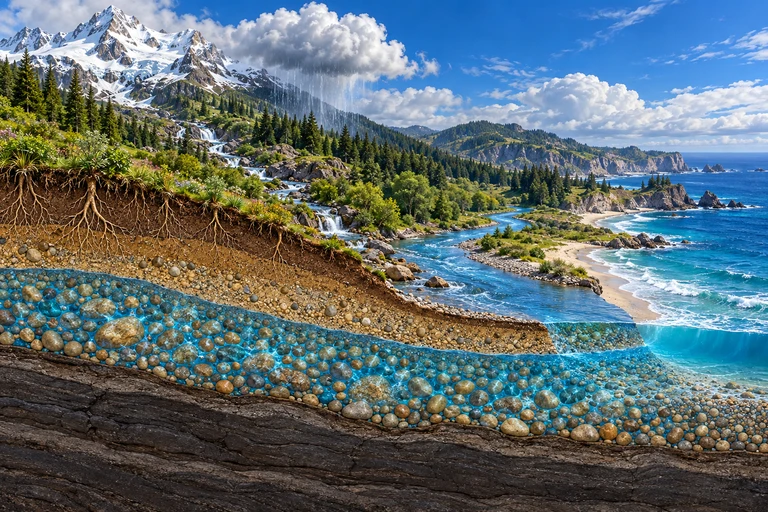 Infiltration crosses the land surface, but only part of infiltrated water becomes groundwater recharge. Water can remain in soil, enter roots, or move toward streams and the coast. Evaporation absorbs latent energy; condensation releases it.
Branching hydrologic pathways
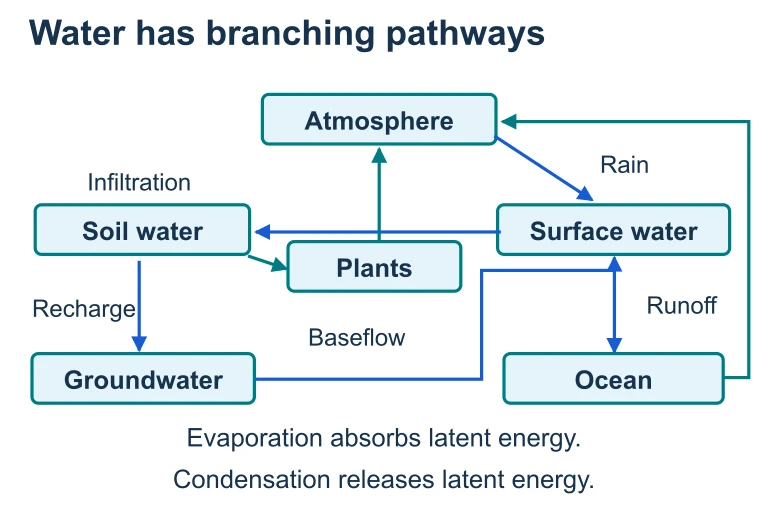 Infiltration crosses the land surface, but only part of infiltrated water becomes groundwater recharge. Water can remain in soil, enter roots, or move toward streams and the coast. Evaporation absorbs latent energy; condensation releases it.
Six Key Processes
The Water Balance Equation
For any region over time, inputs must equal outputs plus change in storage:
Evaporation vs. Transpiration
| Evaporation | Transpiration | |
|---|---|---|
| Source | Open water, soil, wet surfaces | Plant stomata on leaves |
| Driver | Solar radiation, wind, humidity | Solar radiation, root uptake |
| Control | Physical (temperature, surface area) | Biological (stomatal regulation) |
| Global share | ~90% from oceans | ~10% of atmospheric moisture |
| Combined term | Evapotranspiration (\( ET \)) | |
Understanding Residence Time
Residence time is the average length of time a water molecule spends in a given reservoir. It is calculated as:
How to Trace a Water Molecule
AP questions often ask you to describe the path a water molecule takes. Use this systematic approach:
Example: Ocean to Rain
Example: Groundwater Recharge
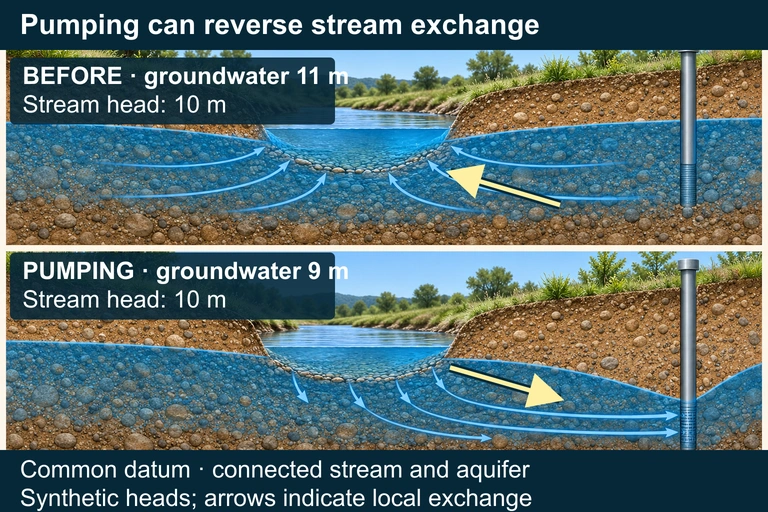
Predict how groundwater withdrawal can affect surface water.
Use this illustration to explore the concept described in its caption.
Example: Water Balance Calculation
A watershed receives 1,200 mm of precipitation per year. Evapotranspiration removes 700 mm, and runoff carries away 400 mm. What is the change in storage?
Human Impacts on the Cycle
Common Mistakes
Summary of Processes
| Process | Phase Change | Direction | Energy |
|---|---|---|---|
| Evaporation | Liquid to Gas | Surface to Atmosphere | Absorbs (endothermic) |
| Transpiration | Liquid to Gas | Plant to Atmosphere | Absorbs (endothermic) |
| Condensation | Gas to Liquid | Atmosphere (in place) | Releases (exothermic) |
| Precipitation | None (already liquid/solid) | Atmosphere to Surface | Gravitational (PE to KE) |
| Infiltration | None | Surface to Subsurface | Gravitational |
| Runoff | None | Land to Ocean/Lake | Gravitational |
Question 1 of 5
Which process describes the release of water vapor from plant leaves into the atmosphere?
Question 2 of 5
A watershed receives \( P = 900 \, \text{mm/yr} \), loses \( ET = 500 \, \text{mm/yr} \), and has \( R = 350 \, \text{mm/yr} \). What is \( \Delta S \)?
Question 3 of 5
Which reservoir has the longest average residence time for water?
Question 4 of 5
A city replaces grassland with impervious concrete surfaces. Which change is most likely?
Question 5 of 5
Condensation in the atmosphere releases energy. This energy was originally absorbed during which process?