The Greenhouse
Effect
Understand how greenhouse gases trap infrared radiation, regulate Earth's temperature, and why their increase leads to global warming.
What Is the Greenhouse Effect?
The greenhouse effect is a natural process in which certain atmospheric gases absorb and re-emit infrared (longwave) radiation emitted by Earth's surface. This trapping of heat keeps our planet warm enough to support life: without it, Earth's average surface temperature would be roughly \(-18\,^\circ\text{C}\) instead of the current \(+15\,^\circ\text{C}\).
Key Greenhouse Gases
Why the Greenhouse Effect Matters
Earth's Energy Balance
The Mechanism: Step by Step
Natural vs. Enhanced Greenhouse Effect
| Natural | Enhanced | |
|---|---|---|
| Cause | Naturally occurring GHGs | Human emissions (\(\text{CO}_2\), \(\text{CH}_4\), CFCs) |
| Temperature Effect | Maintains \(\approx 15\,^\circ\text{C}\) average | Raises average beyond \(15\,^\circ\text{C}\) |
| Rate of Change | Gradual (millennia) | Rapid (decades) |
| Ecosystem Impact | Ecosystems adapted over time | Species cannot adapt fast enough |
| Reversibility | Self-regulating via carbon cycle | Requires human intervention |
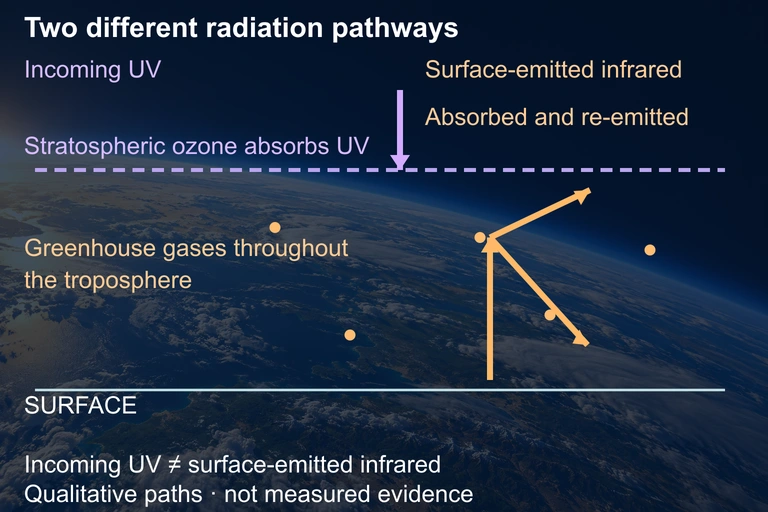
Shortwave vs. Longwave Radiation
Distinguish ozone depletion from enhanced greenhouse warming.
Use this illustration to explore the concept described in its caption.
How to Analyze a Greenhouse Problem
Example 1: Earth Without the Greenhouse Effect
Using the Stefan-Boltzmann law and Earth's energy balance, we can estimate the surface temperature without any greenhouse gases.
Example 2: \(\text{CO}_2\) Concentration Trends
Example 3: Radiative Forcing
Radiative forcing measures how much a factor (like increased \(\text{CO}_2\)) changes the energy balance at the top of the atmosphere, in \(\text{W/m}^2\).
Positive Feedback Loops
Connection to the Carbon Cycle
Common Mistakes
Summary: Greenhouse Gas Comparison
| Gas | GWP (100-yr) | Main Source | Atm. Lifetime |
|---|---|---|---|
| \(\text{CO}_2\) | 1 | Fossil fuels, deforestation | \(300\text{--}1000\;\text{yr}\) |
| \(\text{CH}_4\) | 28 | Agriculture, landfills, gas | \(\approx 12\;\text{yr}\) |
| \(\text{N}_2\text{O}\) | 265 | Fertilizers, combustion | \(\approx 121\;\text{yr}\) |
| CFCs | \(5,000\text{--}11,000\) | Refrigerants (legacy) | \(50\text{--}100\;\text{yr}\) |
| \(\text{H}_2\text{O}\) | N/A (feedback) | Evaporation | \(\approx 9\;\text{days}\) |
Question 1 of 5
Without the natural greenhouse effect, Earth's average surface temperature would be approximately:
Question 2 of 5
Which type of radiation do greenhouse gases primarily absorb and re-emit?
Question 3 of 5
The ice-albedo feedback is an example of a positive feedback because:
Question 4 of 5
A student claims that \(\text{CH}_4\) is a more important greenhouse gas than \(\text{CO}_2\) because it has a higher GWP. What is the best response?
Question 5 of 5
Using the formula \(\Delta F = 5.35 \times \ln(C/C_0)\), what would the radiative forcing be if \(\text{CO}_2\) doubled from its pre-industrial level of 280 ppm to 560 ppm?