01 / 20
C

The Carbon
Cycle

Explore how carbon moves through Earth's atmosphere, biosphere, hydrosphere, and geosphere: the biogeochemical cycle that drives climate and life.

AP Environmental Science

What Makes Carbon Special?

Carbon is the fourth most abundant element in the universe and the backbone of all organic molecules. Its ability to form four covalent bonds allows it to create the complex molecules essential for life: proteins, lipids, carbohydrates, and nucleic acids.

Earth's Carbon Reservoirs

Atmosphere
\(\text{CO}_2\) and \(\text{CH}_4\) gases: ~830 GtC (gigatons of carbon)
Biosphere
Living organisms and dead organic matter: ~2,000 GtC
Geosphere
Fossil fuels and sedimentary rocks: ~66,000,000 GtC
Hydrosphere
Dissolved \(\text{CO}_2\) and carbonates in oceans: ~38,000 GtC

Why the Carbon Cycle Matters

1
Climate regulation: Atmospheric \(\text{CO}_2\) is a greenhouse gas that traps heat. Changes in the carbon cycle directly affect global temperatures.
2
Energy for life: Photosynthesis and cellular respiration are carbon-cycle processes that power virtually all ecosystems.
3
Ocean chemistry: Dissolved \(\text{CO}_2\) forms carbonic acid, affecting ocean pH and marine organisms that build calcium carbonate shells.
4
Human impact: Burning fossil fuels transfers geosphere carbon to the atmosphere far faster than natural sinks can absorb it.

The Carbon Cycle: Overview

Atmosphere (CO₂) Biosphere Oceans Geosphere Photosynthesis Respiration Dissolution Outgassing Burial Combustion / Volcanism Sedimentation

Photosynthesis vs. Respiration

Photosynthesis
$$6\text{CO}_2 + 6\text{H}_2\text{O} \xrightarrow{\text{light}} \text{C}_6\text{H}_{12}\text{O}_6 + 6\text{O}_2$$ Plants, algae, and cyanobacteria remove \(\text{CO}_2\) from the atmosphere and convert it into organic carbon (glucose).
Cellular Respiration
$$\text{C}_6\text{H}_{12}\text{O}_6 + 6\text{O}_2 \rightarrow 6\text{CO}_2 + 6\text{H}_2\text{O} + \text{ATP}$$ All living organisms release \(\text{CO}_2\) back into the atmosphere by breaking down organic molecules for energy.

Fast vs. Slow: Two Carbon Cycles

Fast (Biological) Cycle Slow (Geological) Cycle
Timescale Days to decades Thousands to millions of years
Key Processes Photosynthesis, respiration, decomposition Weathering, sedimentation, volcanism
Carbon Moved ~120 GtC/year ~0.1 GtC/year
Reservoirs Atmosphere, biosphere Geosphere, deep ocean
Human Impact Deforestation, land-use change Fossil fuel combustion

One tagged carbon atom and one added carbon pulse tell different stories
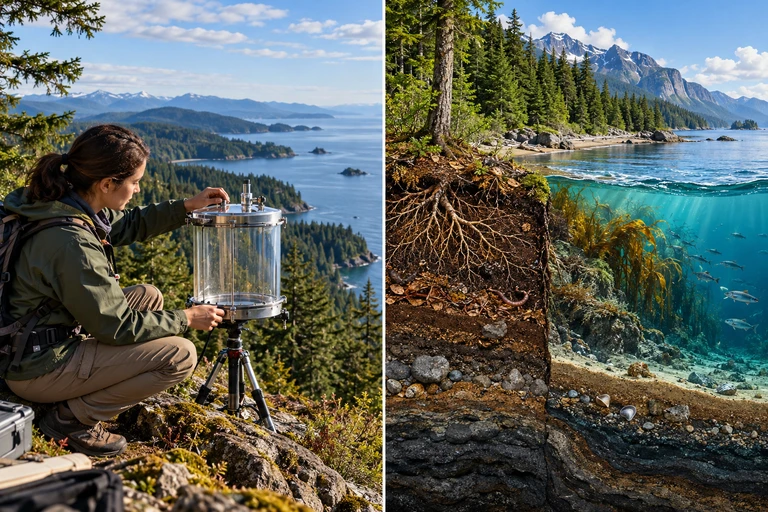
Separate sampling-cylinder and coast/forest cutaway scenes distinguish a tagged-atom thought experiment from bulk reservoir redistribution. No generated molecule count or concentration color coding. Separate exact panel: A tagged carbon atom enters a reservoir alongside M/F; a separate bulk-pulse diagram shows atmosphere, ocean and land reservoirs exchanging carbon.Tracking one tagged carbon atom differs from tracking an added carbon pulse. M/F requires a defined stock, gross outflow and mixing assumptions; an added pulse redistributes among reservoirs over multiple timescales.

Tagged-atom exchange time differs from persistence of a bulk carbon perturbation.
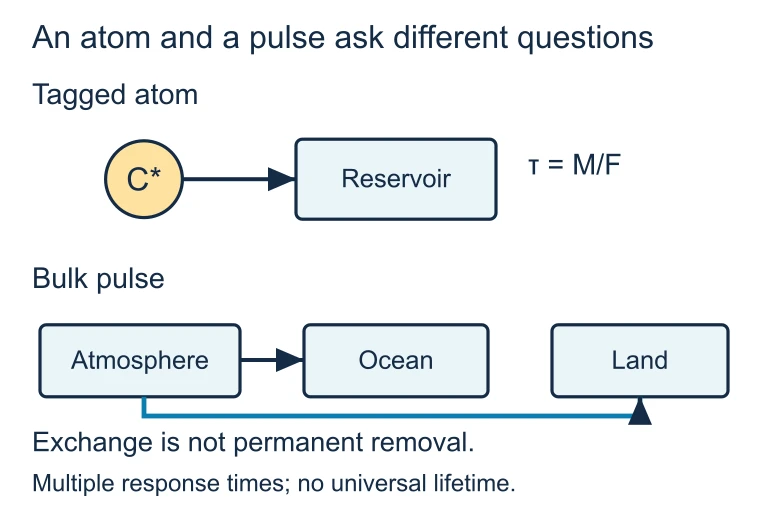
Tagged-atom exchange time differs from persistence of a bulk carbon perturbation.. Tracking one tagged carbon atom differs from tracking an added carbon pulse. M/F requires a defined stock, gross outflow and mixing assumptions; an added pulse redistributes among reservoirs over multiple timescales.Tracking one tagged carbon atom differs from tracking an added carbon pulse. M/F requires a defined stock, gross outflow and mixing assumptions; an added pulse redistributes among reservoirs over multiple timescales.

The Ocean Carbon Pump

The oceans absorb about 25% of annual human \(\text{CO}_2\) emissions through two major mechanisms:

Physical (Solubility) Pump
\(\text{CO}_2\) dissolves in cold surface water, forming carbonic acid: \(\text{CO}_2 + \text{H}_2\text{O} \rightarrow \text{H}_2\text{CO}_3\). Cold water sinks at the poles, carrying dissolved carbon to the deep ocean.
Biological Pump
Phytoplankton use photosynthesis to fix \(\text{CO}_2\) into organic matter. When they die, their remains sink to the deep ocean, transporting carbon downward for centuries.

The Geological Carbon Cycle

1. Weathering CO₂ + rock → ions 2. River Transport Ions → ocean 3. Sedimentation CaCO₃ deposits 4. Subduction Plates push rock down 5. Volcanism CO₂ → atmosphere 6. Atmosphere CO₂ available again Timescale: 100,000 to 200,000,000 years

Sources vs. Sinks

Carbon Sources
Processes that release carbon into the atmosphere: combustion of fossil fuels, respiration, decomposition, volcanic eruptions, deforestation.
Carbon Sinks
Processes that absorb carbon from the atmosphere: photosynthesis, ocean dissolution, rock weathering, soil organic matter storage.

How to Analyze Carbon Flux

1
Identify reservoirs: List all carbon pools involved (atmosphere, ocean, soil, vegetation, fossil fuels).
2
Map fluxes: Draw arrows between reservoirs and label each with the process (photosynthesis, respiration, combustion, etc.).
3
Quantify rates: Assign flow rates in GtC/year. Compare inputs and outputs for each reservoir.
4
Calculate net change: If \(\text{inputs} > \text{outputs}\), the reservoir is a net sink. If \(\text{outputs} > \text{inputs}\), it is a net source.
5
Evaluate perturbations: Ask: "What happens if this flux increases or decreases?" Trace cascading effects through the system.

Example: Simple Carbon Budget

A forest ecosystem receives 12 GtC/year via photosynthesis, loses 9 GtC/year through respiration, and 1 GtC/year through decomposition. Is this forest a net source or sink?

Example: Ocean Acidification

Since the Industrial Revolution, ocean pH has dropped from 8.21 to 8.10. The relationship between dissolved \(\text{CO}_2\) and pH involves these reactions:

CO₂(g) dissolves CO₂(aq) + H₂O H₂CO₃ carbonic acid H⁺ + HCO₃⁻ lowers pH More atmospheric CO₂ → more dissolved CO₂ → lower ocean pH

Example: Human Perturbation

Humans emit approximately 10 GtC/year from fossil fuels. Natural sinks absorb about 5.5 GtC/year (oceans: 2.5, land: 3.0). Where does the rest go?

Emissions: 10 GtC/yr Ocean: 2.5 GtC Land: 3.0 GtC Atmos: 4.5 GtC Net atmospheric increase: 10 - 2.5 - 3.0 = 4.5 GtC/yr This is why CO₂ concentrations keep rising

Common Mistakes

✕ Confusing Reservoir and Flux
A reservoir is a pool of stored carbon (GtC). A flux is a rate of movement between reservoirs (GtC/year). Don't mix up stocks and flows.
✕ Ignoring the Ocean
Students often focus only on terrestrial processes. The ocean absorbs ~25% of human \(\text{CO}_2\) emissions and holds 50x more carbon than the atmosphere.
✕ "Plants Fix Everything"
While forests are carbon sinks, they also respire and decompose. A mature forest may be near carbon-neutral. Only growing forests are strong net sinks.

Carbon Cycle Summary

Process Direction Timescale Example
Photosynthesis Atmos → Bio Seconds Trees, algae
Respiration Bio → Atmos Seconds All organisms
Decomposition Bio → Atmos/Soil Days to years Bacteria, fungi
Ocean Dissolution Atmos → Ocean Years Surface uptake
Combustion Geo → Atmos Instant Fossil fuels
Weathering Atmos → Geo 10⁴-10⁸ yrs Silicate rocks
Volcanism Geo → Atmos Episodic Eruptions

Question 1 of 5

Which of the following is the largest reservoir of carbon on Earth?

Question 2 of 5

Photosynthesis and cellular respiration are considered part of which carbon cycle?

Question 3 of 5

If a forest absorbs 15 GtC/year through photosynthesis and releases 12 GtC/year through respiration and decomposition combined, what is its net carbon status?

Question 4 of 5

Why does burning fossil fuels disrupt the carbon cycle more significantly than burning wood?

Question 5 of 5

Ocean acidification is primarily caused by which process?