Sustainable
Forestry
Explore the science of managing forest ecosystems for long-term ecological health, biodiversity, and resource renewal while meeting human needs.
What Is Sustainable Forestry?
Sustainable forestry is the practice of managing forests so that current timber and resource needs are met without compromising the ability of future generations to meet their own needs. It balances three pillars: ecological integrity, economic viability, and social equity.
Why Forests Matter
Key Terminology
The Logistic Growth Model
The growth rate is maximized at \( N = \frac{K}{2} \). This is where Maximum Sustainable Yield occurs: the point at which we can harvest the most while still allowing full regrowth.
Maximum Sustainable Yield
Harvesting Methods Compared
| Clear-Cutting | Selective Cutting | Shelterwood | |
|---|---|---|---|
| Description | All trees removed at once | Only mature trees removed | Gradual removal in stages |
| Biodiversity Impact | High loss | Low impact | Moderate |
| Erosion Risk | Severe | Minimal | Low-Moderate |
| Regrowth Type | Even-aged stand | Uneven-aged stand | Two-aged stand |
| Cost Efficiency | Low cost | Higher cost | Moderate |
Harvest methods retain different canopy and regeneration structures
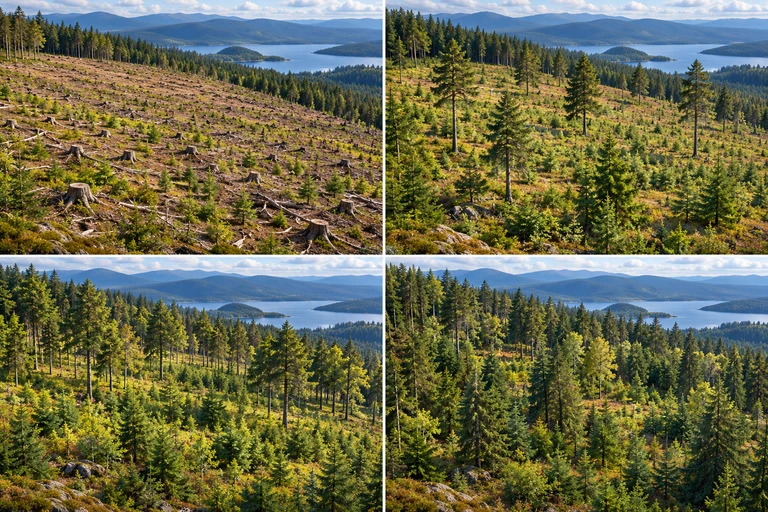 Harvest methods differ in retained canopy and regeneration. Shelterwood uses staged removal; selection can maintain several age classes when species and site conditions support it.
Retention and regeneration differ
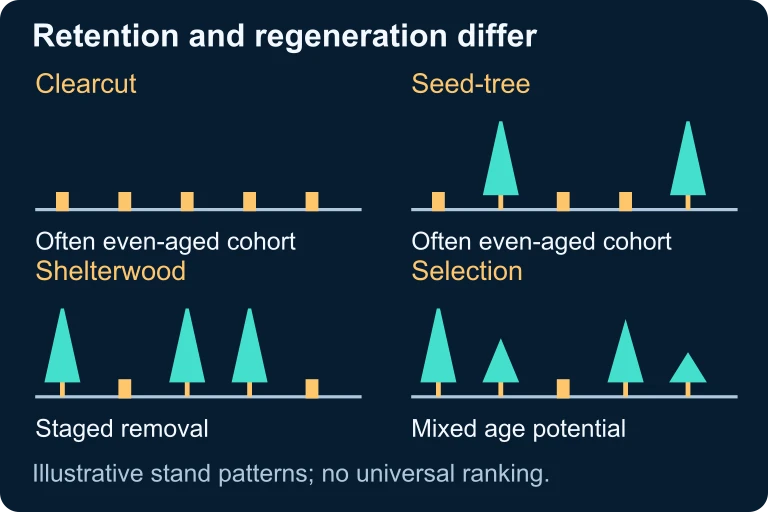 Harvest methods differ in retained canopy and regeneration. Shelterwood uses staged removal; selection can maintain several age classes when species and site conditions support it.
Clear-Cutting vs. Selective Cutting
How to Apply Sustainable Management
Example: Calculating MSY
A managed pine forest has a carrying capacity of \( K = 8{,}000 \) cubic meters of timber and an intrinsic growth rate of \( r = 0.12 \) per year. Find the Maximum Sustainable Yield.
Example: Sustainability Check
A tropical hardwood forest has \( K = 5{,}000 \) tonnes of biomass, \( r = 0.08 \) per year, and a current standing biomass of \( N = 3{,}500 \) tonnes. The logging company removes 150 tonnes per year. Is this sustainable?
Example: Rotation Period
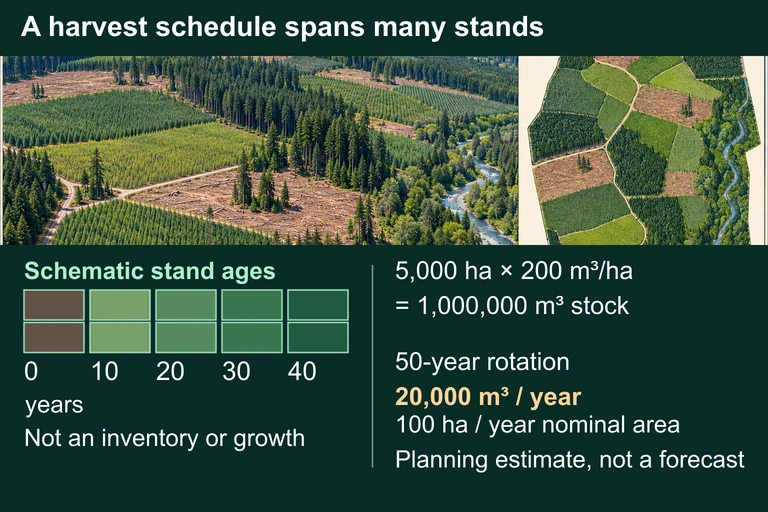
A forest manager plants Douglas fir that reach harvestable size in 50 years. The forest covers 10,000 hectares. How should the land be divided for continuous annual harvest?
Explain landscape yield over time rather than one stand regrowing instantly.
Use this illustration to explore the concept described in its caption.
Forest Ecosystem Services
Sustainable forestry aims to maintain all ecosystem services simultaneously: not just timber production, but carbon storage, watershed protection, habitat, and recreation value.
Canopy removal alters coupled watershed pathways
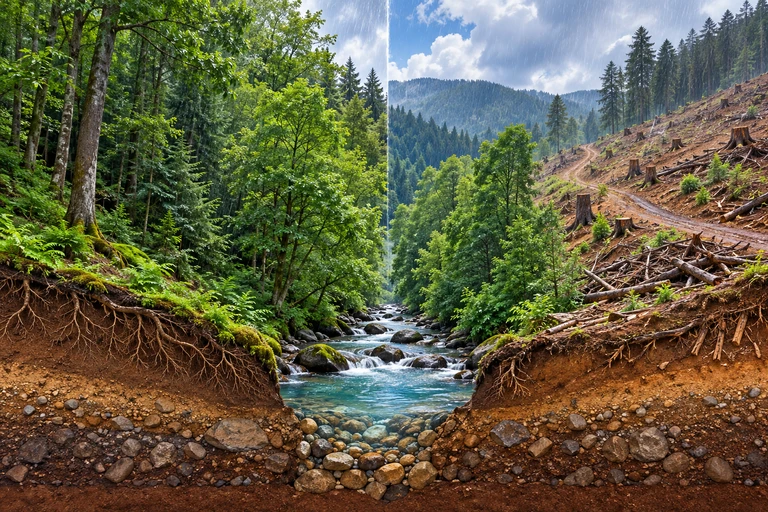 Canopy removal changes interception, transpiration, soil exposure and runoff pathways. Rainfall, slope, roads, residual cover and management affect the outcome; a connected riparian buffer can retain shade and intercept some flows.
Canopy removal affects interception and uptake while roads and ground cover influence runoff and sediment.
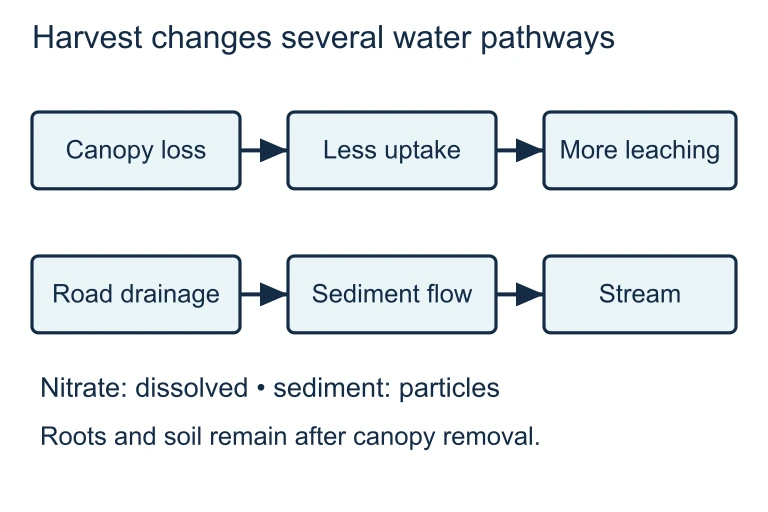 Canopy removal changes interception, transpiration, soil exposure and runoff pathways. Rainfall, slope, roads, residual cover and management affect the outcome; a connected riparian buffer can retain shade and intercept some flows.
Certification and Policy Tools
Common Mistakes
Summary: Key Comparisons
| Unsustainable | Sustainable | |
|---|---|---|
| Harvest Rate | \( H > \frac{rK}{4} \) | \( H \leq \frac{rK}{4} \) |
| Method | Large-scale clear-cutting | Selective or shelterwood |
| Biodiversity | Declining | Maintained |
| Soil Health | Eroded, nutrient-depleted | Intact root systems |
| Carbon Impact | Net carbon source | Net carbon sink |
| Long-Term Yield | Decreasing to zero | Perpetual |
Question 1 of 5
A forest has \( K = 6{,}000 \) m³ and \( r = 0.10 \) per year. What is the Maximum Sustainable Yield?
Question 2 of 5
Which harvesting method best maintains an uneven-aged forest with high biodiversity?
Question 3 of 5
In the logistic growth model, at what population size does maximum growth rate occur?
Question 4 of 5
A 20,000-hectare forest of spruce has a rotation period of 80 years. How many hectares should be harvested annually for even-flow management?
Question 5 of 5
Scenario: A timber company proposes to clear-cut 500 hectares of old-growth temperate rainforest and replace it with a fast-growing eucalyptus plantation. They argue this will produce more timber per year than the original forest, increase carbon sequestration due to faster growth rates, and provide jobs for the local community. Environmental scientists object, noting that old-growth forests store more total carbon in biomass and soil, support endemic species found nowhere else, and regulate local water cycles through deep root systems and canopy interception.
Which statement best explains why the eucalyptus plantation would not be considered sustainable forestry?