Sustainable
Agriculture
Explore the practices that maintain long-term food production while preserving soil health, biodiversity, and natural resources for future generations.
What Is Sustainable Agriculture?
Sustainable agriculture is a farming approach that meets current food and fiber needs without compromising the ability of future generations to meet theirs. It integrates three main goals:
Why Does It Matter?
Industrial agriculture has boosted yields but at a steep environmental cost. Understanding these impacts is essential for the AP Environmental Science exam and for real-world problem solving.
Key Terms to Know
Explain temporal diversification rather than merely showing colorful adjacent fields.
Use this illustration to explore the concept described in its caption.
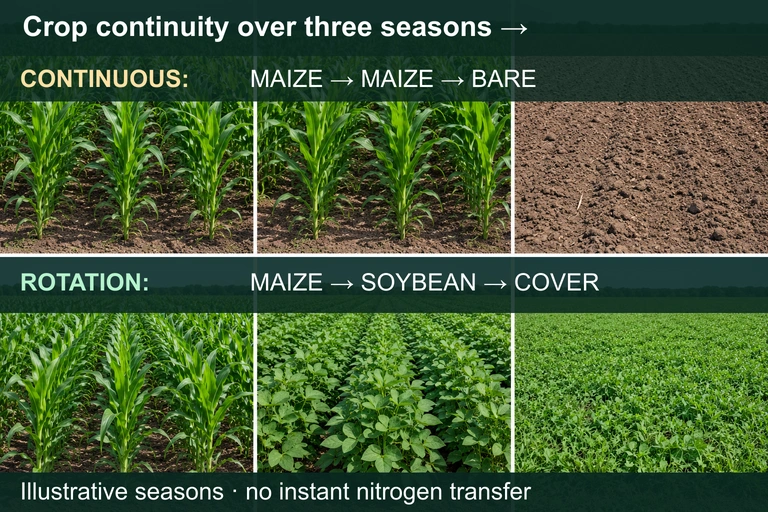
The Soil Health Cycle
Quantifying Sustainability
Environmental scientists use measurable indicators to evaluate farm sustainability. One key metric is the nitrogen use efficiency (NUE):
Another important relationship is the soil carbon balance: $$\Delta C_{\text{soil}} = C_{\text{inputs}} - C_{\text{losses}}$$ where \(C_{\text{inputs}}\) includes crop residues and compost, and \(C_{\text{losses}}\) includes decomposition and erosion. Sustainable practices aim for \(\Delta C_{\text{soil}} \geq 0\).
Conventional vs. Sustainable
| Conventional | Sustainable | |
|---|---|---|
| Soil management | Heavy tillage | No-till / cover crops |
| Pest control | Broad-spectrum pesticides | IPM, biological controls |
| Fertilizer | Synthetic (high N runoff) | Compost, green manures |
| Crop diversity | Monoculture | Polyculture / rotation |
| Water use | Flood / overhead irrigation | Drip irrigation, rain harvesting |
| Long-term yield | Declines as soil degrades | Maintains or increases |
Five Pillars of Practice
Farm practices interrupt distinct erosion, nutrient and habitat pathways
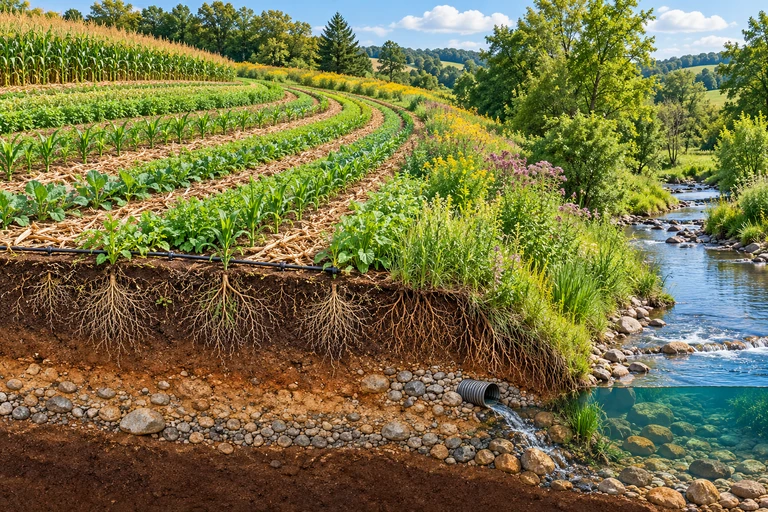 A riparian strip can intercept surface runoff, while a buried drain may bypass it. Practices that reduce erosion and sediment-bound transport can affect dissolved nutrient pathways differently.
Farm practices interrupt distinct erosion, nutrient and habitat pathways
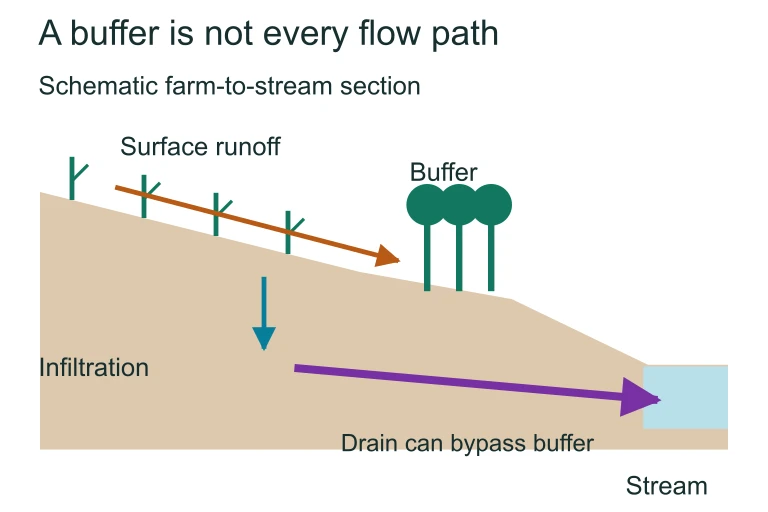 A riparian strip can intercept surface runoff, while a buried drain may bypass it. Practices that reduce erosion and sediment-bound transport can affect dissolved nutrient pathways differently.
How to Evaluate a Farm
On the AP exam, you may be asked to recommend sustainable practices for a given scenario. Follow this checklist:
Example: Nitrogen Runoff
A farm applies \(150 \text{ kg N/ha}\) of synthetic fertilizer. The harvested corn removes \(90 \text{ kg N/ha}\). Calculate the nitrogen use efficiency and the potential N lost to the environment.
Example: Soil Carbon Balance
A no-till field receives \(2.5 \text{ t C/ha/yr}\) from crop residues and cover crops. Decomposition and erosion remove \(2.0 \text{ t C/ha/yr}\). Is the field building or losing carbon?
Example: IPM Decision Tree
Water Conservation Techniques
Biodiversity & Ecosystem Services
Common Mistakes on the Exam
Practice Summary Table
| Practice | Primary Benefit | Addresses |
|---|---|---|
| Crop rotation | Breaks pest/disease cycles | Pest pressure, soil nutrients |
| Cover crops | Prevents erosion, adds N | Soil loss, nutrient runoff |
| No-till | Preserves soil structure | Erosion, carbon loss |
| IPM | Reduces pesticide use | Biodiversity loss, pollution |
| Drip irrigation | Conserves water | Aquifer depletion, salinization |
| Polyculture | Increases resilience | Monoculture vulnerability |
Question 1 of 5
Which of the following best describes the primary purpose of crop rotation in sustainable agriculture?
Question 2 of 5
A farmer applies \(200 \text{ kg N/ha}\) of fertilizer. The harvested crop removes \(100 \text{ kg N/ha}\). What is the nitrogen use efficiency?
Question 3 of 5
In Integrated Pest Management (IPM), chemical pesticides are considered:
Question 4 of 5
A no-till field has \(C_{\text{inputs}} = 3.0 \text{ t C/ha/yr}\) and \(C_{\text{losses}} = 2.2 \text{ t C/ha/yr}\). Which statement is correct?
Question 5 of 5
Which combination of practices would most effectively reduce soil erosion on a hilly farm?