Stratospheric
Ozone Depletion
Explore how chlorofluorocarbons destroy the protective ozone layer, the chemistry behind the Antarctic ozone hole, and international efforts to reverse the damage.
What Is the Ozone Layer?
The ozone layer is a region of the stratosphere, roughly 15 to 35 km above Earth's surface, where ozone (\( \text{O}_3 \)) is concentrated at its highest levels. It absorbs 97-99% of the Sun's harmful ultraviolet-B radiation.
Key Terms in Ozone Chemistry
Why Ozone Depletion Matters
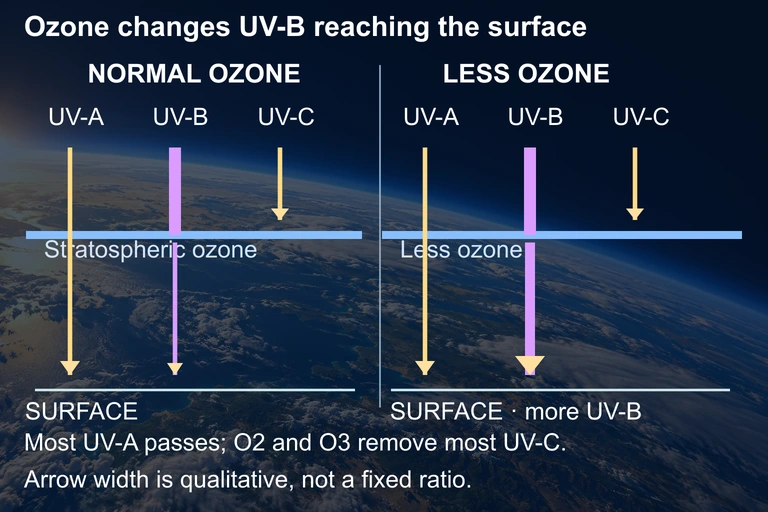
A thinner ozone layer allows more UV-B radiation to reach Earth's surface. Every 1% decrease in stratospheric ozone leads to roughly a 2% increase in UV-B at the surface.
The Chapman Cycle: Natural Ozone
In the stratosphere, ozone is naturally created and destroyed in a balanced cycle driven by UV radiation. This is the Chapman Cycle:
CFC Catalytic Destruction of Ozone
CFCs are extremely stable in the troposphere. Once they rise to the stratosphere, UV radiation breaks them apart, releasing chlorine atoms that catalytically destroy ozone:
The Antarctic Ozone Hole
Each austral spring (September-October), a severe thinning of ozone occurs over Antarctica. This "ozone hole" was first detected in 1985 by Farman, Gardiner, and Shanklin.
Polar winter primes chemistry;spring sunlight triggers ozone loss
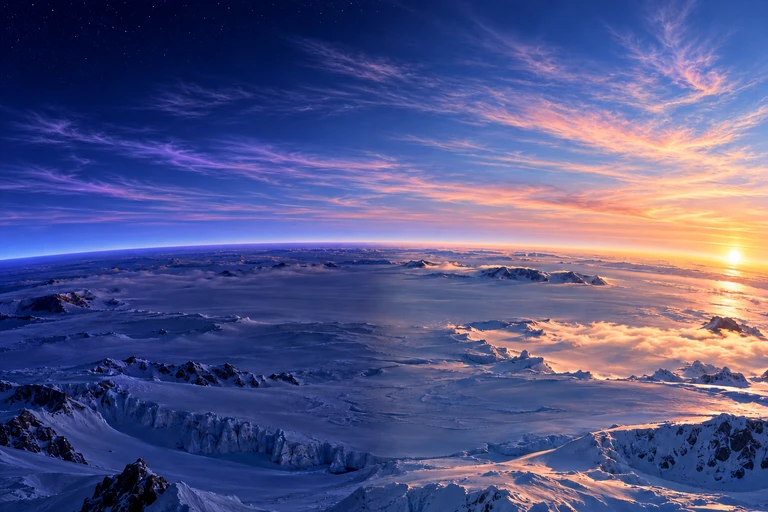 Antarctic winter cold and polar stratospheric clouds prepare chlorine chemistry before sunlight returns. Spring light activates reactive chlorine that contributes to ozone loss.
Polar winter primes chemistry;spring sunlight triggers ozone loss
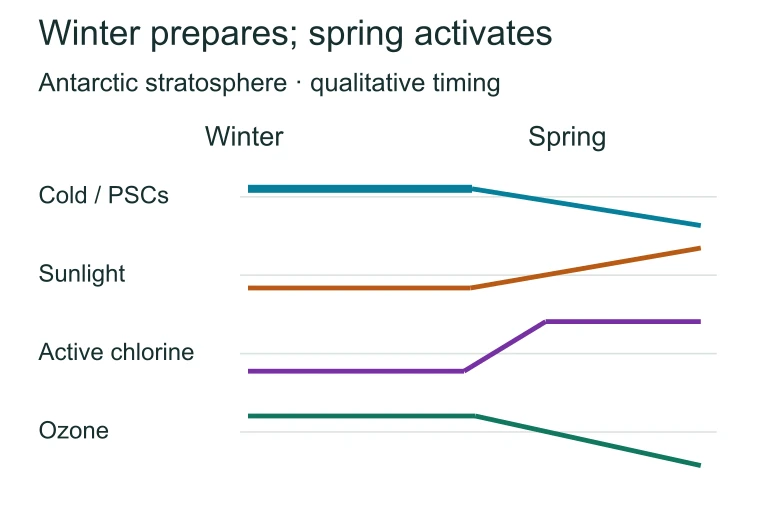 Antarctic winter cold and polar stratospheric clouds prepare chlorine chemistry before sunlight returns. Spring light activates reactive chlorine that contributes to ozone loss.
Ozone Depletion vs. Global Warming
| Ozone Depletion | Global Warming | |
|---|---|---|
| Location | Stratosphere (15-35 km) | Troposphere (0-15 km) |
| Primary Pollutants | CFCs, HCFCs, halons | \( \text{CO}_2 \), \( \text{CH}_4 \), \( \text{N}_2\text{O} \) |
| Mechanism | Catalytic destruction of \( \text{O}_3 \) | Enhanced greenhouse effect |
| Effect | More UV-B reaches surface | Surface temperatures rise |
| International Treaty | Montreal Protocol (1987) | Paris Agreement (2015) |
Explain ozone shielding without merging it with greenhouse warming.
Use this illustration to explore the concept described in its caption.
Sources of Ozone-Depleting Substances
The Montreal Protocol
Signed in 1987, the Montreal Protocol is an international treaty designed to phase out the production and use of ozone-depleting substances. It is often called the most successful environmental treaty ever adopted.
How to Analyze an Ozone Question
Example 1: CFC Lifetime
Problem: CFC-12 has an atmospheric lifetime of approximately 100 years. If global CFC-12 emissions ceased in 1996, estimate what fraction of the original CFC-12 concentration remains in the stratosphere in 2046.
Example 2: Catalytic Efficiency
Problem: One chlorine atom can destroy approximately 100,000 ozone molecules. If 1 kg of CFC-11 (\( \text{CFCl}_3 \), molar mass \( \approx 137 \text{ g/mol} \)) releases all its chlorine, how many ozone molecules are destroyed?
Example 3: Dobson Units
Problem: Ozone is measured in Dobson Units (DU). The global average is about 300 DU. The ozone hole is defined as regions where ozone drops below 220 DU. What percentage decrease from normal does this represent?
Common Mistakes
Recovery Timeline
Question 1 of 5
Which layer of the atmosphere contains the ozone layer that protects Earth from harmful UV radiation?
Question 2 of 5
In the catalytic destruction of ozone by chlorine, why is chlorine described as a catalyst?
Question 3 of 5
The Antarctic ozone hole is most severe during which season, and why?
Question 4 of 5
Which international agreement is specifically designed to phase out ozone-depleting substances?
Question 5 of 5
A student claims that increasing \( \text{CO}_2 \) emissions are the primary cause of stratospheric ozone depletion. Which response best corrects this misconception?