Sources of
Pollution
Explore how point sources and nonpoint sources introduce contaminants into air, water, and soil: the foundational concept for understanding environmental degradation.
What Is Pollution?
Pollution is the introduction of contaminants into the natural environment that cause adverse change. These contaminants can be chemical substances, energy (heat, noise, light), or biological agents that degrade the quality of air, water, or land.
Why Identifying Sources Matters
Two Fundamental Categories
Point Source Pollution
A point source discharges pollutants from a discrete, identifiable location: a pipe, ditch, channel, tunnel, or container. Because the origin can be pinpointed, point sources are easier to monitor, regulate, and control.
Nonpoint Source Pollution
A nonpoint source (NPS) originates from many diffuse locations across a broad area. NPS pollution is typically carried by stormwater runoff and is the leading cause of water quality problems in the United States.
Point vs. Nonpoint: Key Distinction
| Point Source | Nonpoint Source | |
|---|---|---|
| Origin | Single, identifiable location | Diffuse, widespread area |
| Example | Factory pipe discharge | Agricultural field runoff |
| Monitoring | Relatively easy | Difficult and expensive |
| Regulation | Permits (NPDES) | Best management practices |
| Control | Treat at the source | Reduce across landscape |
| U.S. Leading cause? | No (greatly reduced) | Yes (biggest challenge) |
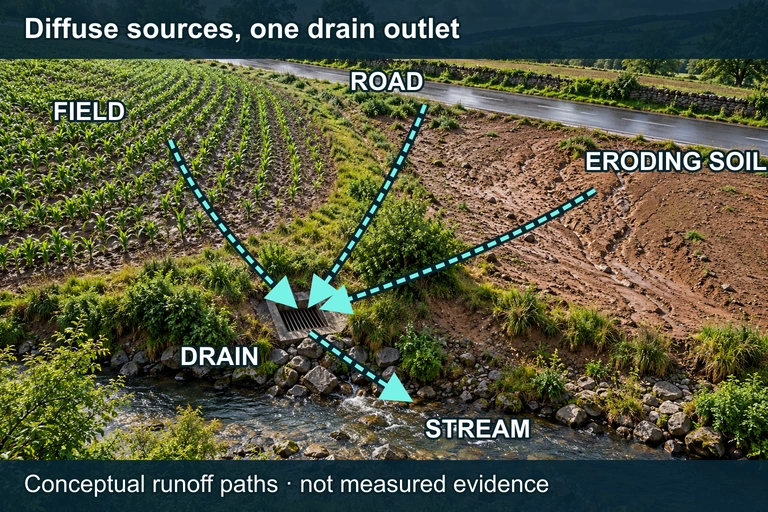
Explain why a pipe outlet does not by itself identify the original source mechanism.
Use this illustration to explore the concept described in its caption.
Major Pollutant Types
Sources of Air Pollution
Sources of Water Pollution
Transport pathways determine where pollutants reach receptors
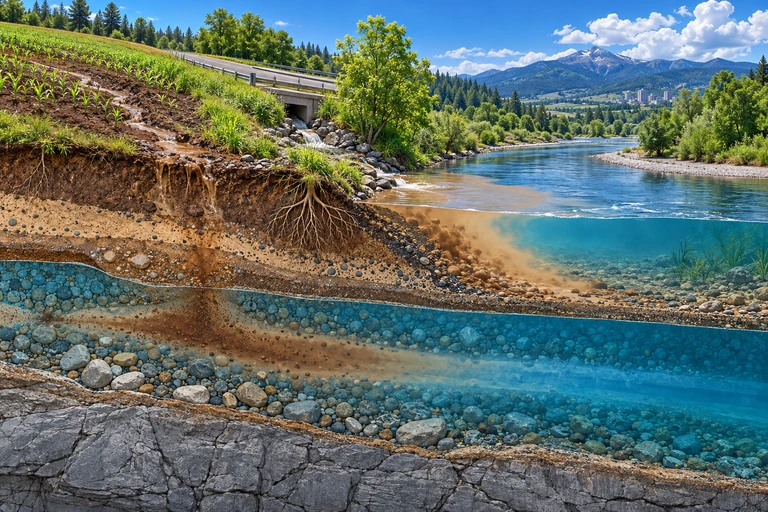 Dissolved pollutants can move with groundwater, while adsorbed pollutants may travel with sediment. Chemical form affects transport and exposure; intake, absorbed dose and tissue concentration are different quantities.
Dissolved and sediment-bound differ
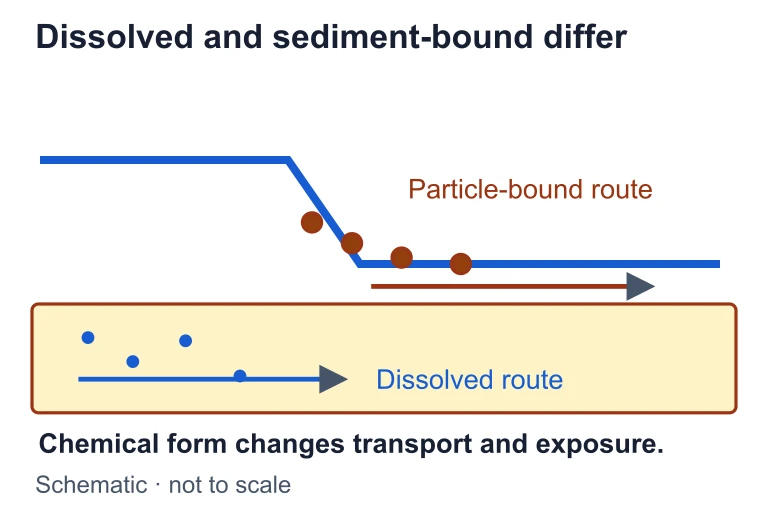 Dissolved pollutants can move with groundwater, while adsorbed pollutants may travel with sediment. Chemical form affects transport and exposure; intake, absorbed dose and tissue concentration are different quantities.
Nutrient Pollution and Eutrophication
Eutrophication is the process by which excess nutrients (nitrogen and phosphorus) from nonpoint sources stimulate explosive algal growth. When these algae die, decomposing bacteria consume dissolved oxygen, creating hypoxic "dead zones" where aquatic life cannot survive.
How to Identify the Source
Example 1: Factory Discharge
Example 2: Suburban Runoff
Example 3: Thermal Pollution
Common Mistakes
Summary Table
| Pollution Type | Source | Medium | Example |
|---|---|---|---|
| Chemical (heavy metal) | Point | Water | Factory Cd discharge |
| Chemical (nutrients) | Nonpoint | Water | Farm fertilizer runoff |
| Physical (heat) | Point | Water | Power plant cooling |
| Physical (sediment) | Nonpoint | Water | Construction site erosion |
| Chemical (\(\text{SO}_2\)) | Point | Air | Coal power plant stack |
| Biological (pathogens) | Both | Water | Sewage / animal waste |
Question 1 of 5
Which of the following is the best example of a nonpoint source of water pollution?
Question 2 of 5
A power plant discharges water that is \(15^\circ C\) warmer than the river it enters. This is an example of:
Question 3 of 5
Which process links excess nutrient pollution to the creation of aquatic dead zones?
Question 4 of 5
Why is nonpoint source pollution generally harder to regulate than point source pollution?
Question 5 of 5
A volcanic eruption releases large amounts of \(\text{SO}_2\) and particulate matter into the atmosphere. How should this be classified?