Solid Waste
Disposal
Explore the environmental impacts of municipal solid waste, compare disposal methods from landfills to incineration, and understand the waste management hierarchy.
What Is Solid Waste?
Solid waste includes any discarded material that is not a liquid or gas. It encompasses everything from household trash and yard debris to industrial scraps and construction rubble. In the United States alone, we generate over 290 million tons of municipal solid waste (MSW) per year.
MSW Composition Breakdown
Why Waste Disposal Matters
The Waste Management Hierarchy
Sanitary Landfills
Landfill barriers manage separate liquid,gas and groundwater pathways
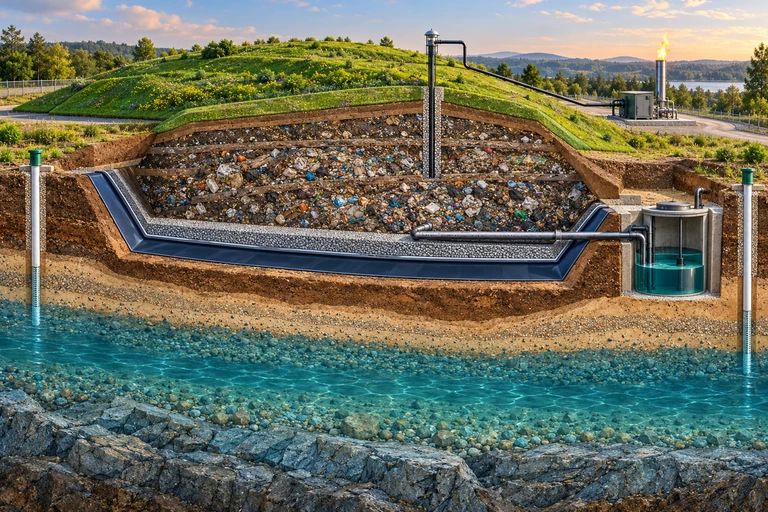 A sanitary landfill collects leachate above a composite liner, routes gas from waste wells to treatment or energy recovery, and monitors groundwater with separate wells. Containment and monitoring manage continuing risks.
Landfill liquid gas and groundwater routes
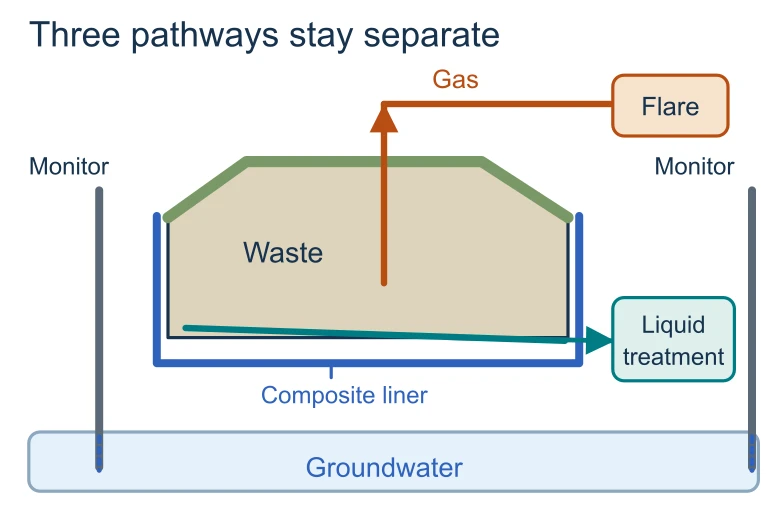 A sanitary landfill collects leachate above a composite liner, routes gas from waste wells to treatment or energy recovery, and monitors groundwater with separate wells. Containment and monitoring manage continuing risks.
Sanitary Landfill vs. Open Dump
| Sanitary Landfill | Open Dump | |
|---|---|---|
| Liner System | Clay + synthetic | None |
| Leachate Control | Collected & treated | Seeps into soil |
| Gas Management | Captured / flared | Uncontrolled release |
| Daily Cover | Soil applied daily | Exposed waste |
| Regulation | RCRA regulated | Illegal in U.S. |
| Health Risk | Minimized | Vectors, disease |
Incineration & Waste-to-Energy
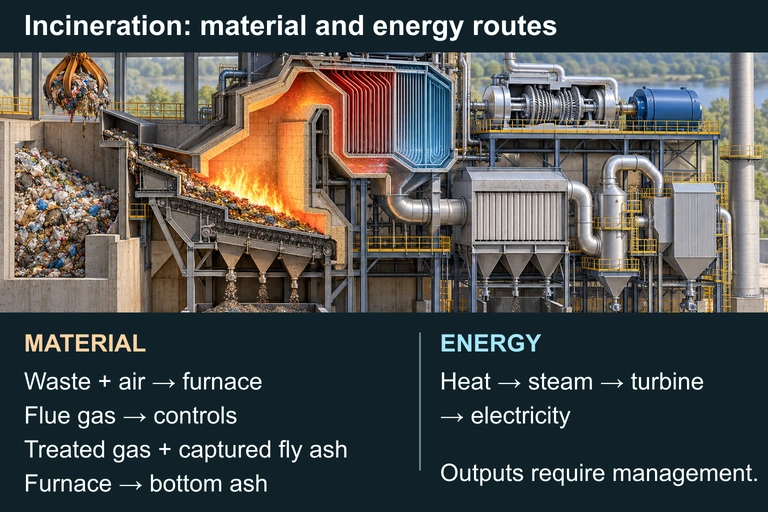
Incineration burns waste at high temperatures (\( \approx 850{-}1100\,{}^\circ\text{C} \)), reducing its volume by up to 90%. When the heat is captured to generate electricity, the process is called Waste-to-Energy (WtE).
Explain energy recovery and residual waste rather than disappearance of matter.
Use this illustration to explore the concept described in its caption.
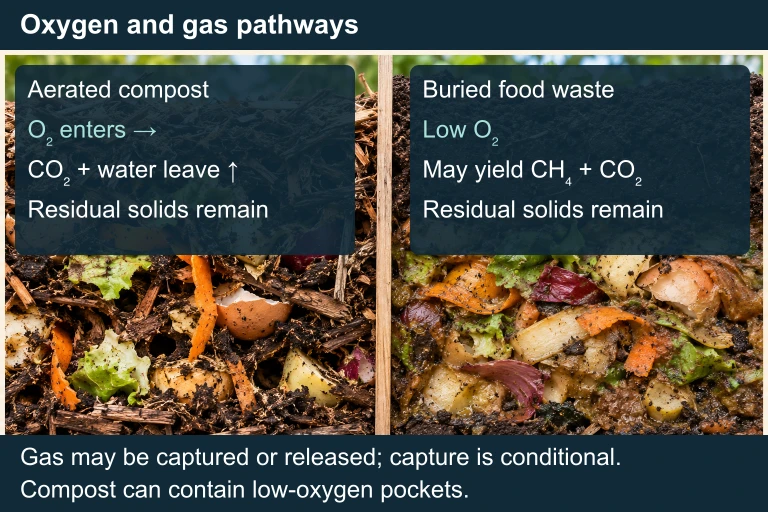
Recycling & Composting
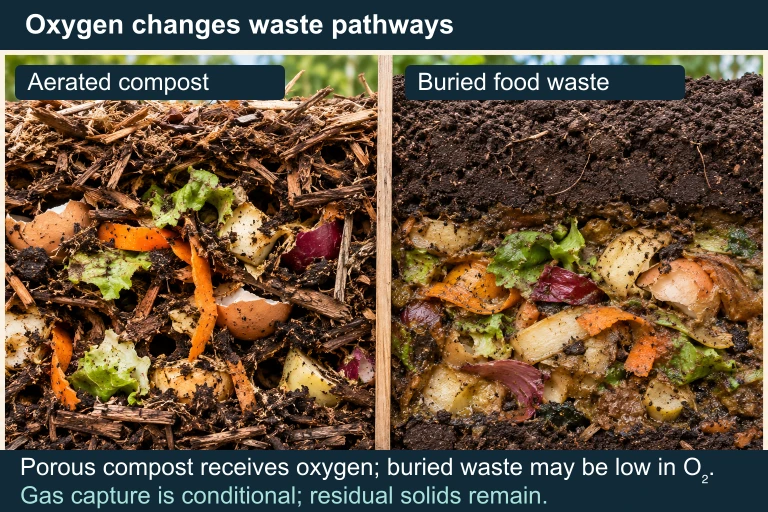
Explain how oxygen conditions change decomposition pathways.
Use this illustration to explore the concept described in its caption.
Source Reduction: The Top Priority
Source reduction (also called waste prevention) means designing, manufacturing, purchasing, or using materials so that the amount or toxicity of waste is minimized before it enters the waste stream. It sits at the very top of the waste hierarchy.
How to Analyze a Waste Scenario
Example: Landfill Capacity
A city generates 500,000 tons of MSW per year. The landfill has a remaining capacity of 8 million cubic meters. Compacted waste has a density of \( 0.6\;\text{tons/m}^3 \). How many years until the landfill is full?
Example: Recycling Impact
The same city currently recycles 25% of its waste. If the recycling rate increases to 50%, how many additional years of landfill life are gained?
Example: Methane Emissions
A landfill produces \( 4{,}200\;\text{m}^3 \) of methane per day. If \( 1\;\text{m}^3 \) of \( \text{CH}_4 \) has a mass of \( 0.656\;\text{kg} \), and the global warming potential (GWP) of \( \text{CH}_4 \) is 28 (over 100 years), what is the annual \( \text{CO}_2 \)-equivalent emission?
Common Mistakes
Disposal Methods Compared
| Landfill | Incineration | Recycling | |
|---|---|---|---|
| Volume Reduction | None | \( \sim 90\% \) | Varies |
| Energy Recovery | \( \text{CH}_4 \) capture | Electricity / heat | Saves production energy |
| GHG Emissions | \( \text{CH}_4 \) | \( \text{CO}_2 \), dioxins | Lowest |
| Land Use | High | Low | Low |
| Toxic Residuals | Leachate | Ash | Minimal |
| Cost | Low-moderate | High capital | Moderate |
Question 1 of 5
According to the waste management hierarchy, which strategy is the most preferred method of managing solid waste?
Question 2 of 5
A sanitary landfill includes all of the following components EXCEPT:
Question 3 of 5
A community generates 200,000 tons of MSW annually. If \( 30\% \) is recycled and the remainder goes to a landfill at a compacted density of \( 0.5\;\text{tons/m}^3 \), what volume of landfill space is used per year?
Question 4 of 5
Which of the following is a major disadvantage of waste-to-energy incineration?
Question 5 of 5
Composting is most effective at reducing landfill waste when applied to which fraction of MSW?