01 / 21

Solar
Energy

Explore how the Sun's radiant energy is captured, converted, and utilized: from photovoltaic cells to passive heating and the environmental trade-offs of going solar.

AP Environmental Science

What Is Solar Energy?

Solar energy is the radiant light and heat emitted by the Sun. It is Earth's most abundant renewable energy source: the Sun delivers approximately \( 1{,}361 \; \text{W/m}^2 \) of power to the top of the atmosphere, known as the solar constant.

The Electromagnetic Spectrum and the Sun

UV Visible Light Infrared Peak solar output Short λ Long λ

Solar radiation spans the UV, visible, and infrared wavelengths. About 43% of solar energy reaching the surface is visible light, and roughly 49% is infrared (heat). Photovoltaic cells primarily capture visible wavelengths.

Why Solar Matters

Renewable
The Sun will shine for another ~5 billion years: solar is virtually inexhaustible on human timescales.
Low Emissions
Solar panels produce electricity with zero direct \( \text{CO}_2 \) emissions during operation.
Scalable
Systems range from a rooftop array to utility-scale farms generating hundreds of megawatts.

Core Concept: Insolation

Insolation (incoming solar radiation) is the measure of solar energy received on a given surface area over time. It is typically expressed in \( \text{kWh/m}^2/\text{day} \).

Earth ★ Equator θ Insolation varies with latitude and angle of incidence θ

Photovoltaic vs. Solar Thermal

Photovoltaic (PV) Solar Thermal
How it works Converts light directly to electricity via the photoelectric effect Absorbs heat to warm fluid, which drives a turbine or heats water
Output Electricity (DC) Heat or electricity
Typical efficiency 15 – 22% 30 – 40% (CSP plants)
Scale Rooftop to utility Mostly utility-scale
Storage Batteries Molten salt thermal storage

How a PV Cell Works

Sunlight (photons) Anti-reflective N-type silicon P-N Junction P-type silicon Back contact e⁻ External circuit → Electricity

A rooftop panel opens into the carrier-separation story
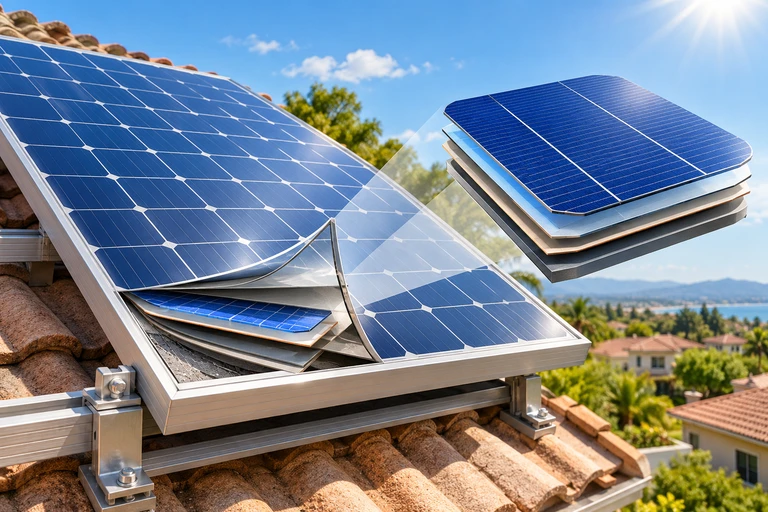
Panel frame and support are visible; exaggerated exploded layers connect rooftop panel to cell material. No carrier geometry or scale inferred from layer thickness. Separate exact panel: An n-over-p junction shows downward electric field, upward electron drift and downward hole drift, with a closed external load path.Illumination generates charge carriers in a photovoltaic cell, and collection competes with recombination. Fixed ion charge lies in the depletion region while the bulk n and p regions remain neutral. Electron flow and conventional current point in opposite directions.

A junction field separates generated charge carriers and a closed external path supports current.
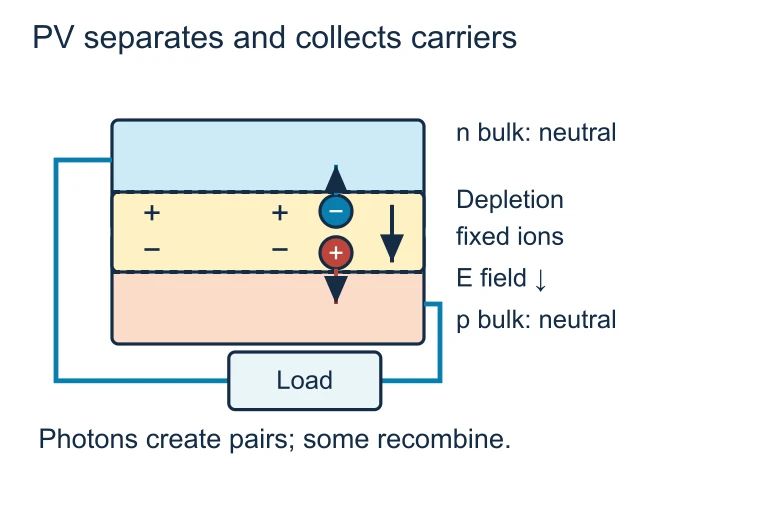
A junction field separates generated charge carriers and a closed external path supports current.. Illumination generates charge carriers in a photovoltaic cell, and collection competes with recombination. Fixed ion charge lies in the depletion region while the bulk n and p regions remain neutral. Electron flow and conventional current point in opposite directions.Illumination generates charge carriers in a photovoltaic cell, and collection competes with recombination. Fixed ion charge lies in the depletion region while the bulk n and p regions remain neutral. Electron flow and conventional current point in opposite directions.

Active vs. Passive Solar

Active Solar
Uses mechanical or electrical devices (PV panels, pumps, fans) to collect and distribute solar energy. Requires external energy input to operate.
Passive Solar
Uses building design (south-facing windows, thermal mass, overhangs) to capture and store heat without mechanical systems.

PV,solar thermal and passive solar take different energy pathways
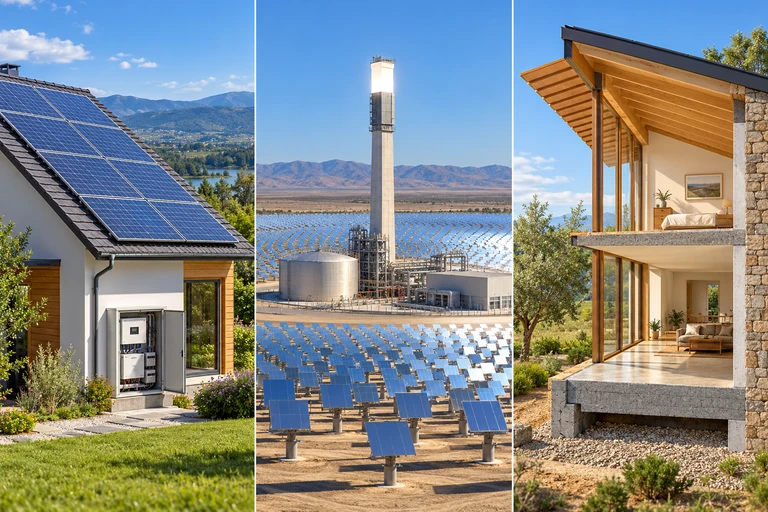
Three distinct scenes show PV with electrical equipment, concentrating mirrors/tower and a passive-solar building with heavy floor. Optical rays, solar angles and exact circuit layout are reserved for models. Separate exact panel: Three vertical mechanisms connect PV to DC and an inverter, CSP heat to a turbine, and passive solar gain to thermal mass and room heat.Photovoltaics convert light to electricity; solar thermal systems transfer heat; passive designs use building geometry and materials. Concentrated solar power can keep its heat-transfer fluid separate from its steam circuit.

PV produces electrical output, CSP uses a heat engine, and passive design manages building heat.
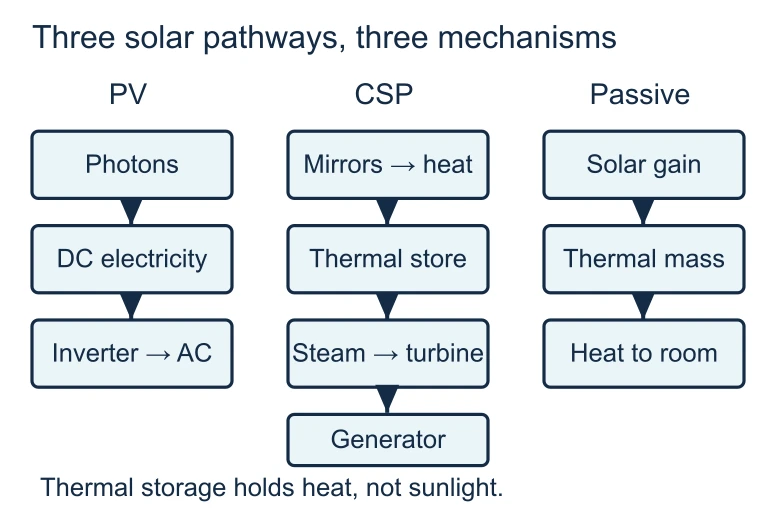
PV produces electrical output, CSP uses a heat engine, and passive design manages building heat.. Photovoltaics convert light to electricity; solar thermal systems transfer heat; passive designs use building geometry and materials. Concentrated solar power can keep its heat-transfer fluid separate from its steam circuit.Photovoltaics convert light to electricity; solar thermal systems transfer heat; passive designs use building geometry and materials. Concentrated solar power can keep its heat-transfer fluid separate from its steam circuit.

Calculating Solar Efficiency

The efficiency of a solar panel is the ratio of useful electrical output to the total solar energy input:

Most commercial silicon PV panels achieve 15 – 22% efficiency. Research multi-junction cells have exceeded 47% in laboratory conditions.

Step-by-Step: Solar Calculations

1
Identify the insolation. What is the average solar radiation at the location? (Often given in \( \text{kWh/m}^2/\text{day} \) or \( \text{W/m}^2 \).)
2
Determine panel area. Calculate total area \( A \) in \( \text{m}^2 \) from panel dimensions or count.
3
Apply the efficiency. Multiply: \( E = I \times A \times \eta \times t \), where \( t \) is time (hours of useful sunlight).
4
Convert units. Express in kWh if needed. Remember: \( 1\;\text{kWh} = 1{,}000\;\text{W} \times 1\;\text{hr} \).

Example 1: Rooftop Array

A homeowner installs 20 panels, each \( 1.6\;\text{m}^2 \), with 18% efficiency. Average insolation is \( 5.0\;\text{kWh/m}^2/\text{day} \). How much energy is produced per day?

1
Total area: \( A = 20 \times 1.6 = 32\;\text{m}^2 \)
2
Total solar input: \( P_{\text{in}} = 5.0 \times 32 = 160\;\text{kWh/day} \)
3
Electrical output: \( E = 160 \times 0.18 = 28.8\;\text{kWh/day} \)

Connect area constraints, rated power and daily energy production.

Use this illustration to explore the concept described in its caption.
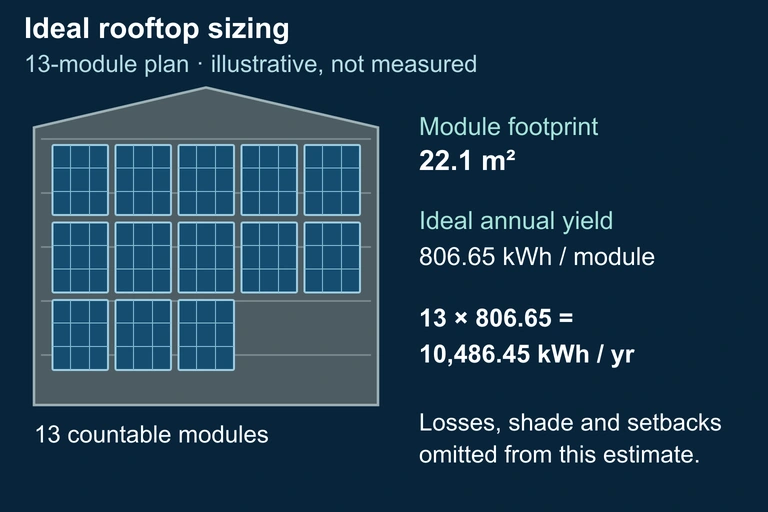
A schematic roof plan has thirteen individually drawn modules. The idealized total footprint is 22.1 square metres and annual production is 10,486.45 kilowatt hours.
The idealized sizing example yields 806.65 kWh per module annually and requires 13 modules to exceed 10,000 kWh. Their 22.1 m² footprint excludes spacing and setbacks, and the estimate omits system losses and shade. It does not guarantee hourly autonomy.

Example 2: Utility-Scale Farm

A solar farm covers 50 hectares (\( 500{,}000\;\text{m}^2 \)) in Arizona. Panels are 20% efficient and average insolation is \( 6.5\;\text{kWh/m}^2/\text{day} \). Estimate annual energy output.

1
Daily input: \( 6.5 \times 500{,}000 = 3{,}250{,}000\;\text{kWh/day} \)
2
Daily output: \( 3{,}250{,}000 \times 0.20 = 650{,}000\;\text{kWh/day} \)
3
Annual output: \( 650{,}000 \times 365 \approx 237\;\text{GWh/year} \)

Example 3: Capacity Factor

A \( 100\;\text{MW} \) solar plant actually generates \( 175{,}200\;\text{MWh} \) per year. What is its capacity factor?

A capacity factor of 20% is typical for solar: the Sun does not shine 24 hours a day, and clouds, seasons, and nighttime reduce output. Compare this to wind (~35%) and nuclear (~90%).

Advantages & Disadvantages

✓ Advantages
Renewable and abundant. Zero direct emissions during operation. Low operating costs. Modular and scalable. Declining panel costs (~90% since 2010).
✕ Disadvantages
Intermittent: no generation at night or under heavy cloud cover. Land-intensive for utility-scale. Manufacturing requires mining (silicon, rare metals). Panel disposal creates e-waste.

Common Mistakes

✕ Confusing Active and Passive
A south-facing window is passive solar. A rooftop PV panel is active solar. Both use the Sun, but only active systems involve mechanical/electrical conversion.
✕ Ignoring Capacity Factor
A \( 100\;\text{MW} \) solar plant does NOT produce \( 100\;\text{MW} \) around the clock. Always multiply by the capacity factor (~0.20) for realistic annual estimates.
✕ Assuming Zero Impact
Solar is clean during operation, but manufacturing, land use, and disposal carry environmental costs. AP exams test your awareness of trade-offs.

Solar Energy Summary

Concept Key Detail
Solar constant \( 1{,}361\;\text{W/m}^2 \) at top of atmosphere
Insolation formula \( I = S\cos\theta \)
Efficiency formula \( \eta = \frac{P_{\text{out}}}{P_{\text{in}}} \times 100\% \)
PV efficiency range 15 – 22% (commercial)
Capacity factor ~20% for solar (varies by location)
Active vs. Passive Mechanical systems vs. building design
Environmental trade-offs Land use, e-waste, mining for materials

Question 1 of 5

The solar constant measures approximately:

Question 2 of 5

A home has 10 panels, each \( 2.0\;\text{m}^2 \), with 20% efficiency. If average insolation is \( 4.0\;\text{kWh/m}^2/\text{day} \), how much energy is produced daily?

Question 3 of 5

Which of the following is an example of passive solar energy use?

Question 4 of 5

A \( 50\;\text{MW} \) solar farm produces \( 96{,}360\;\text{MWh} \) in a year. What is the capacity factor?

Question 5 of 5

Which of the following is a legitimate environmental concern associated with large-scale solar energy development?