Soil Formation
and Erosion
Explore how parent material transforms into soil over time and how natural and human forces break it down through erosion.
What Is Soil?
Soil is a dynamic mixture of minerals, organic matter, water, air, and living organisms. It forms at the interface between the lithosphere, atmosphere, hydrosphere, and biosphere: a thin layer that sustains nearly all terrestrial life.
How Soil Forms: Pedogenesis
Soil forms through pedogenesis: the slow transformation of parent material by physical, chemical, and biological weathering over hundreds to thousands of years. Five key factors control the process.
The Five Soil-Forming Factors
Soil horizons reflect additions,translocation and weathering
 Compare surfaces of different relative ages while holding climate, organisms, relief and parent material similar. Horizon differentiation can change with development, while erosion can remove an A horizon and expose underlying material.
Relative age and surface loss are different influences on soil horizons.
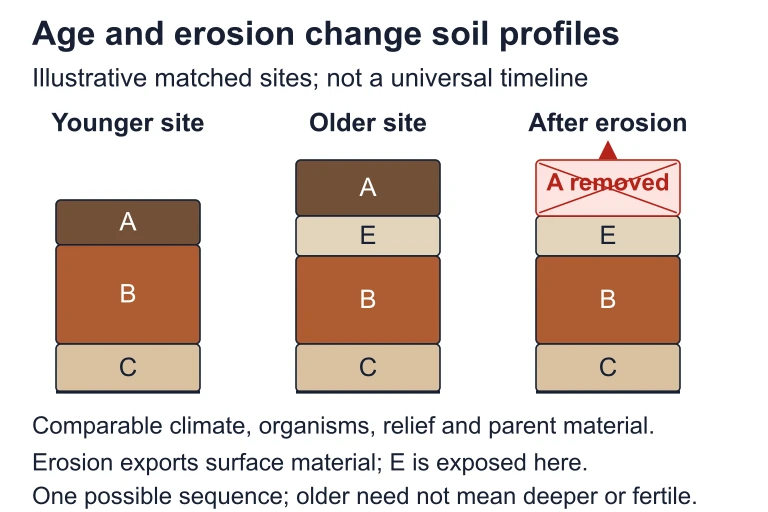 Compare surfaces of different relative ages while holding climate, organisms, relief and parent material similar. Horizon differentiation can change with development, while erosion can remove an A horizon and expose underlying material.
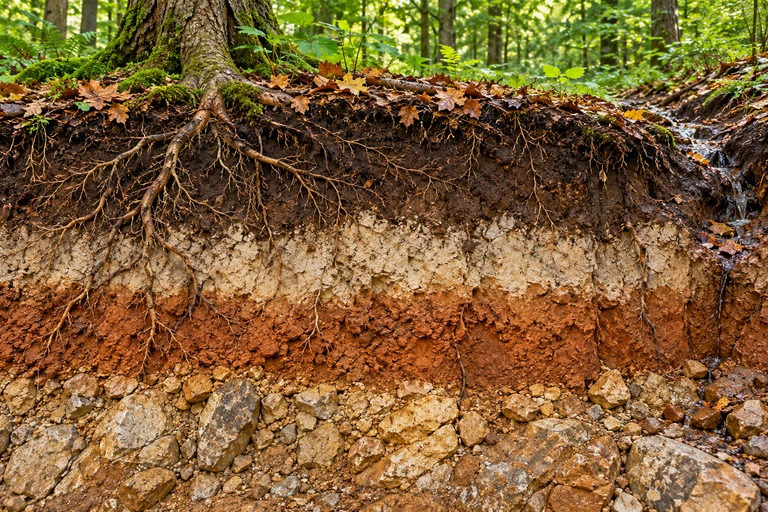
Soil Horizons: The Soil Profile
Soil Texture: Sand, Silt, and Clay
Soil texture describes the relative proportions of sand, silt, and clay particles. It determines water retention, drainage, aeration, and nutrient-holding capacity. The USDA Soil Texture Triangle classifies soils by these proportions.
Weathering: Physical vs. Chemical
| Physical Weathering | Chemical Weathering | |
|---|---|---|
| What happens | Rock breaks into smaller pieces without changing composition | Minerals are chemically altered into new substances |
| Key agents | Frost wedging, root growth, abrasion, thermal expansion | Water, acids, oxidation, hydrolysis, carbonation |
| Climate link | Dominant in cold, dry climates with freeze-thaw cycles | Dominant in warm, wet climates |
| Example | Ice splits granite along cracks | Acid rain dissolves limestone (\(\text{CaCO}_3\)) |
| Soil result | Coarse, sandy, mineral-rich parent material | Fine clay particles, leached minerals |
What Is Erosion?
Erosion is the removal and transport of soil or rock by water, wind, ice, or gravity. While weathering breaks material down in place, erosion moves it. Natural erosion shapes landscapes over geologic time, but human activities can accelerate it by 10 to 100 times the natural rate.
Types of Erosion
Water and wind erode soil through distinct transport modes
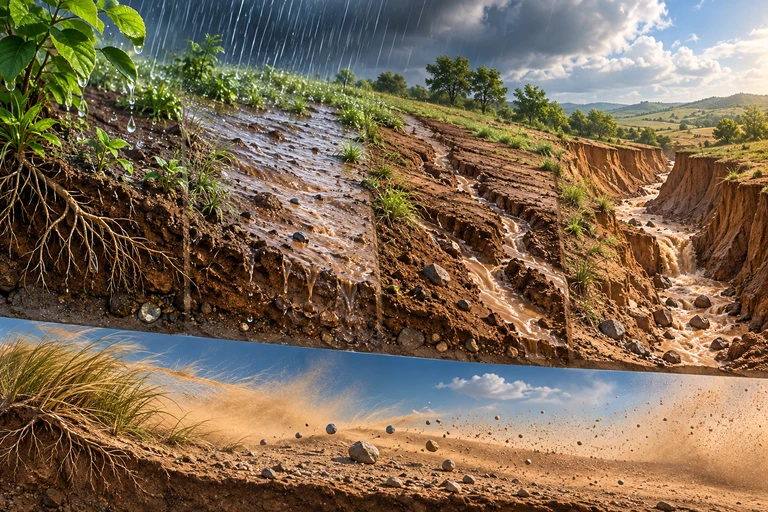 Splash, sheet flow, rills and gullies describe different forms of water erosion. Wind creep, saltation and suspension differ in how particles move.
Different erosion transport modes
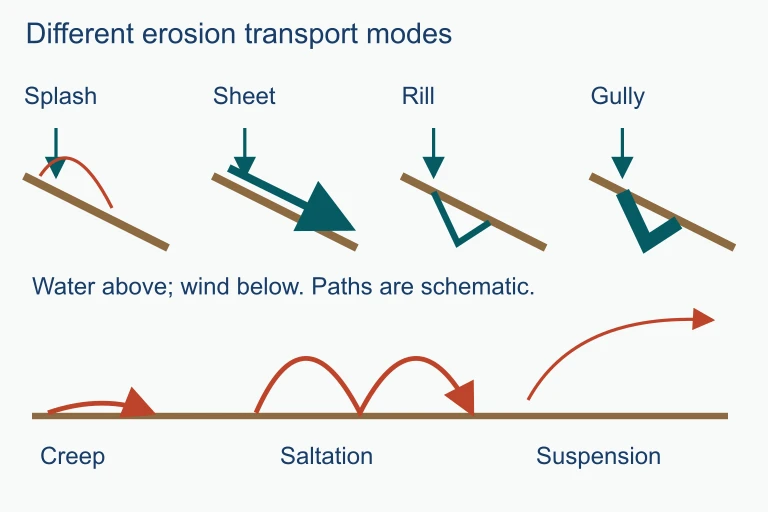 Splash, sheet flow, rills and gullies describe different forms of water erosion. Wind creep, saltation and suspension differ in how particles move.
Formation vs. Erosion: A Balance
| Soil Formation | Soil Erosion | |
|---|---|---|
| Process | Weathering builds soil from rock | Transport removes soil from land |
| Rate | Very slow: ~1 cm per 200-1000 years | Can be rapid: cm per year on bare land |
| Driving forces | Climate, organisms, time | Water, wind, gravity, human activity |
| Result when dominant | Deep, fertile soil profile develops | Thin or absent topsoil; degraded land |
| Human influence | Composting, no-till farming | Deforestation, overgrazing, construction |
Human Activities That Accelerate Erosion
Soil Conservation Strategies
Worked Example: The USLE
A farmer's field has the following USLE factor values. Estimate the annual soil loss \(A\).
Reducing Loss with Conservation
Now the farmer adopts contour plowing (\(P = 0.50\)) and switches to no-till with cover crop (\(C = 0.10\)). Same field, same climate.
Erosion Pathway: Cause to Impact
Common Mistakes
Question 1 of 5
Which soil horizon is characterized by the accumulation of leached minerals (illuviation) such as clay, iron oxides, and aluminum?
Question 2 of 5
A farmer switches from conventional tillage (\(C = 0.40\)) to no-till with cover crops (\(C = 0.10\)) while keeping all other USLE factors the same. By what percentage does soil loss decrease?
Question 3 of 5
Which of the five soil-forming factors (CLOrPT) is most difficult for humans to modify?
Question 4 of 5
Contour plowing reduces erosion by modifying which factor in the Universal Soil Loss Equation?
Question 5 of 5
A soil sample contains 40% sand, 40% silt, and 20% clay. This texture class is closest to which description?