Sewage
Treatment
Explore how wastewater is transformed from a public health hazard into safe effluent through physical, biological, and chemical processes.
What Is Sewage?
Sewage (also called wastewater) is the liquid waste produced by households, industries, and stormwater runoff. It contains organic matter, pathogens, nutrients, and suspended solids that must be removed before discharge into the environment.
Why Does Treatment Matter?
Untreated sewage introduces pathogens (cholera, typhoid), excess nutrients (nitrogen, phosphorus), and oxygen-demanding organic matter into water bodies: causing disease, eutrophication, and aquatic dead zones.
Essential Vocabulary
Three Stages of Treatment
Primary Treatment: Physical Separation
Secondary Treatment: Biological Processes
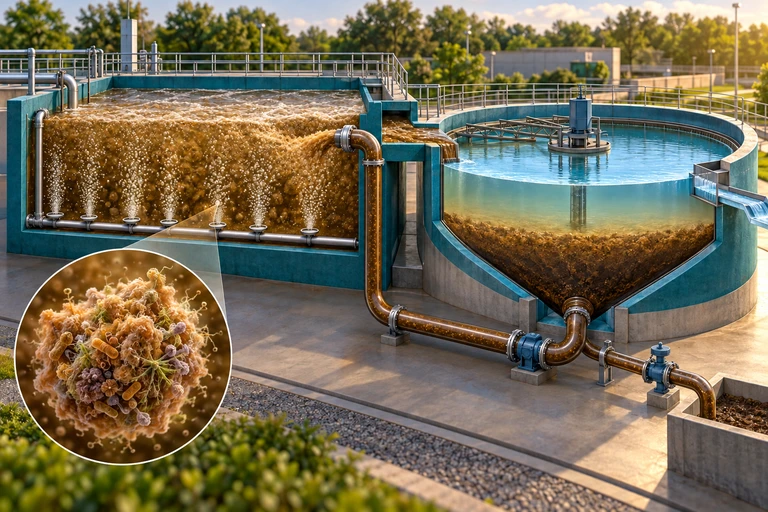
After primary treatment, the water still contains dissolved organic matter. Secondary treatment uses aerobic bacteria to decompose this material, dramatically reducing BOD.
The microbial floc stays while water moves on
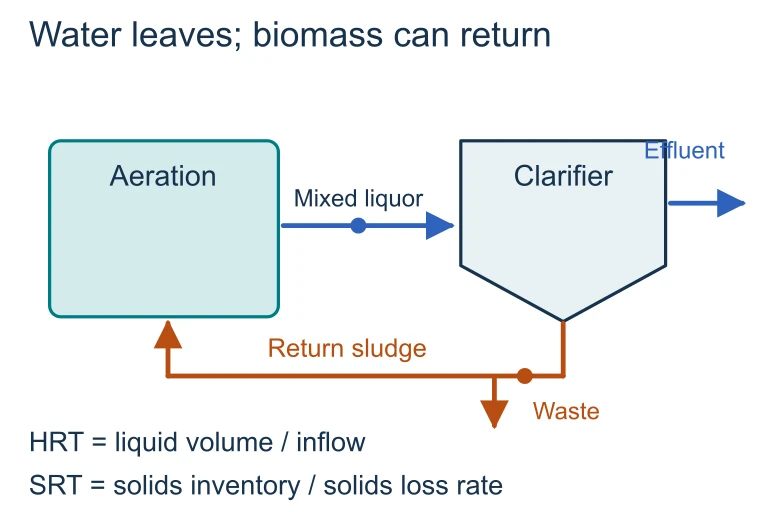
In activated-sludge treatment, settled biomass returns from the clarifier to aeration while effluent and wasted sludge leave. Hydraulic retention time tracks liquid volume and external flow; solids retention time tracks solids inventory and solids losses.Water and solids residence differ
In activated-sludge treatment, settled biomass returns from the clarifier to aeration while effluent and wasted sludge leave. Hydraulic retention time tracks liquid volume and external flow; solids retention time tracks solids inventory and solids losses.Tertiary Treatment: Advanced Polishing
Tertiary treatment targets pollutants that survive primary and secondary stages: nitrogen, phosphorus, remaining pathogens, and trace chemicals.
Explain why pathogen inactivation does not itself remove dissolved nutrient mass.
Use this illustration to explore the concept described in its caption.
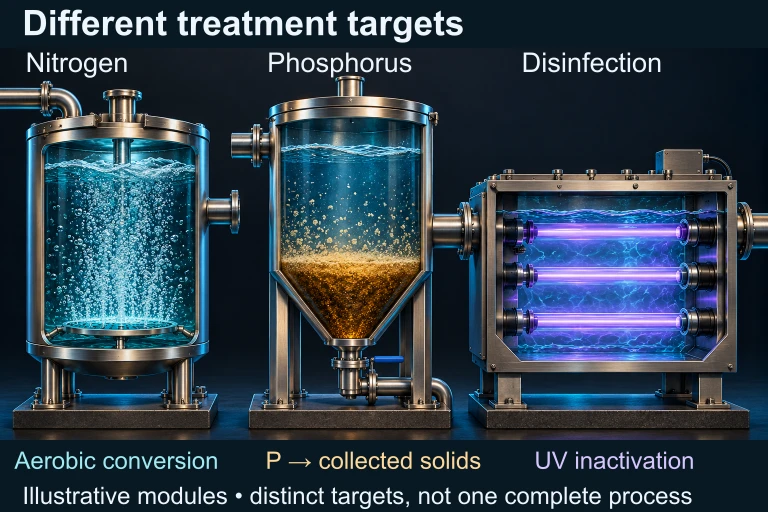
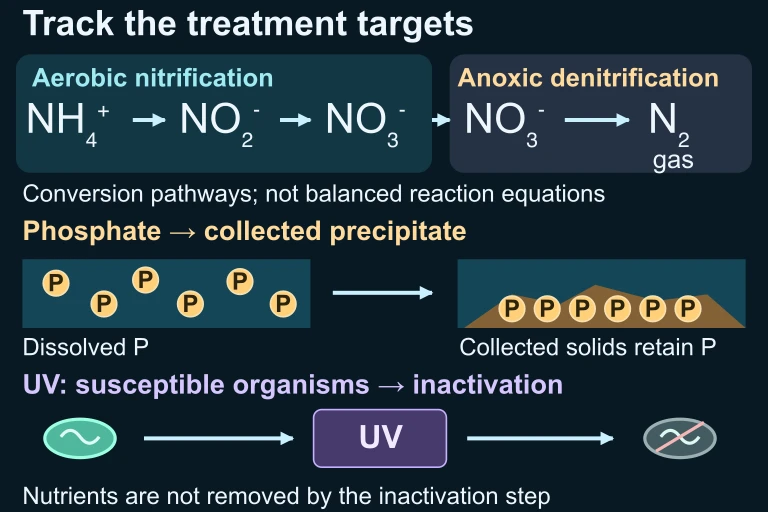
Treatment stages separate contaminants through different physical and biological mechanisms
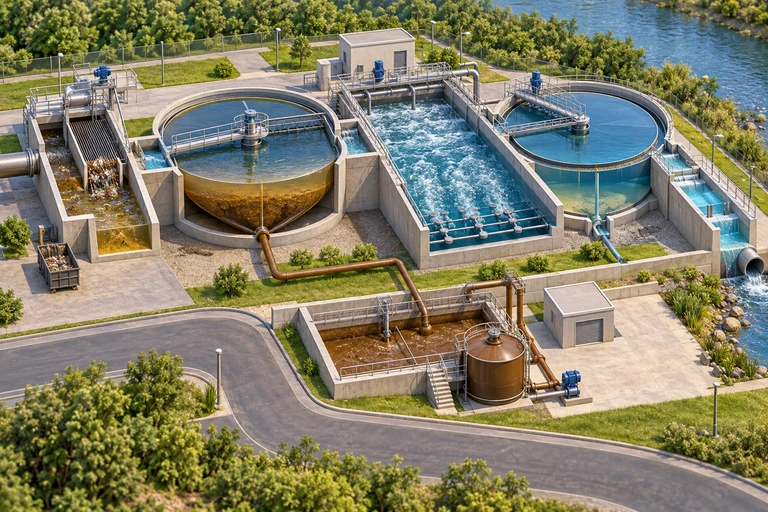
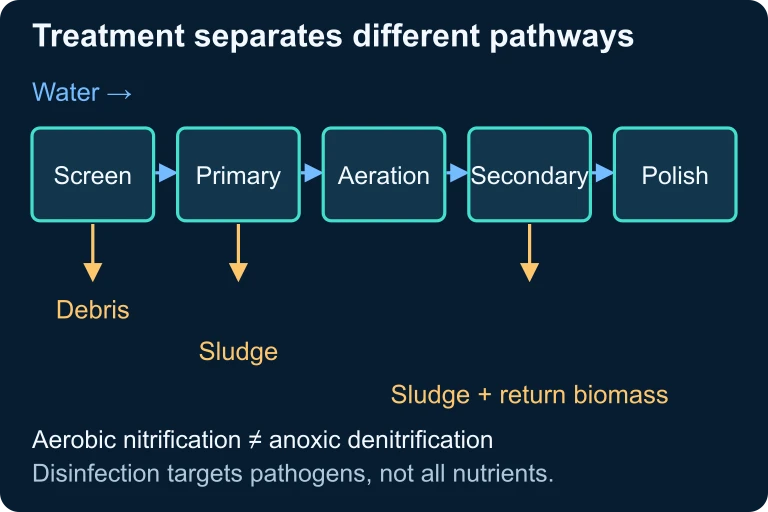
Screens, settling, biological processing and advanced treatment target different contaminants. Organic carbon can become CO₂ or biomass, while residual contaminants remain in effluent.Treatment separates different pathways
Screens, settling, biological processing and advanced treatment target different contaminants. Organic carbon can become CO₂ or biomass, while residual contaminants remain in effluent.Nitrogen removal and disinfection differ
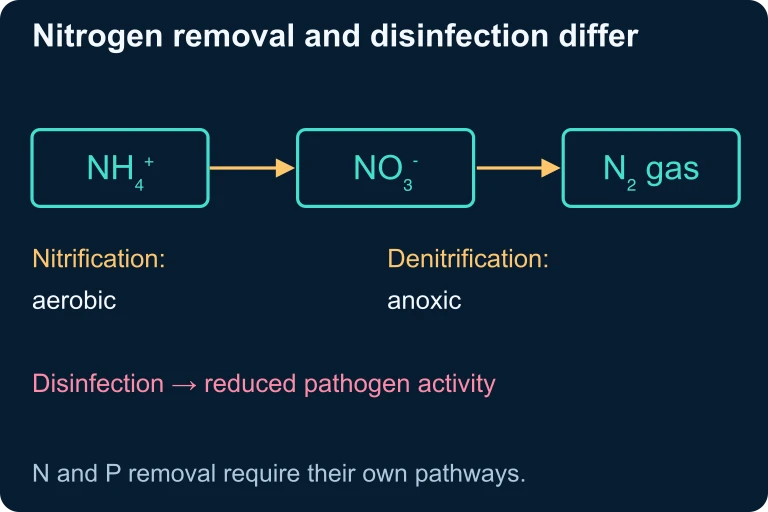
Aerobic nitrification converts ammonium to nitrate; anoxic denitrification can remove nitrogen as N₂. Disinfection instead targets pathogens and does not substitute for nutrient removal.Settling and metabolism have different exits
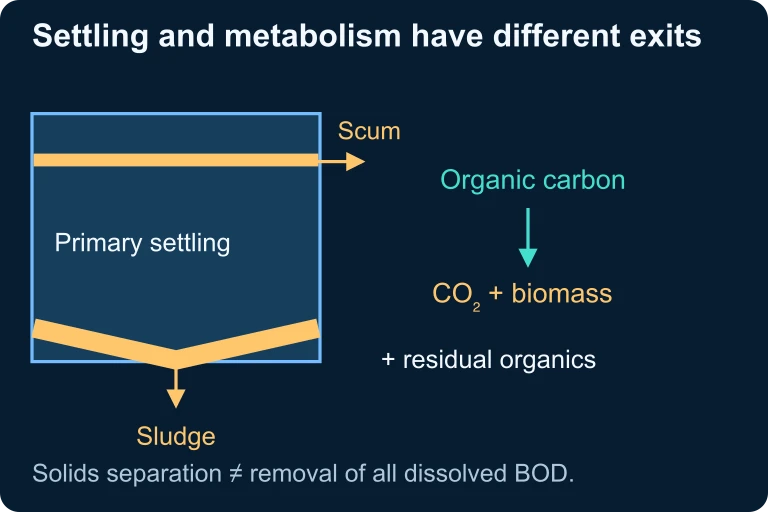
Settling separates scum and sludge. Biological processing divides organic carbon among CO₂, new biomass and residual effluent; solids and carbon follow different exit routes.Comparing the Three Stages
| Primary | Secondary | Tertiary | |
|---|---|---|---|
| Method | Physical | Biological | Chemical / Advanced |
| Targets | Solids, debris | Dissolved organics | Nutrients, pathogens |
| BOD Removal | 25-40% | 85-90% | >95% |
| Key Process | Sedimentation | Activated sludge | Disinfection |
| Required? | Yes (minimum) | Yes (most plants) | Varies by regulation |
BOD and Dissolved Oxygen
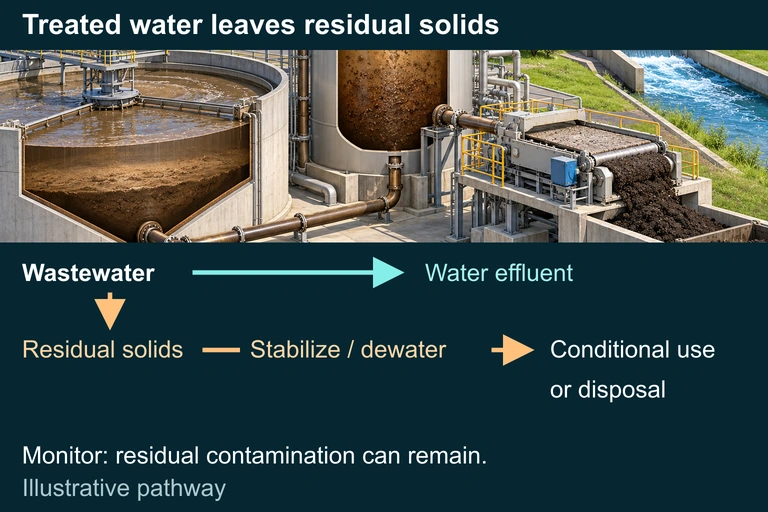
What Happens to the Sludge?
Both primary and secondary treatment produce sludge: a concentrated mixture of solids and microorganisms. This sludge itself must be treated before final disposal.
Trace where removed pollutants and biomass go.
Use this illustration to explore the concept described in its caption.
Full Treatment Process: Step by Step
Example: BOD Removal Calculation
A wastewater plant receives influent with a BOD of 250 mg/L. After primary treatment, the BOD drops to 150 mg/L. After secondary treatment, the BOD is 25 mg/L. What is the percent removal at each stage?
Example: Eutrophication Link
Septic Systems vs. Municipal Plants
Common Mistakes
Summary: Treatment at a Glance
| Process | Type | What It Removes | Key Example |
|---|---|---|---|
| Screening | Physical | Large debris | Bar screens |
| Sedimentation | Physical | Suspended solids | Settling tanks |
| Activated Sludge | Biological | Dissolved organics | Aeration basins |
| Nitrification | Biological | Ammonia/Nitrogen | Nitrifying bacteria |
| Chlorination | Chemical | Pathogens | \( \mathrm{Cl}_2 \) dosing |
| UV Disinfection | Physical | Pathogens | UV lamps |
Question 1 of 5
Which stage of sewage treatment relies on aerobic bacteria to decompose dissolved organic matter?
Question 2 of 5
A plant's influent has a BOD of 300 mg/L and the effluent BOD is 30 mg/L. What is the overall percent BOD removal?
Question 3 of 5
Which of the following is the primary environmental concern when nitrogen and phosphorus are not removed from sewage effluent?
Question 4 of 5
During anaerobic digestion of sewage sludge, what useful byproduct is generated?
Question 5 of 5
A septic system differs from a municipal sewage plant primarily because a septic system: