Renewable &
Nonrenewable Resources
Understand the critical difference between resources that replenish naturally and those with finite supplies, and explore how human consumption rates determine sustainability.
What Are Natural Resources?
A natural resource is any material, energy source, or service provided by the environment that humans use to meet their needs. Resources can be living (biotic) or nonliving (abiotic), and they power everything from agriculture to industry.
Defining Renewable Resources
A renewable resource is a natural resource that can be replenished by natural processes at a rate comparable to or faster than the rate of human consumption. However, "renewable" does not mean "unlimited": overuse can still deplete these resources.
Defining Nonrenewable Resources
A nonrenewable resource exists in fixed quantities on Earth and is consumed far faster than natural processes can replace it. Most formed over millions of years through geological processes.
The Sustainability Condition
The fundamental principle governing resource sustainability can be expressed mathematically. A renewable resource remains sustainable only when:
Replenishment Rate vs. Consumption Rate
Understanding the relationship between how fast a resource regenerates and how fast we use it is central to environmental science. The replenishment rate depends on natural cycles, while consumption rate depends on human behavior and population.
Renewable vs. Nonrenewable: Key Differences
| Feature | Renewable | Nonrenewable |
|---|---|---|
| Replenishment | Days to decades | Millions of years |
| Supply | Potentially infinite | Fixed and finite |
| Examples | Solar, wind, timber | Coal, oil, uranium |
| Pollution | Generally low | Often high (\( \text{CO}_2 \), waste) |
| Depletion risk | Only if overused | Inevitable with use |
| Cost trend | Decreasing over time | Increasing as supplies shrink |
Energy Flow from Resources
Most energy on Earth traces back to the Sun. Renewable sources tap into current solar flux, while fossil fuels represent ancient solar energy stored in organic matter.
How to Classify a Resource
Use this step-by-step approach to determine whether a resource is renewable, nonrenewable, or conditionally renewable (renewable only under proper management).
Example 1: Solar Energy
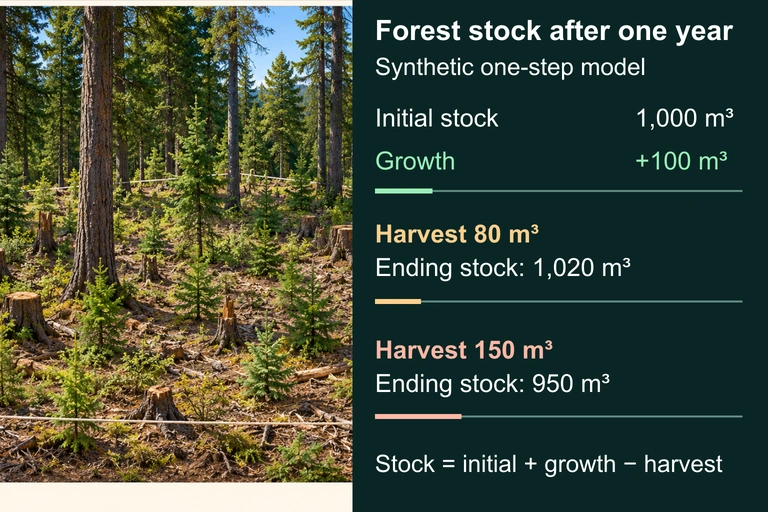
Example 2: Timber as Conditionally Renewable
Timber is renewable only if harvesting does not exceed regrowth. This depends on management practices: replanting, selective logging, and rotation cycles.
Judge renewable use by replenishment rate rather than the resource label.
Use this illustration to explore the concept described in its caption.
Example 3: Petroleum Depletion
Petroleum exemplifies a nonrenewable resource. We can model the depletion of a finite stock \( S \) being consumed at rate \( C \) per year:
Hubbert's Peak Curve
M. King Hubbert predicted that production of any finite resource follows a bell-shaped curve: production rises, peaks, then irreversibly declines as extraction becomes uneconomical.
Major Renewable Energy Sources
Environmental Impacts of Each Type
No energy source is impact-free. Understanding trade-offs is essential for the AP exam. Even renewable sources carry environmental costs.
Common Mistakes
Summary Comparison Table
| Resource | Type | Replenishment | Key Trade-off |
|---|---|---|---|
| Solar | Renewable | Continuous | Intermittent, land use |
| Wind | Renewable | Continuous | Bird mortality, noise |
| Timber | Conditional | 25-80 years | Deforestation if mismanaged |
| Fish stocks | Conditional | 1-10 years | Overfishing, bycatch |
| Coal | Nonrenewable | ~300M years | \( \text{CO}_2 \), mining damage |
| Petroleum | Nonrenewable | ~100M years | \( \text{CO}_2 \), spills, finite supply |
| Uranium | Nonrenewable | N/A | Radioactive waste |
Question 1 of 5
Which of the following is the best example of a conditionally renewable resource?
Question 2 of 5
A fishery has a stock replenishment rate of 50,000 tonnes/year. If the annual harvest is 65,000 tonnes, what will happen to the fish population over time?
Question 3 of 5
Nuclear energy is often described as "clean" because it produces minimal greenhouse gas emissions during operation. Why is it still classified as nonrenewable?
Question 4 of 5
Hubbert's Peak model predicts that the production of a nonrenewable resource will:
Question 5 of 5
A country has proven oil reserves of \( 5.0 \times 10^{10} \) barrels and consumes \( 2.5 \times 10^{9} \) barrels per year. Using a simple static model, approximately how many years of oil remain?