Reduction of
Air Pollutants
Explore the legislation, technologies, and strategies that reduce harmful emissions and improve air quality around the world.
What Are Air Pollutants?
Air pollutants are substances released into the atmosphere that harm human health, damage ecosystems, or degrade air quality. They can be primary (emitted directly) or secondary (formed by chemical reactions in the atmosphere).
The Six Criteria Pollutants
The Clean Air Act directs the EPA to set National Ambient Air Quality Standards (NAAQS) for six pollutants that pose the greatest risk to public health:
Why Reduction Matters
The Clean Air Act
The Clean Air Act (CAA) is the primary federal law governing air pollution in the United States. It authorizes the EPA to regulate emissions from both stationary sources (factories, power plants) and mobile sources (vehicles).
Key Regulatory Tools
Point vs. Non-Point Sources
| Point Sources | Non-Point Sources | |
|---|---|---|
| Definition | Single identifiable source | Many diffuse, dispersed sources |
| Examples | Smokestacks, exhaust pipes | Agriculture, construction sites |
| Monitoring | Easier to measure and regulate | Difficult to measure directly |
| Reduction Strategy | Scrubbers, filters, permits | Best practices, land-use planning |
Technologies for Reducing Emissions
How Scrubbers & Catalytic Converters Work
$$\text{CaCO}_3 + \text{SO}_2 \rightarrow \text{CaSO}_3 + \text{CO}_2$$
Removes up to 95% of \(\text{SO}_2\).
$$2\text{CO} + \text{O}_2 \rightarrow 2\text{CO}_2$$
$$2\text{NO} \rightarrow \text{N}_2 + \text{O}_2$$
Standard on all cars since 1975.
Control devices remove different pollutants through distinct mechanisms
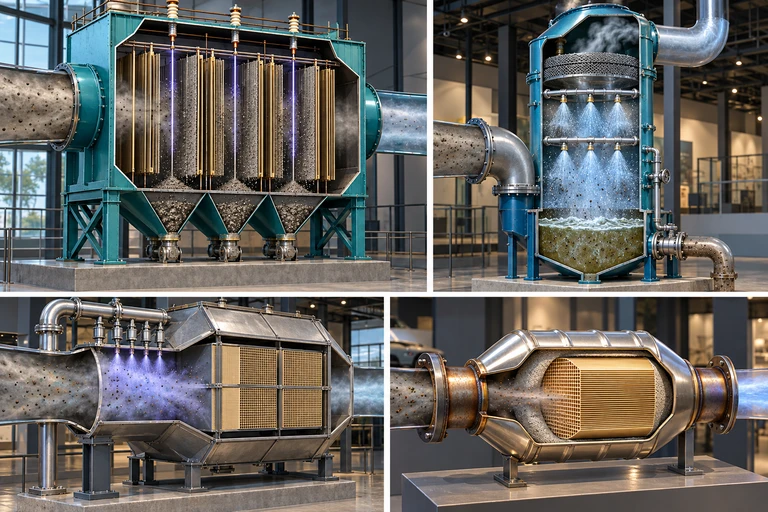 Electrostatic collection transfers particles to collected ash. Alkaline scrubbing transfers sulfur species into a managed liquid or solid waste stream. Different pollutants require different removal mechanisms.
Control devices remove different pollutants through distinct mechanisms
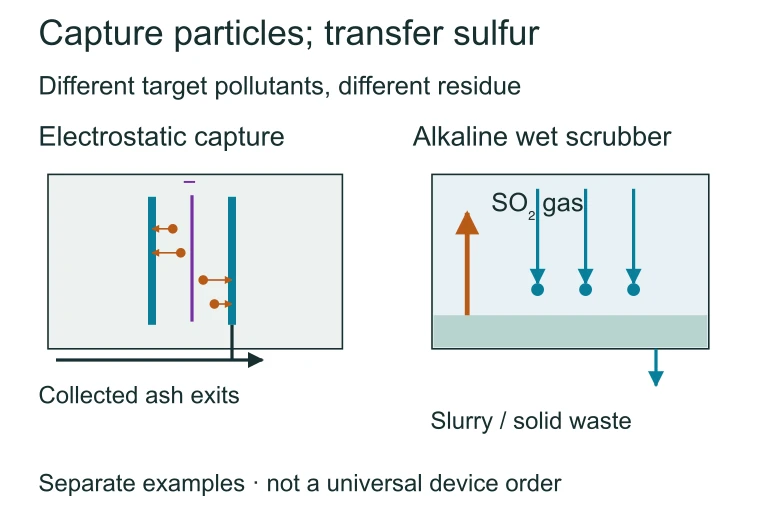 Electrostatic collection transfers particles to collected ash. Alkaline scrubbing transfers sulfur species into a managed liquid or solid waste stream. Different pollutants require different removal mechanisms.
Catalytic NOx reduction
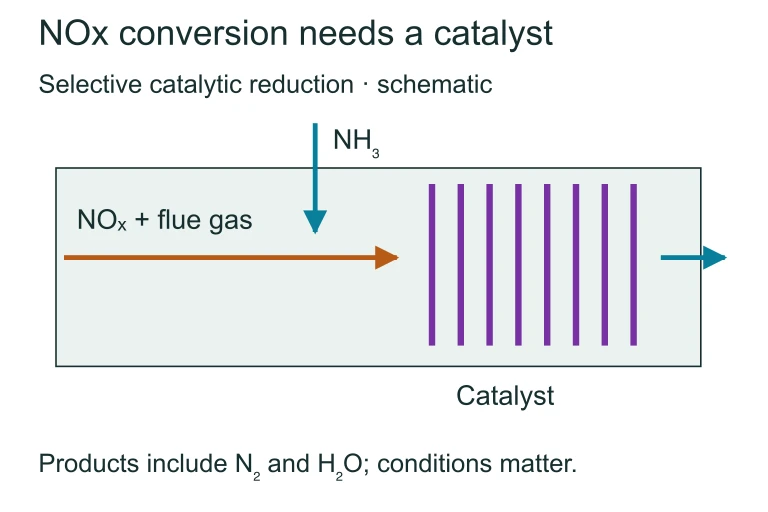 Selective catalytic reduction brings nitrogen oxides into contact with a reducing agent and catalyst. Appropriate operating conditions promote conversion to nitrogen and water.
Vehicle catalyst honeycomb
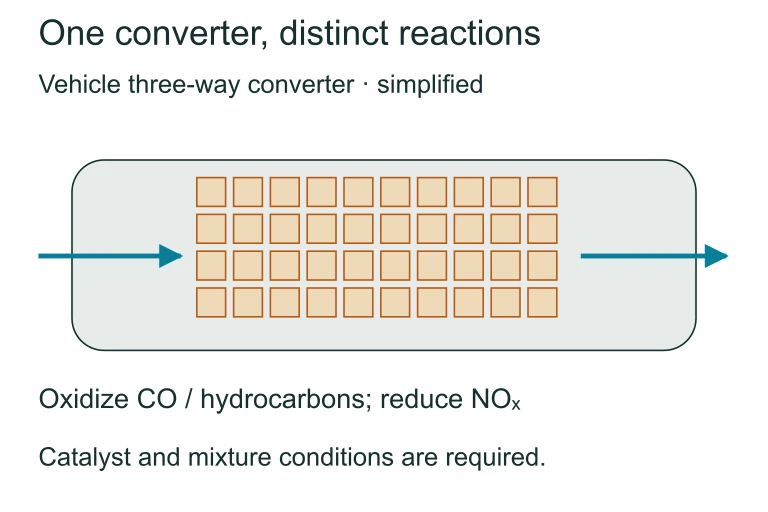 A vehicle catalytic converter promotes oxidation of carbon monoxide and hydrocarbons and reduction of nitrogen oxides. These reactions target different pollutants through different catalytic pathways.
Cap-and-Trade in Action
How to Approach Reduction Questions
Example 1: Choosing a Technology
Example 2: Cap-and-Trade Math
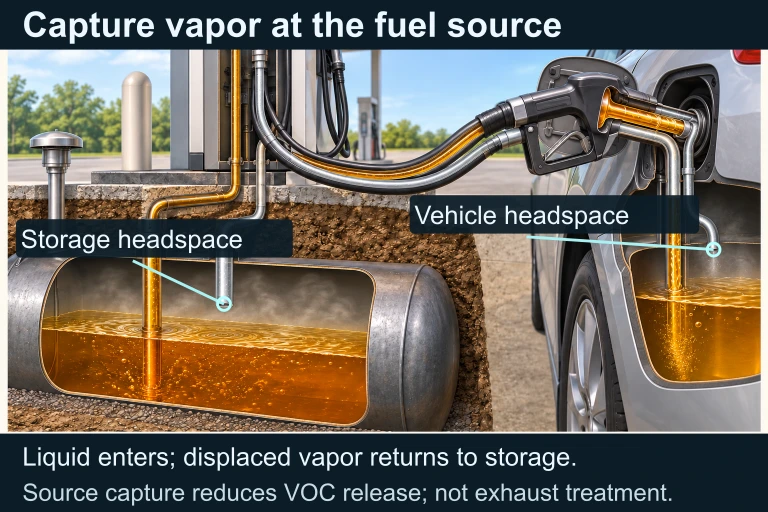
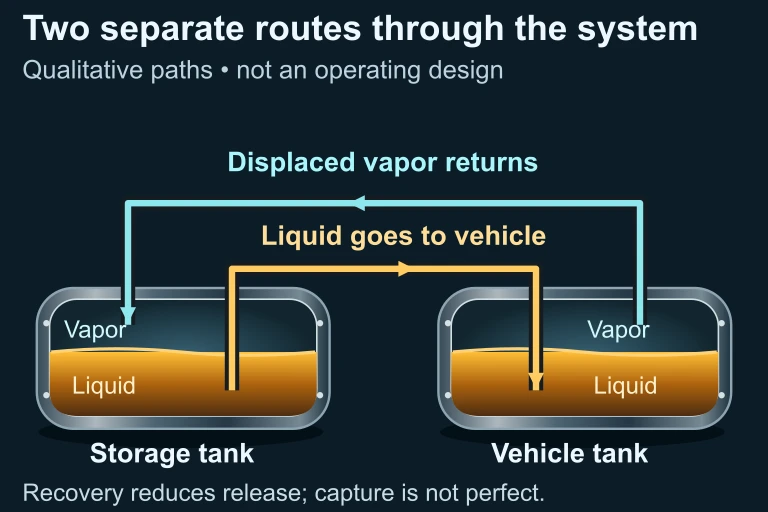
Example 3: Reducing \(\text{VOCs}\) & Ozone
Ground-level ozone formation:
Explain source capture of VOCs and distinguish it from exhaust treatment.
Use this illustration to explore the concept described in its caption.
Common Mistakes
Summary: Pollutants & Solutions
| Pollutant | Source | Reduction Method | Policy Tool |
|---|---|---|---|
| \(\text{SO}_2\) | Coal power plants | Wet scrubber (FGD) | Cap-and-trade |
| \(\text{NO}_x\) | Vehicles, power plants | SCR, catalytic converter | Emission standards |
| \(\text{CO}\) | Vehicle exhaust | Catalytic converter | Vehicle inspections |
| \(\text{PM}\) | Combustion, dust | Electrostatic precipitator | NAAQS limits |
| \(\text{O}_3\) | Secondary (\(\text{VOCs} + \text{NO}_x\)) | Reduce precursors | Ozone action days |
| \(\text{Pb}\) | Smelters, aviation fuel | Fuel reformulation | Phase-out bans |
Question 1 of 5
Which technology is most effective at removing \(\text{SO}_2\) from coal plant emissions?
Question 2 of 5
Ground-level ozone is classified as a secondary pollutant because it:
Question 3 of 5
In a cap-and-trade system, Plant X has 200 permits and emits 150 tons. Plant Y has 200 permits and emits 250 tons. If permits cost $500 each, how much does Plant Y pay Plant X?
Question 4 of 5
The 1990 Clean Air Act Amendment is most significant for introducing which of the following?
Question 5 of 5
A city's air monitoring shows elevated \(\text{PM}_{2.5}\) levels near a construction zone and a coal plant. Which combination of strategies would most effectively address both sources?