Reducing
Ozone Depletion
Explore the science behind the ozone layer, the chemicals that destroy it, and the international policies that have helped it recover.
What Is the Ozone Layer?
The ozone layer is a region of the stratosphere (roughly 15 to 35 km altitude) where \(\text{O}_3\) molecules are concentrated. These molecules absorb most of the Sun's harmful ultraviolet-B (UV-B) radiation, protecting life on Earth.
The Ozone-Oxygen Cycle
Why Ozone Depletion Matters
CFCs and the Chain Reaction
Chlorofluorocarbons (CFCs) are synthetic chemicals once widely used in refrigerants, aerosol sprays, and foam insulation. In the stratosphere, UV radiation breaks them apart, releasing free chlorine atoms that catalytically destroy ozone.
The Antarctic Ozone Hole
In 1985, scientists discovered a dramatic thinning of the ozone layer over Antarctica each spring. Polar stratospheric clouds (PSCs) form during the extremely cold Antarctic winter, providing surfaces on which chlorine reservoir species convert into reactive chlorine. When sunlight returns in spring, this chlorine rapidly destroys ozone.
ODS vs. Greenhouse Gases
| ODS (e.g., CFCs) | GHGs (e.g., \(\text{CO}_2\)) | |
|---|---|---|
| Primary effect | Destroy stratospheric \(\text{O}_3\) | Trap heat in troposphere |
| Layer affected | Stratosphere | Troposphere |
| UV connection | Increases UV-B at surface | No direct UV effect |
| Key treaty | Montreal Protocol | Paris Agreement |
| Recovery status | Recovering | Still rising |
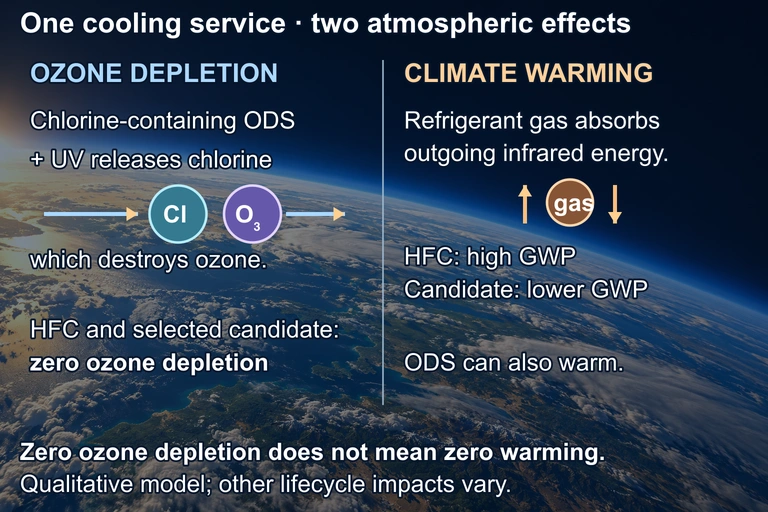
Compare ozone-depletion potential with global-warming potential as separate metrics.
Use this illustration to explore the concept described in its caption.
The Montreal Protocol
Signed in 1987, the Montreal Protocol is widely considered the most successful international environmental treaty. It required nations to phase out the production and consumption of ozone-depleting substances (ODS), including CFCs, halons, carbon tetrachloride, and methyl chloroform.
The Kigali Amendment (2016)
HFCs were introduced as CFC replacements because they do not deplete ozone. However, HFCs are extremely potent greenhouse gases (up to 14,800 times the warming potential of \(\text{CO}_2\)). The Kigali Amendment added HFCs to the Montreal Protocol phasedown schedule.
Measuring Ozone: Dobson Units
Ozone concentration is measured in Dobson Units (DU). One DU equals a layer of pure ozone 0.01 mm thick at standard temperature and pressure. Normal stratospheric ozone is about 300 DU. The "ozone hole" is defined as the area where total column ozone falls below 220 DU.
Recovery Timeline
How to Evaluate ODS Policies
Example: CFC-12 Phase-Out
Scenario: CFC-12 (dichlorodifluoromethane) was the primary refrigerant in automobile air conditioning. It has an ODP of 1.0 and a GWP of 10,900. Evaluate the environmental benefit of replacing it.
An old cooling unit is a chemical reservoir
 Recovery contains refrigerant, reclamation prepares eligible material for reuse, and destruction changes the chemical. Installed legacy refrigerant banks can persist after new manufacture declines.
Refrigerant recovery transfers material; destruction is a separate process.
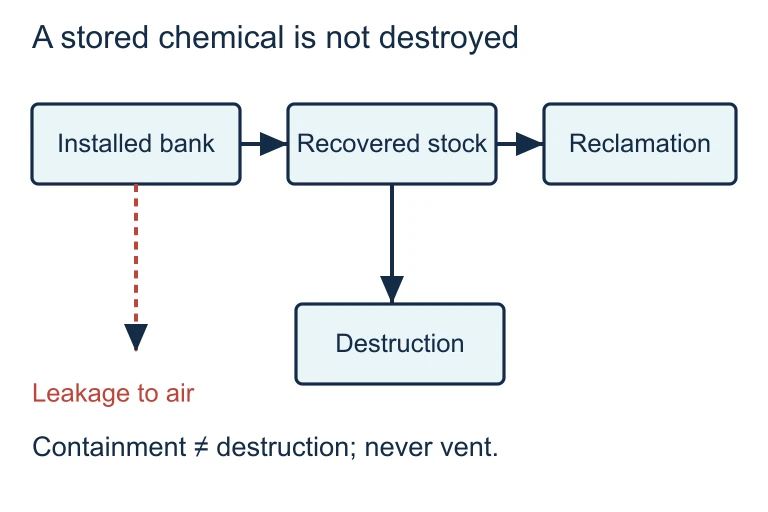 Recovery contains refrigerant, reclamation prepares eligible material for reuse, and destruction changes the chemical. Installed legacy refrigerant banks can persist after new manufacture declines.
Example: Comparing ODP Values
Problem: A factory uses 500 kg/yr of Halon-1301 (ODP = 10.0) for fire suppression. If it switches to HFC-227ea (ODP = 0), what is the equivalent CFC-11 reduction?
Example: Multi-Factor Analysis
Scenario: A country must choose between two CFC replacements for its refrigeration sector. Evaluate both options.
| HCFC-22 | R-290 (Propane) | |
|---|---|---|
| ODP | 0.055 | 0 |
| GWP (100-yr) | 1,810 | 3 |
| Atmospheric lifetime | 12 years | 12 days |
| Safety concern | Low toxicity | Flammable |
| Montreal status | Phase-out by 2030 | Not restricted |
Common Mistakes
Question 1 of 5
Which atmospheric layer contains the highest concentration of ozone that shields Earth from UV-B radiation?
Question 2 of 5
A single chlorine atom released from a CFC molecule can destroy approximately how many ozone molecules before being deactivated?
Question 3 of 5
The Kigali Amendment to the Montreal Protocol primarily targets which group of chemicals?
Question 4 of 5
A factory uses 200 kg/yr of a substance with an ODP of 0.5. What is the CFC-11 equivalent emission?
Question 5 of 5
Why does the ozone hole form specifically over Antarctica rather than uniformly around the globe?