Primary
Productivity
Understand how ecosystems capture and convert solar energy into organic matter: the foundation of every food web on Earth.
What Is Primary Productivity?
Primary productivity is the rate at which autotrophs (mainly plants, algae, and cyanobacteria) convert inorganic carbon into organic compounds through photosynthesis or chemosynthesis. It is the entry point for virtually all energy in an ecosystem.
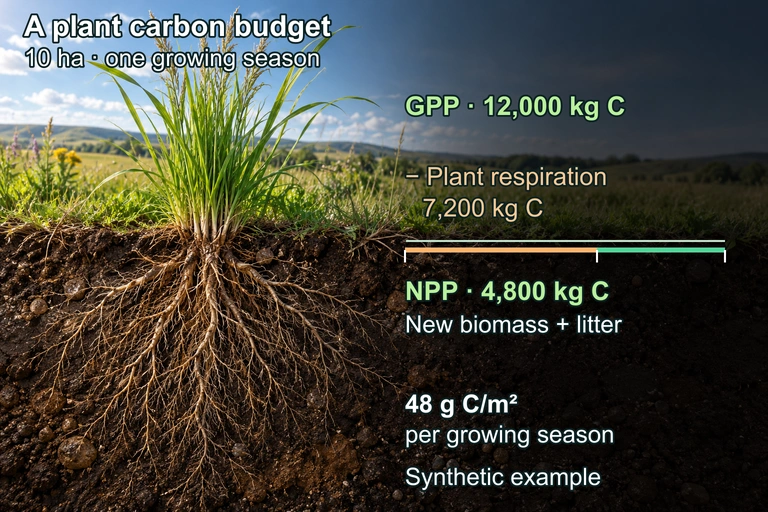
GPP, NPP, and Respiration
Distinguish GPP, NPP and NEP system boundaries.
Use this illustration to explore the concept described in its caption.
Why NPP Matters
Net primary productivity determines how much energy is available for consumers (herbivores, carnivores, decomposers). Higher NPP means more biomass to support larger, more diverse food webs.
The Core Equation
Energy Flow: Sun to Biomass
GPP vs NPP: Key Distinction
| GPP | NPP | |
|---|---|---|
| Definition | Total carbon fixed by photosynthesis | Carbon stored as new biomass |
| Includes respiration? | Yes | No (subtracted out) |
| Measurable directly? | Difficult (must estimate R) | Easier (harvest method, remote sensing) |
| Ecological meaning | Total energy captured | Energy available to consumers |
| Analogy | Gross salary | Take-home pay |
Factors That Control NPP
Four bottles test which nutrient is limiting
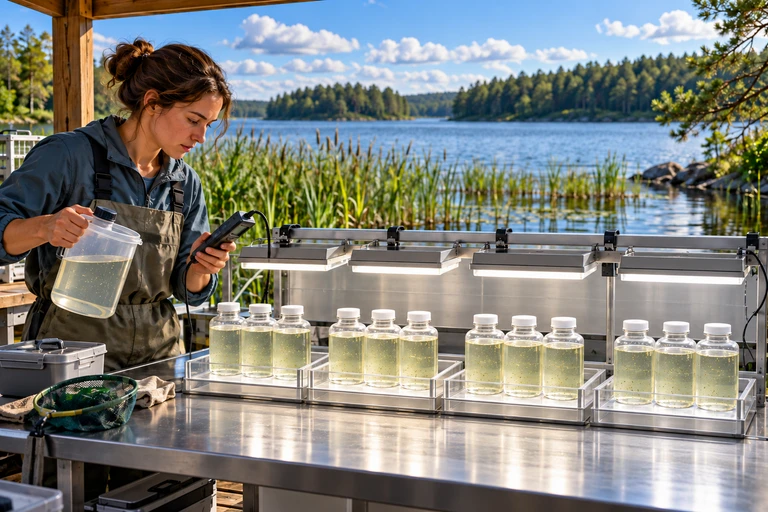 Compare a control, added nitrogen, added phosphorus, and both nutrients, with three independent vessels per treatment. Keep starting conditions, light, handling and measurement time consistent; infer nutrient limitation from measured responses.
Nutrient limitation is a comparison
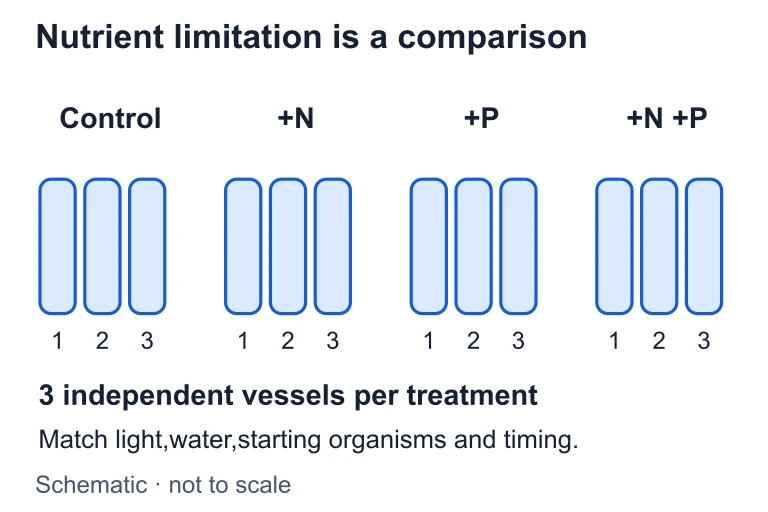 Compare a control, added nitrogen, added phosphorus, and both nutrients, with three independent vessels per treatment. Keep starting conditions, light, handling and measurement time consistent; infer nutrient limitation from measured responses.
A field design for nutrient limitation
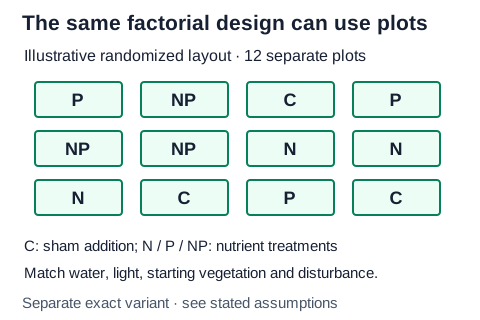 Randomly assign sham, nitrogen, phosphorus, or combined nitrogen-plus-phosphorus additions to three independent contained plots each. Match water, light, starting vegetation, disturbance and additions unrelated to nutrients; compare dry-biomass change per area over the same interval.Open full diagram
NPP Across Biomes
Aquatic vs Terrestrial NPP
How to Calculate NPP
Example 1: Forest Ecosystem
A temperate forest has a GPP of \( 2{,}500 \; \text{g C/m}^2\text{/yr} \). Autotroph respiration accounts for \( 1{,}300 \; \text{g C/m}^2\text{/yr} \). What is the NPP?
Example 2: Efficiency Calculation
An ecosystem receives \( 1{,}000{,}000 \; \text{kcal/m}^2\text{/yr} \) of solar energy. Its GPP is \( 20{,}000 \; \text{kcal/m}^2\text{/yr} \) and NPP is \( 8{,}000 \; \text{kcal/m}^2\text{/yr} \). Find the photosynthetic efficiency and the fraction of GPP lost to respiration.
Example 3: Comparing Two Ecosystems
| Coral Reef | Open Ocean | |
|---|---|---|
| GPP (\( \text{g C/m}^2\text{/yr} \)) | 2,500 | 250 |
| R (\( \text{g C/m}^2\text{/yr} \)) | 1,000 | 125 |
| NPP (\( \text{g C/m}^2\text{/yr} \)) | 1,500 | 125 |
| R as % of GPP | 40% | 50% |
Common Mistakes
Summary of Key Concepts
| Concept | Key Idea |
|---|---|
| GPP | Total photosynthesis by all autotrophs |
| NPP | \( \text{GPP} - R \): energy available to consumers |
| R (autotroph) | Energy used by producers for metabolism |
| Limiting factors | Light, water, temperature, nutrients (N, P) |
| Highest NPP biome | Tropical rainforest, estuaries, coral reefs |
| Lowest NPP biome | Open ocean (per \( \text{m}^2 \)), deserts, tundra |
| Photosynthetic efficiency | ~1-2% of incoming solar radiation |
Question 1 of 5
An ecosystem has a GPP of \( 5{,}000 \; \text{kcal/m}^2\text{/yr} \) and autotroph respiration of \( 3{,}000 \; \text{kcal/m}^2\text{/yr} \). What is the NPP?
Question 2 of 5
Which factor is most likely to limit primary productivity in the open ocean?
Question 3 of 5
If a forest's GPP is \( 3{,}000 \; \text{g C/m}^2\text{/yr} \) and its NPP is \( 1{,}200 \; \text{g C/m}^2\text{/yr} \), what percentage of GPP is lost to autotroph respiration?
Question 4 of 5
Which biome typically has the highest NPP per unit area?
Question 5 of 5
A student claims: "Since the ocean covers 71% of Earth, it must produce 71% of global NPP." Which statement best explains why this claim is incorrect?