Pollution and
Human Health
How air, water, and soil pollutants enter the human body, cause disease, and create environmental justice challenges.
What Is Pollution?
Pollution is the introduction of harmful substances or energy into the environment at rates that exceed the environment's capacity to disperse, dilute, decompose, recycle, or store them in a harmless form.
Major Categories of Pollutants
Exposure Pathways
Explain exposure differences through location, activity and susceptibility.
Use this illustration to explore the concept described in its caption.
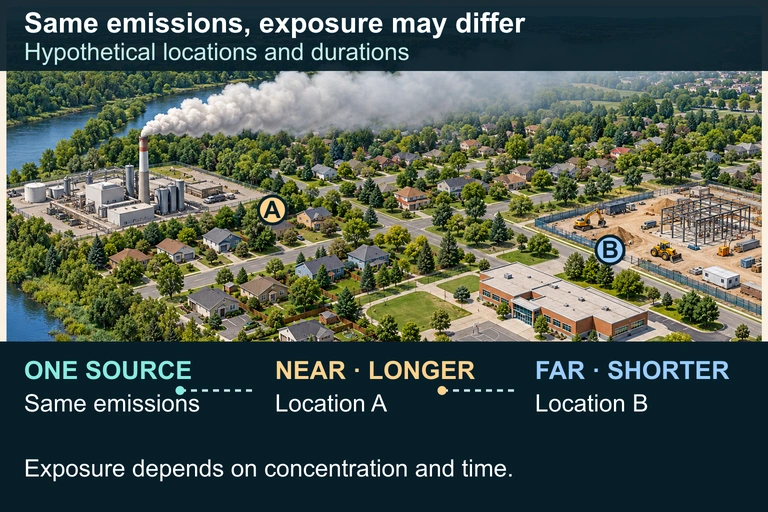
Transport pathways determine where pollutants reach receptors
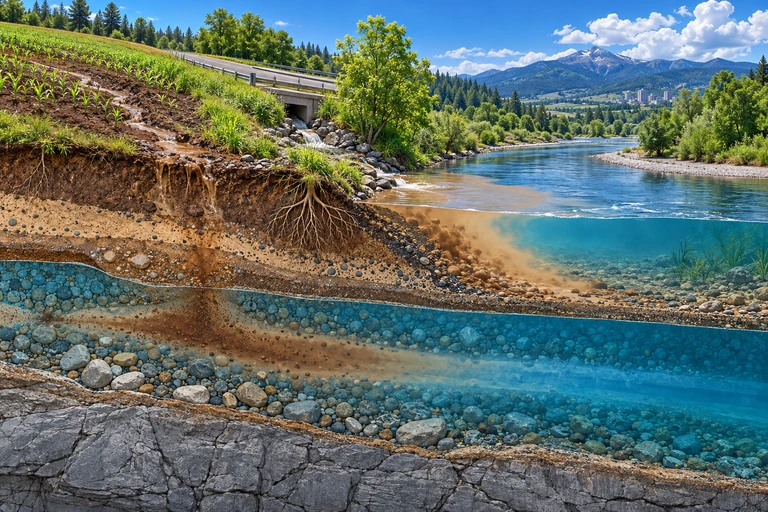 Dissolved pollutants can move with groundwater, while adsorbed pollutants may travel with sediment. Chemical form affects transport and exposure; intake, absorbed dose and tissue concentration are different quantities.
Dissolved and sediment-bound differ
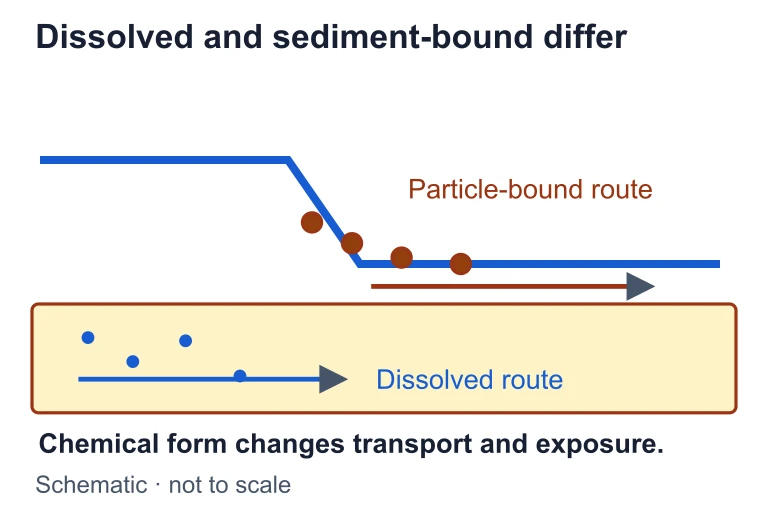 Dissolved pollutants can move with groundwater, while adsorbed pollutants may travel with sediment. Chemical form affects transport and exposure; intake, absorbed dose and tissue concentration are different quantities.
The Dose-Response Relationship
Toxicology's central principle: "The dose makes the poison." The severity of a health effect depends on the amount of substance an organism is exposed to over a given time.
Bioaccumulation vs. Biomagnification
Acute vs. Chronic Effects
| Acute Exposure | Chronic Exposure | |
|---|---|---|
| Duration | Single or short-term event (hours to days) | Repeated low-level exposure over months or years |
| Onset | Symptoms appear quickly | Symptoms develop gradually |
| Example | Chemical spill causing respiratory distress | Lead in drinking water causing neurological damage |
| Measurement | \(\text{LD}_{50}\) | Chronic daily intake (CDI) |
Pollutants and Health Effects
| Pollutant | Primary Source | Health Effect |
|---|---|---|
| Lead (Pb) | Old pipes, paint | Neurological damage, reduced IQ in children |
| Mercury (Hg) | Coal plants, fish | Minamata disease, CNS damage |
| Asbestos | Building insulation | Mesothelioma (lung cancer) |
| \(\text{PM}_{2.5}\) | Combustion, vehicles | Cardiovascular and respiratory disease |
| Ground-level \(O_3\) | NOx + VOCs + sunlight | Asthma exacerbation, lung inflammation |
How to Analyze a Pollution Problem
Example: Lead in Flint, Michigan
In 2014, Flint switched its water source to the Flint River. The more corrosive water leached lead (Pb) from aging pipes. Blood lead levels in children doubled.
Example: DDT and Biomagnification
DDT was widely used as a pesticide until Rachel Carson's Silent Spring (1962) documented its devastating ecological effects. DDT bioaccumulates in fatty tissue and biomagnifies up the food chain.
Example: Interpreting \(\text{LD}_{50}\) Data
Given the following \(\text{LD}_{50}\) values (mg/kg, oral, rat), rank these substances from most toxic to least toxic.
| Substance | \(\text{LD}_{50}\) (mg/kg) |
|---|---|
| Caffeine | 192 |
| Table salt (NaCl) | 3,000 |
| Nicotine | 50 |
| Botulinum toxin | 0.001 |
Environmental Justice
Environmental justice is the fair treatment and meaningful involvement of all people regardless of race, income, or nationality with respect to environmental laws and policies. Pollution disproportionately affects marginalized communities.
Key Legislation
Common Mistakes
Summary Table
| Concept | Definition | AP Exam Tip |
|---|---|---|
| Point Source | Single identifiable origin | Give a specific example (factory, pipe) |
| Nonpoint Source | Diffuse, widespread origin | Agricultural runoff is the classic example |
| Bioaccumulation | Toxin builds in one organism | Within: fat-soluble compounds persist |
| Biomagnification | Concentration rises per trophic level | Across: DDT, mercury in food chains |
| \(\text{LD}_{50}\) | Dose lethal to 50% of test organisms | Lower = more toxic |
| Threshold Dose | Below this, no observable effect | Some substances have no safe threshold (e.g., lead) |
Question 1 of 5
Which of the following best describes biomagnification?
Question 2 of 5
Substance X has an \(\text{LD}_{50}\) of 5 mg/kg. Substance Y has an \(\text{LD}_{50}\) of 500 mg/kg. Which statement is correct?
Question 3 of 5
A farmer applies pesticides to a crop field. Rain washes the pesticides into a nearby river. This is an example of:
Question 4 of 5
Which federal law specifically funds the cleanup of hazardous waste sites and holds polluters liable for contamination?
Question 5 of 5
Mercury contamination is found at high levels in tuna but not in the surrounding seawater. Which two processes best explain this observation?