Pest Control
Methods
Explore chemical, biological, and integrated approaches to managing pest populations, and understand their environmental trade-offs.
What Is a Pest?
A pest is any organism that interferes with human activities: damaging crops, spreading disease, or competing for resources. Pests include insects, weeds, fungi, rodents, and even invasive species.
Why Pest Control Matters
The Three Major Categories
Chemical Pest Control
Chemical pest control uses synthetic or natural toxins to kill, repel, or inhibit pests. These include insecticides (target insects), herbicides (target weeds), fungicides (target fungi), and rodenticides (target rodents).
Bioaccumulation and Biomagnification
The Pesticide Treadmill
Biological Pest Control
Biological control uses living organisms to suppress pest populations. This mimics natural ecological relationships, typically predator-prey or host-parasite dynamics.
Chemical vs. Biological Control
| Chemical | Biological | |
|---|---|---|
| Speed of action | Fast (hours to days) | Slow (weeks to months) |
| Specificity | Often broad-spectrum | Usually species-specific |
| Resistance risk | High: pests evolve quickly | Low: co-evolutionary arms race |
| Non-target effects | Significant: pollinators, soil life | Minimal if well-chosen |
| Persistence | Can bioaccumulate | Self-regulating |
| Cost pattern | Recurring purchases | One-time + monitoring |
Integrated Pest Management (IPM)
IPM is a holistic, threshold-based strategy that combines multiple pest control methods while minimizing environmental harm. It is considered the gold standard by the EPA and AP Environmental Science curriculum.
Control methods act at different points in pest ecology
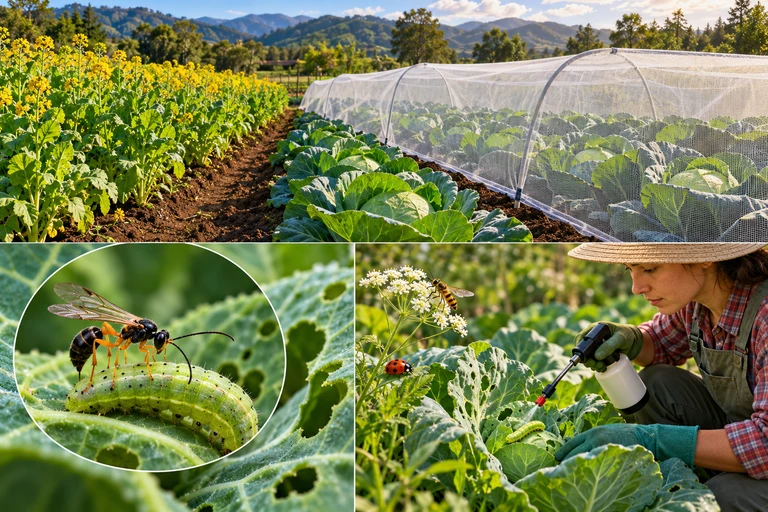 Pest controls can interrupt host availability, exclude pests physically, use natural enemies, or apply a directed treatment. Effective choices depend on the pest, host, timing and non-target effects.
Pest controls target different mechanisms
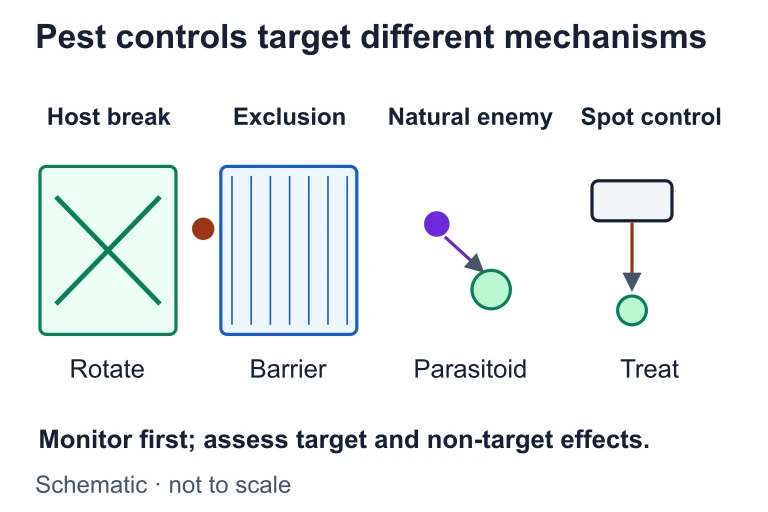 Pest controls can interrupt host availability, exclude pests physically, use natural enemies, or apply a directed treatment. Effective choices depend on the pest, host, timing and non-target effects.
How to Apply IPM
The Economic Threshold
Case Study: DDT and Bald Eagles
DDT was widely sprayed to control mosquitoes in the mid-20th century. As a persistent, broad-spectrum organochlorine pesticide, it entered aquatic food chains and biomagnified up to apex predators.
Case Study: Cactus Moth in Australia
In the 1920s, prickly pear cactus (Opuntia) had invaded over \(24\) million hectares of Australian farmland. Chemical control was impractical at this scale.
Genetic Control: Sterile Male Technique
Common Mistakes
Pest Control Summary
| Method | Chemical | Biological | IPM |
|---|---|---|---|
| Approach | Synthetic toxins | Natural enemies | Combined strategies |
| Effectiveness | Rapid, powerful | Gradual, sustained | Balanced, adaptive |
| Resistance risk | High | Low | Low |
| Ecosystem impact | High | Variable | Minimal |
| Cost over time | Increasing (treadmill) | Low after establishment | Cost-effective |
| AP Exam focus | DDT, biomagnification | Bt, predator-prey | Threshold concept |
Question 1 of 5
A farmer notices that the concentration of a pesticide increases at each successive trophic level in a nearby lake ecosystem. This phenomenon is best described as:
Question 2 of 5
In Integrated Pest Management, which step is performed first?
Question 3 of 5
The "pesticide treadmill" describes a situation where:
Question 4 of 5
A scientist releases sterilized male screwworm flies into a wild population. This technique is an example of:
Question 5 of 5
Which statement about biological pest control is most accurate?