Persistent Organic
Pollutants (POPs)
Explore the chemistry, behavior, and environmental impact of toxic chemicals that resist degradation, accumulate in food webs, and threaten ecosystems worldwide.
What Are Persistent Organic Pollutants?
Persistent Organic Pollutants (POPs) are toxic chemical substances that share four critical properties: they persist in the environment for long periods, they bioaccumulate through food webs, they undergo long-range environmental transport, and they cause adverse effects on human health and ecosystems.
The Dirty Dozen: Original POPs
The 2001 Stockholm Convention initially targeted 12 POPs, known as the "Dirty Dozen." These fall into three categories:
Why POPs Matter Globally
POPs are a global environmental crisis because they do not respect borders. Even remote ecosystems far from any industrial source contain measurable POP concentrations.
Four Defining Properties of POPs
Bioaccumulation vs. Biomagnification
The Grasshopper Effect: Long-Range Transport
POPs volatilize in warmer climates, travel through the atmosphere, then condense and deposit in cooler regions. This cycle repeats, "hopping" them toward the poles: a process called global distillation. This explains why Inuit communities in the Arctic have some of the highest POP body burdens on Earth.
A contaminant parcel crosses warm and cold landscapes
 For suitable semi-volatile persistent pollutants, repeated volatilization, transport and deposition can redistribute contamination toward colder regions. Chemical properties determine whether this mechanism applies.
A contaminant parcel crosses warm and cold landscapes
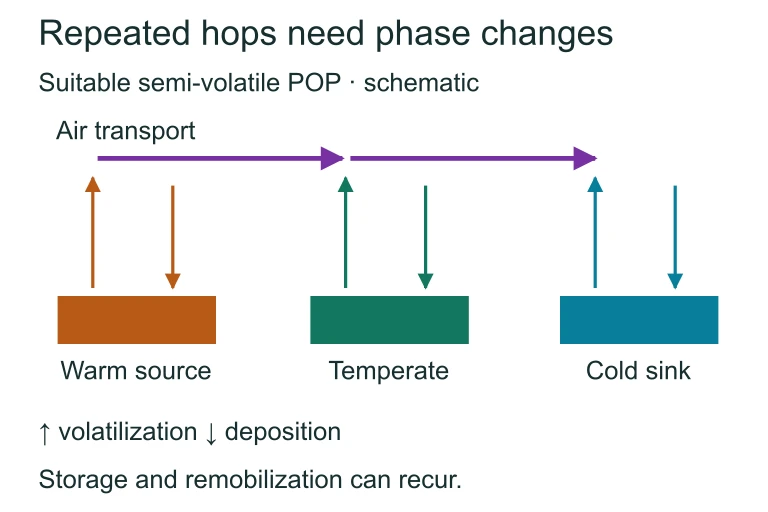 For suitable semi-volatile persistent pollutants, repeated volatilization, transport and deposition can redistribute contamination toward colder regions. Chemical properties determine whether this mechanism applies.
Key Distinction: Accumulation vs. Magnification
| Bioaccumulation | Biomagnification | |
|---|---|---|
| Scale | Within a single organism | Across trophic levels |
| Mechanism | Absorption > excretion | Prey transfers load to predator |
| Concentration trend | Increases over an organism's lifetime | Increases up the food chain |
| Example | Mercury in a fish's liver | DDT in plankton → fish → eagle |
| Required for POPs? | ✓ Yes | ✓ Yes (consequence) |
Chemical Properties That Make POPs Persistent
Measuring Persistence: Environmental Half-Life
The environmental half-life (\( t_{1/2} \)) measures how long it takes for half of a substance's concentration to degrade. For POPs, these values are measured in years or decades:
How to Identify a POP
Use this four-criteria checklist to determine whether a substance qualifies as a POP under the Stockholm Convention:
Case Study: DDT and Eggshell Thinning
DDT (dichlorodiphenyltrichloroethane) was widely used as a pesticide from the 1940s. Rachel Carson's Silent Spring (1962) exposed its devastating ecological effects:
Case Study: PCBs in Aquatic Food Webs
Polychlorinated biphenyls (PCBs) were used in electrical transformers, hydraulic fluids, and flame retardants from the 1930s to 1979. Despite being banned, they persist in sediments and continue to contaminate aquatic food webs.
Worked Example: Biomagnification Factor
Problem: A lake ecosystem has measured DDT concentrations at each trophic level. Calculate the biomagnification factor (BMF) between trophic levels.
Worked Example: Half-Life Calculation
Problem: A soil sample contains 200 mg/kg of DDT. If DDT's soil half-life is 15 years, how much remains after 45 years?
Common Mistakes
Summary: Major POPs at a Glance
| POP | Primary Use | Soil \( t_{1/2} \) | Key Impact |
|---|---|---|---|
| DDT | Pesticide | 15 years | Eggshell thinning |
| PCBs | Electrical insulation | 6-10 years | Endocrine disruption |
| Dioxins | By-product | 7-11 years | Carcinogen |
| Aldrin | Pesticide | 1-6 years | Liver/kidney damage |
| HCB | Fungicide / By-product | 3-6 years | Liver toxicity |
Question 1 of 5
Which of the following is NOT one of the four defining criteria for a Persistent Organic Pollutant (POP)?
Question 2 of 5
A pesticide has a concentration of 0.01 ppm in zooplankton and 10 ppm in an osprey that feeds at the top of the food chain. What is the overall biomagnification factor?
Question 3 of 5
The "grasshopper effect" explains how POPs are transported to polar regions. This process is driven primarily by:
Question 4 of 5
If a soil sample initially contains \( 160 \) mg/kg of a POP with a half-life of 8 years, how much remains after 24 years?
Question 5 of 5
DDT's metabolite DDE causes eggshell thinning in birds by: