Ocean
Warming
Explore how rising ocean temperatures reshape marine ecosystems, alter global climate patterns, and drive environmental change on a planetary scale.
What Is Ocean Warming?
Ocean warming refers to the long-term increase in the average temperature of the world's oceans. Since the 1970s, the ocean has absorbed more than 90% of the excess heat trapped in the Earth system by greenhouse gases.
The Scale of Heat Absorption
Why Oceans Absorb So Much Heat
Greenhouse Effect and the Ocean Connection
Increased greenhouse gas concentrations trap more outgoing infrared radiation. The atmosphere re-radiates energy downward, and the ocean absorbs the vast majority of this energy imbalance, raising its temperature over decades.
Earth's Energy Imbalance
Earth's energy imbalance (EEI) is the difference between incoming solar energy and outgoing thermal radiation. Currently, the imbalance is approximately:
Ocean Warming vs. SST Change
| Ocean Warming (OHC) | Sea Surface Temp (SST) | |
|---|---|---|
| What it measures | Total heat energy stored in the entire water column | Temperature of the top ~1 m of ocean |
| Units | Joules (ZJ) | Degrees Celsius (°C) |
| Depth | Surface to 2,000 m+ | Surface only (~1 m) |
| Climate signal | Best indicator of total energy gain | Drives weather, hurricanes, El Nino |
| Trend since 1970 | +380 ZJ | +0.8°C global avg |
Consequences of Ocean Warming
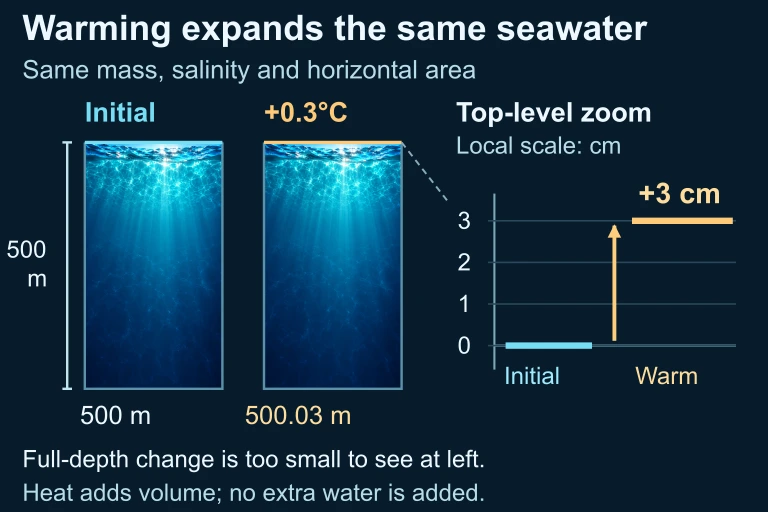
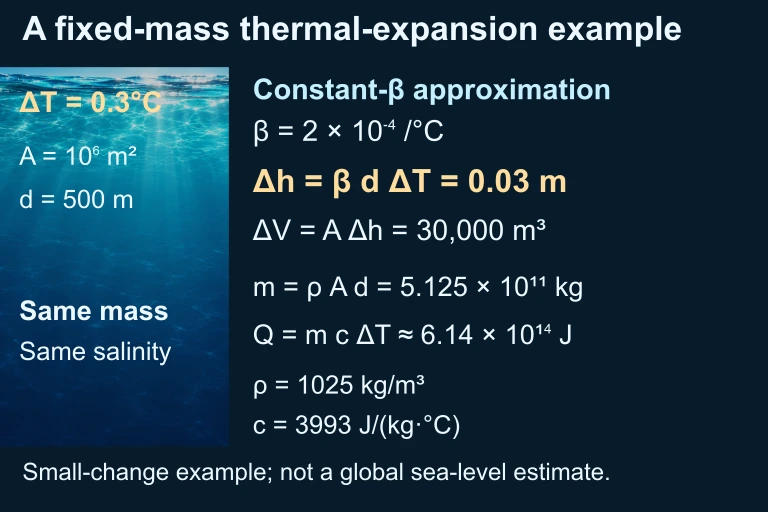
Thermal Expansion and Sea Level Rise
Explain thermosteric sea-level rise separately from added meltwater.
Use this illustration to explore the concept described in its caption.
Warming and Ocean Stratification
Warming is strongest in the upper 700 m, strengthening the thermocline: the layer where temperature drops rapidly with depth. This increased stratification reduces vertical mixing, trapping nutrients in the deep and oxygen near the surface.
Warming, stratification and oxygen supply interact

Warming can strengthen stratification and affect oxygen supply. Mixing, circulation, salinity and productivity also influence oxygen conditions. Warming and CO₂-driven acidification are distinct interacting changes.Warming can affect oxygen via solubility, vertical exchange and biological demand.
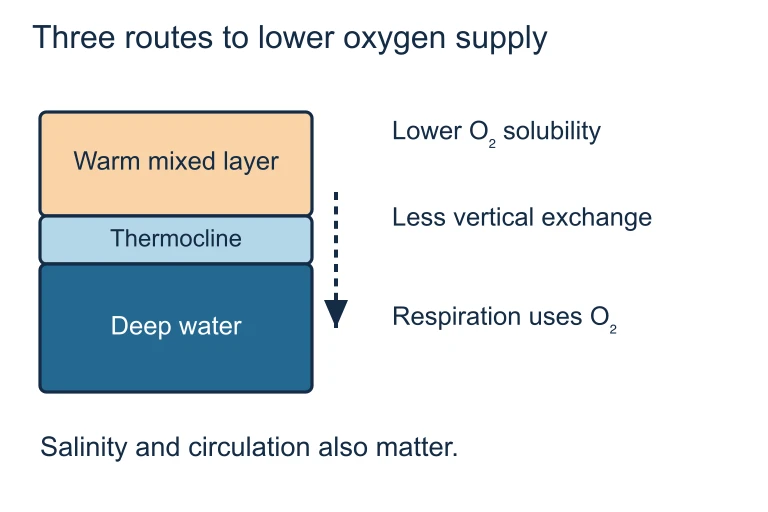
Warming can strengthen stratification and affect oxygen supply. Mixing, circulation, salinity and productivity also influence oxygen conditions. Warming and CO₂-driven acidification are distinct interacting changes.Feedback Loops in Ocean Warming
How to Analyze Ocean Warming Problems
Example 1: Calculating Heat Absorbed
Problem: A layer of ocean water has a mass of \( 5.0 \times 10^{18} \, \text{kg} \) and warms by \( 0.05°\text{C} \). How much energy was absorbed? (Use \( c = 4{,}186 \, \mathrm{J/(kg\,K)} \)).
Example 2: Thermal Expansion
Problem: If the top 1,000 m of the ocean warms by \( 0.1°\text{C} \), estimate the sea level rise from thermal expansion alone. (Use \( \beta = 2.6 \times 10^{-4} \, \text{K}^{-1} \), initial depth \( d = 1{,}000 \, \text{m} \)).
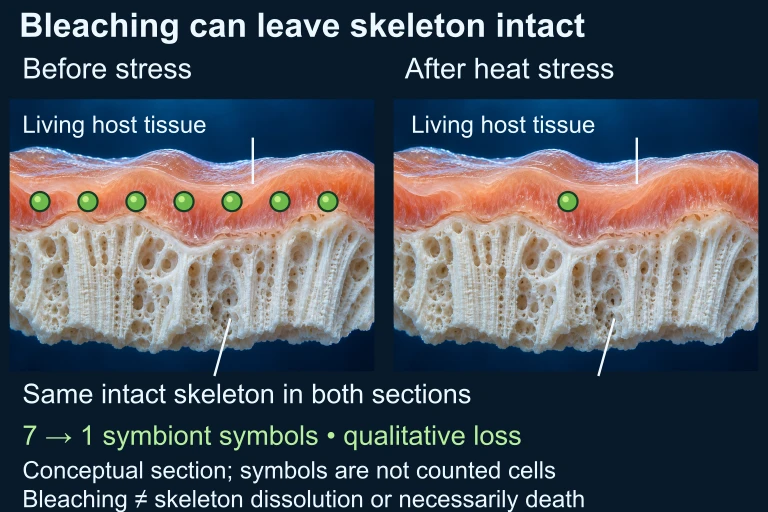
Example 3: Coral Bleaching Threshold
Distinguish bleaching from acidification and coral death.
Use this illustration to explore the concept described in its caption.
Common Mistakes
Summary of Key Concepts
| Concept | Key Fact | Why It Matters |
|---|---|---|
| Heat Absorption | Ocean absorbs >90% of excess heat | Primary buffer against atmospheric warming |
| Energy Imbalance | \( \approx +1.0 \, \text{W/m}^2 \) | Drives all warming trends |
| Thermal Expansion | ~42% of sea level rise | Threatens coastal populations |
| Stratification | Stronger thermocline | Reduces nutrient/oxygen mixing |
| Coral Bleaching | +1°C above MMM for 4+ weeks | Biodiversity and fisheries collapse |
| Ice-Albedo Feedback | Positive (amplifying) | Accelerates Arctic warming |
Question 1 of 5
The ocean has absorbed approximately what percentage of the excess heat trapped by greenhouse gases since the 1970s?
Question 2 of 5
Which of the following is a positive feedback loop associated with ocean warming?
Question 3 of 5
A researcher measures that a volume of ocean water with mass \( 2.0 \times 10^{17} \, \text{kg} \) has warmed by \( 0.2°\text{C} \). Using \( c = 4{,}186 \, \mathrm{J/(kg\,K)} \), approximately how much energy was absorbed?
Question 4 of 5
Thermal expansion of ocean water accounts for approximately what fraction of observed sea level rise since 1993?
Question 5 of 5
Increased ocean stratification due to warming most directly leads to which of the following?