Ocean
Acidification
Explore how rising \(CO_2\) levels alter ocean chemistry, threaten marine ecosystems, and disrupt the global carbon cycle.
What Is Ocean Acidification?
Ocean acidification is the ongoing decrease in the pH of Earth's oceans, driven primarily by the uptake of atmospheric \(CO_2\). Since the Industrial Revolution, the ocean has absorbed roughly 30% of all human-produced carbon dioxide.
The pH Scale in Context
Why It Matters
The Core Chemistry
When \(CO_2\) dissolves in seawater, a series of equilibrium reactions occurs:
The Carbonate System
Acidification vs. Eutrophication
| Ocean Acidification | Eutrophication | |
|---|---|---|
| Primary Cause | Excess atmospheric \(CO_2\) | Excess nitrogen/phosphorus |
| Scale | Global oceans | Local: bays, estuaries, lakes |
| pH Effect | Decreases pH (more acidic) | Can decrease pH locally via decomposition |
| Key Impact | Shell dissolution, reef loss | Algal blooms, dead zones |
| Reversibility | Decades to centuries | Years (if nutrient inputs stop) |
The Saturation State \(\Omega\)
The aragonite saturation state \((\Omega_\text{arag})\) measures whether seawater can support shell formation:
Saturation state affects calcification and dissolution conditionally
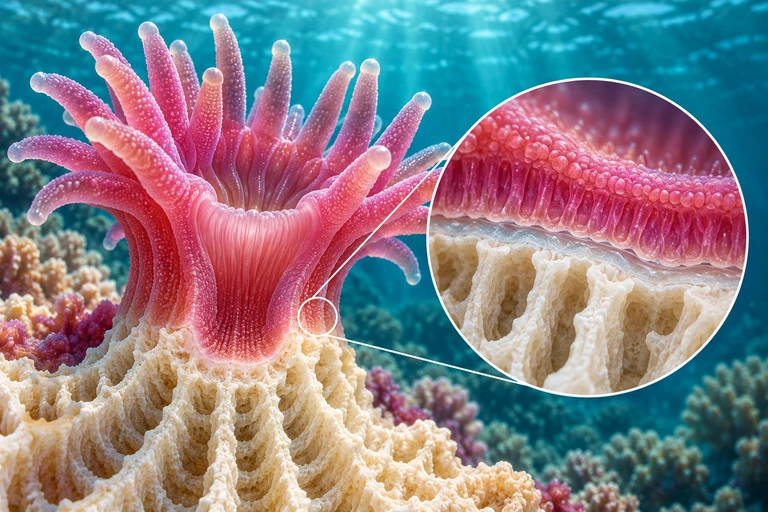 Saturation state describes the thermodynamic tendency of a specified calcium-carbonate mineral. Living calcifiers regulate local fluids, and protection, kinetics and exposure time affect net shell or skeleton change.
Saturation is not a biological on/off switch
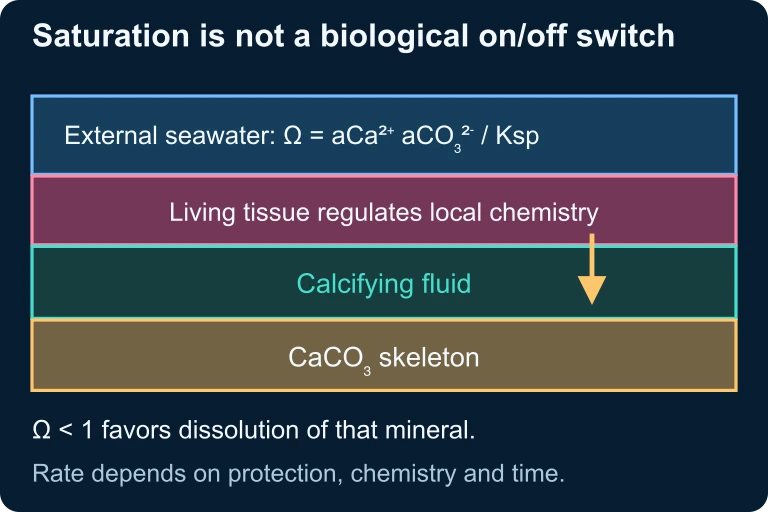 Saturation state describes the thermodynamic tendency of a specified calcium-carbonate mineral. Living calcifiers regulate local fluids, and protection, kinetics and exposure time affect net shell or skeleton change.
How to Analyze a Problem
Example 1: pH Change Calculation
If the ocean's pH drops from 8.2 to 8.1, by what factor does the \(H^+\) concentration increase?
Example 2: Saturation State
A lab sample has \([Ca^{2+}] = 0.010\) M and \([CO_3^{2-}] = 2.0 \times 10^{-4}\) M. The \(K_\text{sp}\) for aragonite is \(6.0 \times 10^{-7}\). Is shell formation favored?
Example 3: Cascade Effects
\(CO_2\) and pH Over Time
Impacts on Marine Life
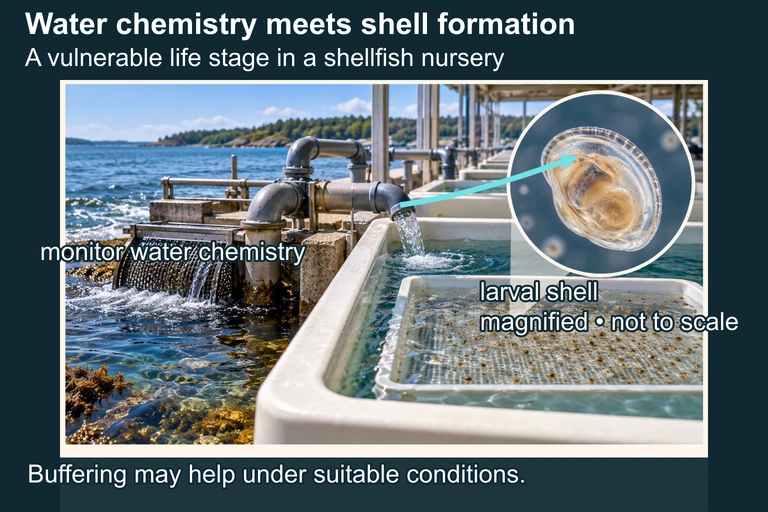
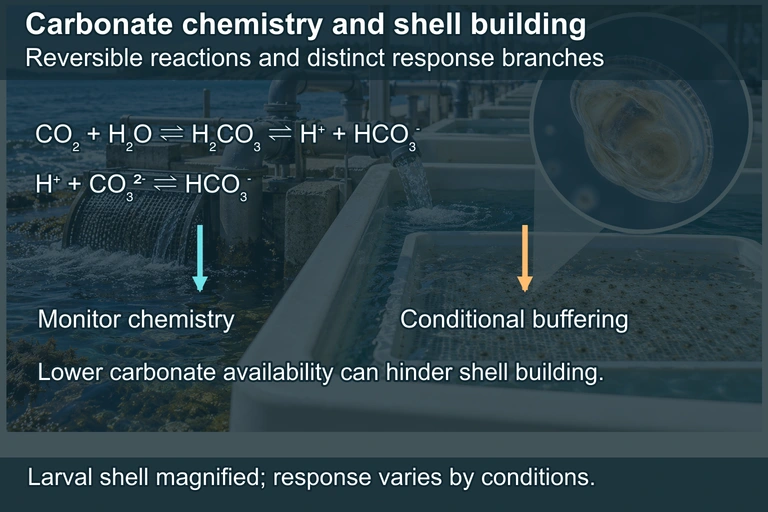
Explain why vulnerable life stages and local water chemistry matter.
Use this illustration to explore the concept described in its caption.
Common Mistakes
Summary Table
| Concept | Key Detail | AP Exam Tip |
|---|---|---|
| Cause | \(CO_2\) absorption from atmosphere | Link to fossil fuel combustion |
| Chemistry | \(CO_2 + H_2O \to H_2CO_3\) | Know all 3 equilibrium steps |
| pH Change | 8.2 to 8.1 (26% more \(H^+\)) | Emphasize logarithmic scale |
| \(\Omega\) State | \(\Omega < 1\) = shell dissolution | Know aragonite vs. calcite |
| Impacts | Corals, shellfish, food webs | Connect to ecosystem services |
| Solutions | Reduce \(CO_2\) emissions, protect reefs | Link to climate policy |
Question 1 of 5
What is the primary cause of ocean acidification?
Question 2 of 5
If ocean pH decreases by 0.3 units, by approximately what factor does the \(H^+\) concentration increase?
Question 3 of 5
Which statement correctly describes the effect of ocean acidification on the carbonate system?
Question 4 of 5
An aragonite saturation state of \(\Omega = 0.8\) indicates that:
Question 5 of 5
Researcher A: Our data show that coral reef calcification rates in the Pacific have declined 14% since 1990, directly correlating with declining aragonite saturation state. Reducing global \(CO_2\) emissions is the only way to halt ocean acidification and preserve reef ecosystems.
Researcher B: While ocean acidification is a concern, the observed coral decline is primarily driven by thermal stress from rising sea surface temperatures. Coral bleaching events have increased fivefold since the 1980s. Addressing acidification alone will not save reefs if temperatures continue to rise.
On which point do Researcher A and Researcher B disagree?