01 / 22

Nuclear
Power

Explore the science of nuclear fission, energy output, reactor design, waste management, and the environmental trade-offs of our most energy-dense fuel source.

AP Environmental Science

What Is Nuclear Energy?

Nuclear energy is the energy stored in the nucleus of an atom: the protons and neutrons bound together by the strong nuclear force. When heavy nuclei are split apart (fission) or light nuclei are fused together (fusion), a small amount of mass is converted into a tremendous amount of energy.

Fission vs Fusion

Fission
A heavy nucleus (e.g., \( ^{235}\text{U} \)) absorbs a neutron and splits into two smaller nuclei, releasing energy and 2-3 additional neutrons.
Fusion
Two light nuclei (e.g., \( ^{2}\text{H} + ^{3}\text{H} \)) combine under extreme heat and pressure to form a heavier nucleus, releasing even more energy per gram.

Why Nuclear Matters for the Environment

Low Carbon
Nuclear emits roughly 12 g \( \text{CO}_2 \)/kWh over its lifecycle: comparable to wind and far below coal (~820 g).
High Density
One kilogram of enriched uranium fuel yields the energy equivalent of roughly 80 tonnes of coal, making it extraordinarily energy-dense.
Baseload Power
Nuclear plants run 24/7 at >90% capacity factor, providing steady electricity independent of weather conditions.

The Fission Chain Reaction

neutron
\(^{235}\text{U}\)
\(^{141}\text{Ba}\)
\(^{92}\text{Kr}\)
n n n ★ Energy
\(^{235}\text{U}\)
\(^{235}\text{U}\)
Chain Reaction Each fission releases ~200 MeV of energy

Controlling the Reaction

In a nuclear reactor, the chain reaction must be precisely controlled. The neutron multiplication factor \( k \) determines whether the reaction grows, shrinks, or stays steady:

\( k < 1 \): Subcritical
Reaction dies out. Fewer neutrons produced than consumed.
\( k = 1 \): Critical
Steady state. Exactly one neutron per fission causes another fission. This is the target for power generation.
\( k > 1 \): Supercritical
Reaction grows exponentially. Used briefly during startup, but dangerous if uncontrolled.

Anatomy of a Nuclear Reactor

Reactor Vessel Fuel Rods Control Rods Hot Coolant Steam Generator Heat Exchange Cool Return Steam Turbine Generator Grid Containment Structure

PWR circuits transfer heat without mixing their fluids
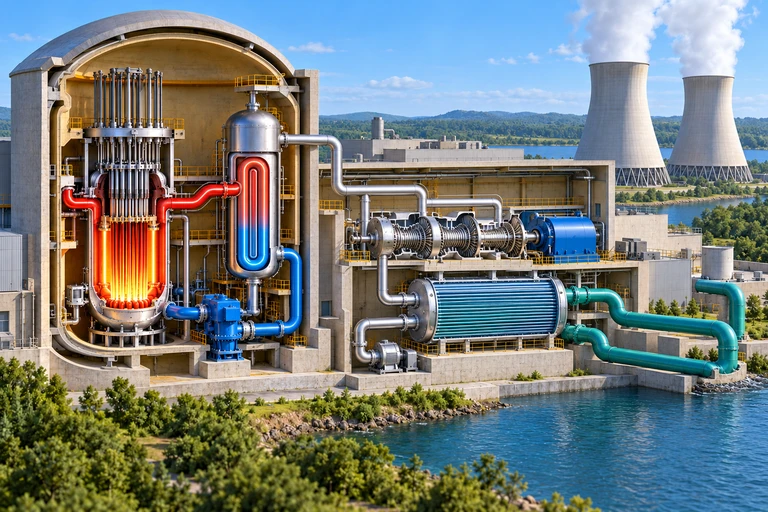
Selected v2 has a primary U-tube return to reactor, a separate steam-to-turbine route and a closed condenser; v1 mixed-looking circuit and open waterfall were rejected. Hidden connections are not certified.In a pressurized water reactor, heat crosses intact exchanger walls while the primary, steam and cooling-water circuits remain separate. Control rods reduce fission power, while decay heat continues to require cooling.

PWR: heat crosses; fluids stay separate
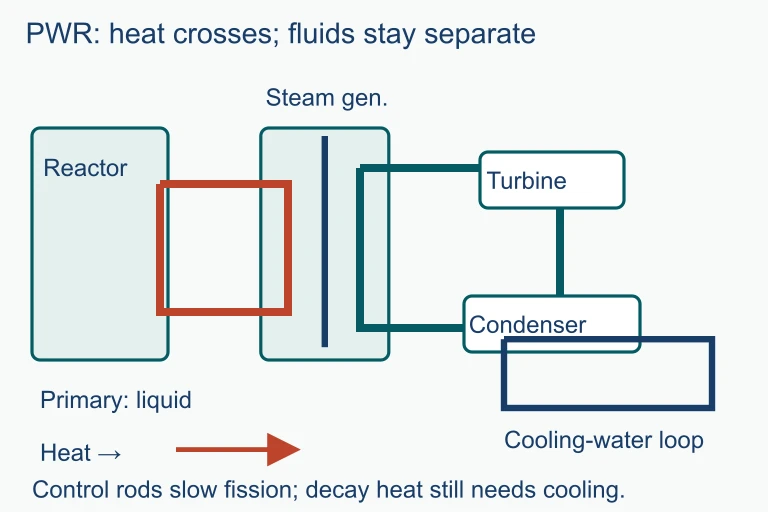
PWR: heat crosses; fluids stay separate. In a pressurized water reactor, heat crosses intact exchanger walls while the primary, steam and cooling-water circuits remain separate. Control rods reduce fission power, while decay heat continues to require cooling.In a pressurized water reactor, heat crosses intact exchanger walls while the primary, steam and cooling-water circuits remain separate. Control rods reduce fission power, while decay heat continues to require cooling.

Key Components Explained

1
Fuel Rods: Contain enriched uranium pellets (\( 3\text{-}5\% \) \( ^{235}\text{U} \)). This is where fission occurs and heat is generated.
2
Control Rods: Made of neutron-absorbing material (boron, cadmium). Inserting them slows the reaction; withdrawing them speeds it up.
3
Moderator: Slows fast neutrons to thermal speeds so they can cause fission. Most reactors use water as both moderator and coolant.
4
Coolant: Carries heat from the reactor core to the steam generator. In a PWR (Pressurized Water Reactor), pressurized water stays liquid at high temperatures.
5
Containment Structure: A thick steel-and-concrete dome designed to prevent any radioactive material from escaping in an accident.

Nuclear vs Fossil Fuels

Nuclear Coal Natural Gas
\( \text{CO}_2 \) (g/kWh) ~12 ~820 ~490
Capacity Factor >90% ~40% ~57%
Land Use (per GWh) Very Low High (mining) Moderate
Air Pollutants None \( \text{SO}_2 \), \( \text{NO}_x \), PM \( \text{NO}_x \)
Waste Concern Radioactive Ash, \( \text{CO}_2 \) \( \text{CO}_2 \)

The Nuclear Fuel Cycle

Mining Uranium Ore Enrichment
3-5% \(^{235}\text{U}\)
Reactor Fission Spent Fuel Cooling Pools Long-Term Storage/Disposal Reprocessing (some countries)

Radioactive Waste: The Central Challenge

Low-Level Waste
Gloves, tools, filters. Mildly radioactive; decays within decades. Disposed of in near-surface facilities.
Intermediate-Level
Reactor components, chemical sludges. Requires shielding and may need hundreds of years of containment.
High-Level Waste
Spent fuel rods. Intensely radioactive. Must be isolated for 10,000+ years in deep geological repositories.

Distinguish cooling, shielding, containment and long-term management.

Use this illustration to explore the concept described in its caption.
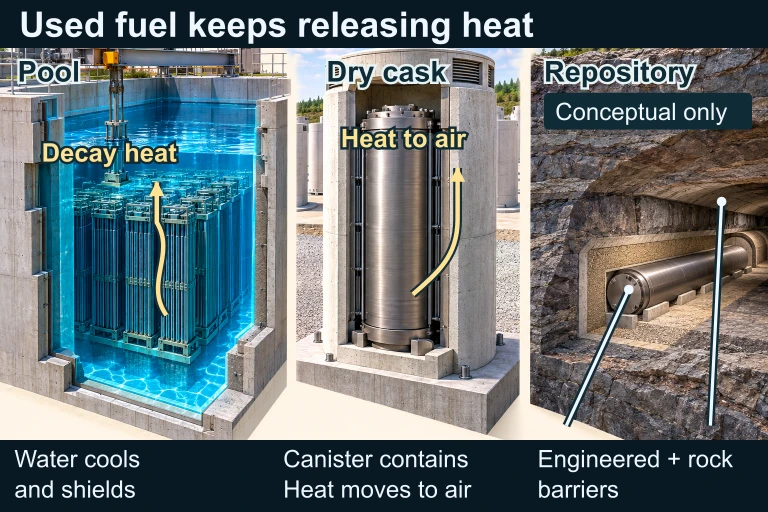
Three large cutaways show submerged fuel with a heat arrow into pool water, a sealed canister with heat moving toward the cask air gap, and a conceptual disposal package surrounded by rock. Separate leaders identify the engineered package and geological barrier.
Used nuclear fuel continues to release decay heat. Large physical cutaways distinguish pool water that cools and shields, a canister and dry cask that contain fuel and pass heat to air, and conceptual disposal using engineered and surrounding-rock barriers. Heat arrows and barrier leaders are illustrative, at separate scales; this is not an operating sequence, a time-to-transfer prescription, or a claim that a particular repository is operating.

Understanding Half-Life

The half-life (\( t_{1/2} \)) of a radioactive isotope is the time it takes for half of a sample to decay. After n half-lives, the fraction remaining is:

Amount Remaining Number of Half-Lives 100% 75% 50% 25% 0% 0 1 2 3 4 50% 25% 12.5% 6.25%

How to Evaluate Nuclear Power

On the AP exam, you will often need to weigh the costs and benefits of nuclear energy compared to alternatives. Use this framework:

1
Identify the energy need: Is it baseload, peak, or distributed generation? Nuclear excels at baseload (constant, large-scale).
2
Compare emissions: Calculate lifecycle \( \text{CO}_2 \) per kWh. Nuclear (~12 g) is comparable to wind (~11 g) and far below gas (~490 g).
3
Assess waste and risk: Consider volume and duration of radioactive waste, accident probability, and thermal water pollution from cooling systems.
4
Factor in economics: Nuclear has very high capital costs but low fuel costs. Construction takes 10-15 years, creating financial risk.
5
Consider alternatives: Could renewables + storage meet the same need? What are the land use and resource trade-offs?

Example: Energy Density Comparison

A coal plant burns 2,460 tonnes of coal per day. If a nuclear plant producing the same electricity uses enriched uranium fuel, how much fuel does it need per day?

Example: Half-Life Calculation

A sample of \( ^{131}\text{I} \) (iodine-131) has a half-life of 8 days. If a nuclear accident releases 800 g of \( ^{131}\text{I} \), how much remains after 32 days?

Common Mistakes

✕ "Nuclear emits \( \text{CO}_2 \)"
Nuclear plants produce no direct \( \text{CO}_2 \) during operation. Lifecycle emissions come from mining, construction, and enrichment: still extremely low.
✕ Confusing fission and fusion
Fission splits heavy atoms; fusion combines light atoms. All current power plants use fission. Fusion is not yet commercially viable.
✕ "Waste lasts forever"
While some isotopes have long half-lives, most fission products decay within 300 years. The long-lived fraction is small but requires deep geological storage.

Summary: Nuclear Power at a Glance

Advantages Disadvantages
Emissions Near-zero \( \text{CO}_2 \) Mining has environmental impact
Reliability >90% capacity factor Not flexible for peak demand
Energy Density Highest of any fuel Enrichment is energy-intensive
Waste Very small volume Radioactive for 10,000+ years
Safety Fewest deaths per TWh produced Catastrophic accident risk
Economics Low operating costs Very high capital costs

Question 1 of 5

In a nuclear power plant, the primary purpose of control rods is to:

Question 2 of 5

A sample of a radioactive isotope has a half-life of 10 years. After 30 years, what fraction of the original sample remains?

Question 3 of 5

Which of the following is a major environmental advantage of nuclear power compared to coal-fired power plants?

Question 4 of 5

The neutron multiplication factor \( k = 1 \) in a nuclear reactor means the reactor is:

Question 5 of 5

The primary concern with high-level radioactive waste from nuclear power plants is that it: