Noise
Pollution
Explore how unwanted sound disrupts ecosystems and human health, measured on the decibel scale, and discover strategies for mitigation.
What Is Noise Pollution?
Noise pollution is any unwanted or harmful sound that disrupts normal activities, degrades quality of life, or damages ecosystems. Unlike chemical pollutants, noise leaves no residue: it is an energy pollutant that dissipates once the source stops.
The Decibel Scale
Sound intensity is measured in decibels (dB). The scale is logarithmic: every \(10\)-dB increase represents a tenfold increase in intensity.
Why Noise Pollution Matters
The Inverse Square Law
Sound intensity decreases with distance from the source according to the inverse square law:
Logarithmic Nature of Decibels
Because the decibel scale is logarithmic, small numerical changes represent large physical changes in intensity.
| Change in dB | Intensity Multiplier | Perceived Loudness |
|---|---|---|
| +3 dB | \(\times 2\) | Slightly louder |
| +10 dB | \(\times 10\) | Twice as loud |
| +20 dB | \(\times 100\) | 4 times as loud |
| +30 dB | \(\times 1{,}000\) | 8 times as loud |
Sources vs Types of Noise
| Anthropogenic Sources | Natural Sources | |
|---|---|---|
| Transportation | Road traffic, aircraft, rail | Thunder, wind |
| Industrial | Factories, construction | Volcanic activity |
| Recreational | Concerts, fireworks | Animal calls |
| Underwater | Sonar, shipping | Seismic events |
Effects on Wildlife
A signal must reach a listener through traffic noise
 Traffic can mask portions of an animal call when their frequency and time ranges overlap within the listener’s sensitivity. Detectability depends on the signal, background noise and receiver.
Hypothetical acoustic masking bands
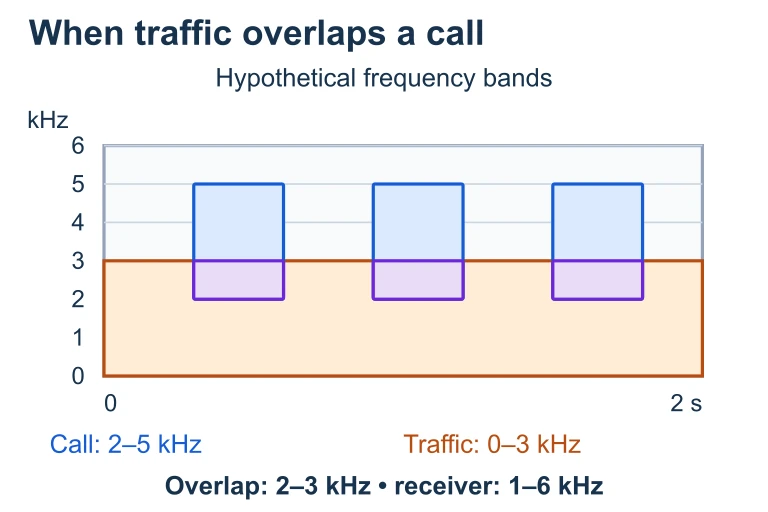 Traffic can mask portions of an animal call when their frequency and time ranges overlap within the listener’s sensitivity. Detectability depends on the signal, background noise and receiver.
How to Analyze a Noise Problem
Example 1: Calculating dB
A jackhammer produces a sound intensity of \(I = 10^{-2}\;\text{W/m}^2\). What is its level in decibels?
Example 2: Distance and dB Drop
A concert speaker measures 110 dB at 1 meter. What is the level at 4 meters?
Example 3: OSHA Exposure Limits
OSHA's Permissible Exposure Limit (PEL) is 8 hours at 90 dB. For every 5-dB increase, the permitted time is halved. How long can a worker be exposed at 100 dB?
Mitigation Strategies
A barrier shields one receiver while sound bends toward another
 For a free-field point source, intensity at 120 m is 1/64 of that at 15 m. A barrier can block a low receiver’s line of sight while leaving an upper receiver exposed; diffraction, reflection and source geometry also affect the sound received.
The inverse-square ratio is not a complete barrier prediction.
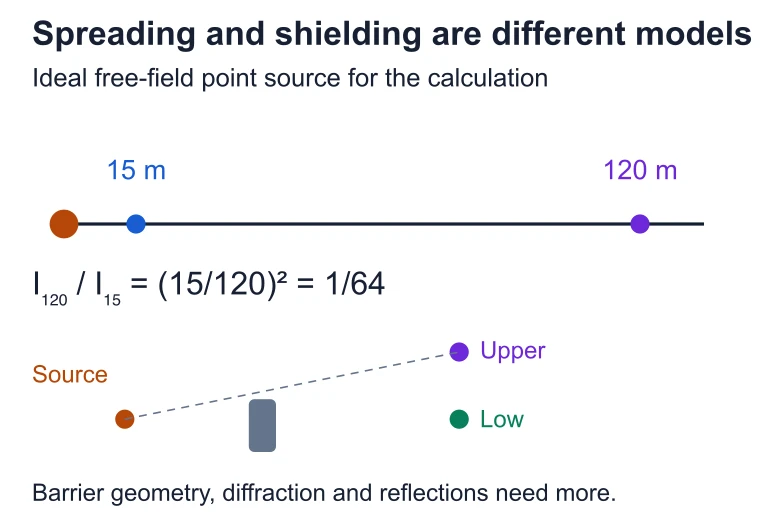 For a free-field point source, intensity at 120 m is 1/64 of that at 15 m. A barrier can block a low receiver’s line of sight while leaving an upper receiver exposed; diffraction, reflection and source geometry also affect the sound received.
Key Regulations
Common Mistakes
Summary Table
| Concept | Key Detail | AP Relevance |
|---|---|---|
| Decibel Scale | Logarithmic: +10 dB = \(\times 10\) intensity | FRQ calculations |
| Inverse Square Law | \(I \propto 1/r^2\); \(-6\) dB per doubling | Distance problems |
| OSHA Limit | 90 dB for 8 hrs; 5-dB exchange rate | MCQ/FRQ scenarios |
| Mitigation | Source → Path → Receiver | FRQ solutions |
| Wildlife Impact | Masking, stress, habitat abandonment | Ecosystem questions |
Question 1 of 5
A sound source has an intensity of \(I = 10^{-5}\;\text{W/m}^2\). What is its decibel level?
Question 2 of 5
If you triple your distance from a sound source, by approximately how many decibels does the level drop?
Question 3 of 5
Under OSHA guidelines, how long can a worker be safely exposed to 95 dB?
Question 4 of 5
Which mitigation strategy is most effective for reducing noise pollution from highway traffic near a residential area?
Question 5 of 5
Two identical machines each produce 80 dB. When both run simultaneously, the combined level is closest to: