Natural Disruptions
to Ecosystems
Explore how wildfires, volcanic eruptions, hurricanes, and other natural events reshape ecological communities and drive succession.
What Is a Natural Disruption?
A natural disruption (also called a natural disturbance) is any event originating from natural processes that significantly alters the structure, composition, or function of an ecosystem. These events are not caused by human activity and have been shaping Earth's landscapes for billions of years.
Major Types of Natural Disruptions
Why Disruptions Matter
Natural disruptions are essential drivers of ecological change. Without periodic disturbances, ecosystems would stagnate, biodiversity would decline, and resilience would weaken. Disruptions create a mosaic of habitats at different stages of recovery.
Ecological Succession Framework
After a natural disruption, ecosystems rebuild through a predictable sequence called ecological succession. The type of succession depends on whether soil and seeds survive the disturbance.
Succession depends on soil and biological legacies
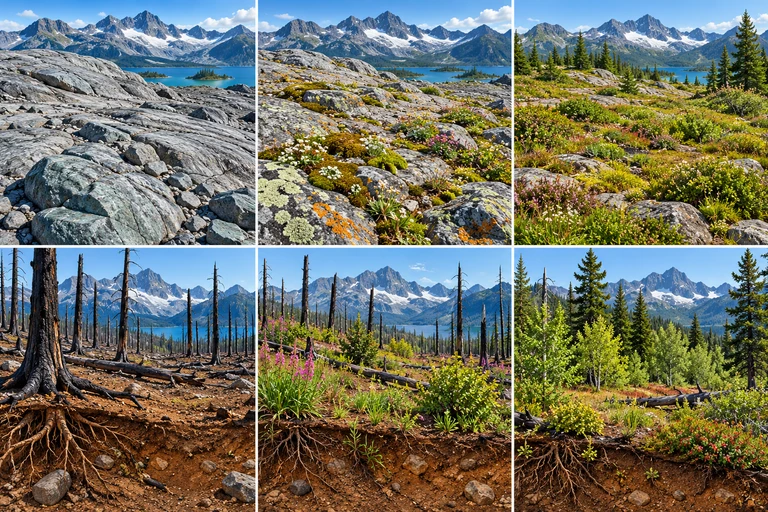 Bare substrate and retained soil create different starting conditions for succession. Colonization and later communities depend on climate, dispersal, surviving organisms and further disturbance.
Succession depends on soil and biological legacies
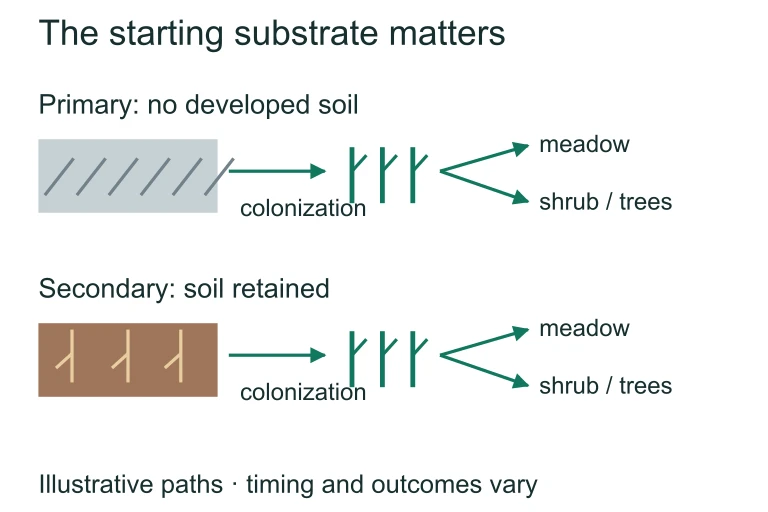 Bare substrate and retained soil create different starting conditions for succession. Colonization and later communities depend on climate, dispersal, surviving organisms and further disturbance.
Primary vs. Secondary Succession
| Primary Succession | Secondary Succession | |
|---|---|---|
| Starting condition | No soil present | Soil remains intact |
| Trigger examples | Volcanic eruption, glacier retreat | Wildfire, hurricane, flood |
| Pioneer species | Lichens, mosses | Grasses, herbaceous plants |
| Time to climax | Centuries to millennia | Decades to centuries |
| Seed bank | Absent: must arrive | Often present in soil |
Wildfire: Destruction and Renewal
Volcanic Eruptions: Primary Succession in Action
Volcanic eruptions create entirely new surfaces: lava flows cool into barren rock, and pyroclastic flows bury existing ecosystems under meters of ash. Recovery begins with primary succession because no soil or seed bank remains.
Hurricanes and Flooding
Drought and Disease as Disruptions
Not all disruptions are sudden. Droughts and disease outbreaks act as slower, sometimes chronic disruptions that reshape ecosystems over months to years.
Ecosystem Resilience and Resistance
Factors Affecting Recovery
Disturbance regime and recovery are separate dimensions
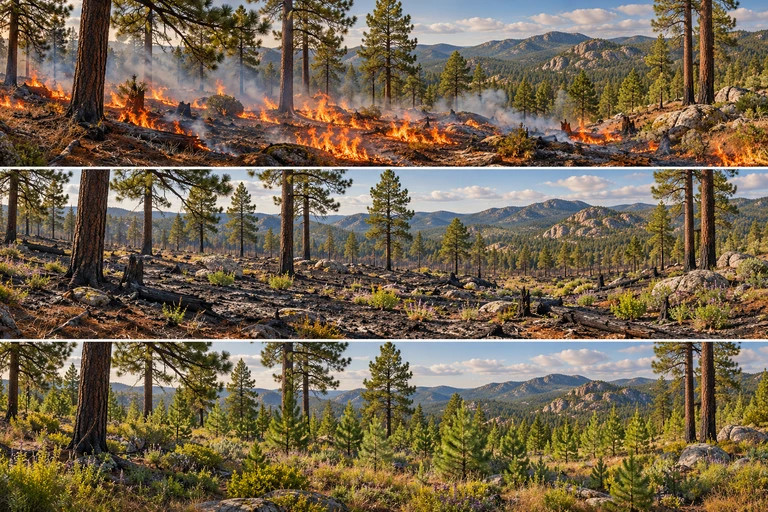 Return interval, fire intensity, ecological severity and time since a fire describe different properties of a disturbance. A single event and its recovery sequence cannot establish a frequency–diversity relationship.
Disturbance regime ≠ recovery time
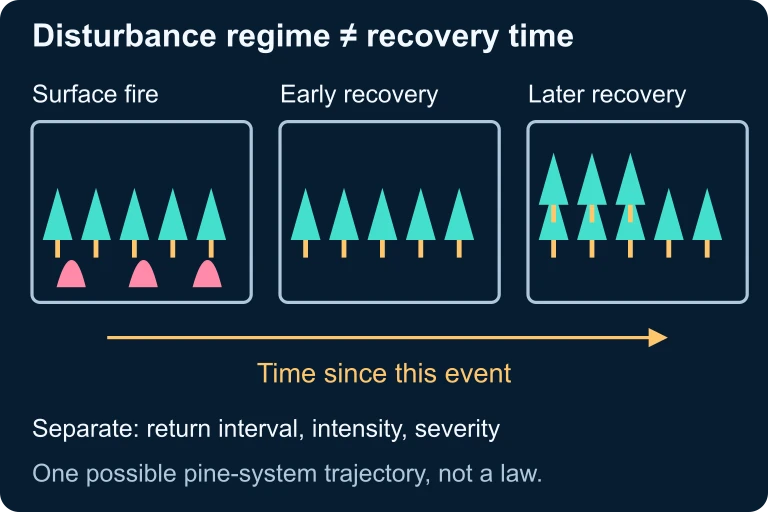 Return interval, fire intensity, ecological severity and time since a fire describe different properties of a disturbance. A single event and its recovery sequence cannot establish a frequency–diversity relationship.
How to Analyze a Natural Disruption
Use this step-by-step framework when the AP exam gives you a disruption scenario:
Example: Yellowstone Fires of 1988
In the summer of 1988, wildfires burned approximately 793,000 acres (36%) of Yellowstone National Park. Let's apply our analysis framework:
Example: Krakatoa Eruption of 1883
The eruption of Krakatoa obliterated the island, leaving only sterile volcanic rock. This became one of ecology's most studied cases of primary succession.
Common Mistakes to Avoid
Disruption Summary Table
| Disruption | Succession | Pioneer Species | Recovery Time |
|---|---|---|---|
| Wildfire | Secondary | Fireweed, grasses | Decades |
| Volcanic eruption | Primary | Lichens, mosses | Centuries |
| Hurricane | Secondary | Shade-intolerant trees | 15 to 50 years |
| Glacier retreat | Primary | Lichens, mosses | Centuries |
| Flood | Secondary | Sedge, grasses | Years to decades |
| Drought | Secondary | Drought-tolerant shrubs | Years to decades |
Question 1 of 5
A volcanic eruption covers an island in lava, destroying all soil and organisms. The ecological recovery that follows is best described as:
Question 2 of 5
Which of the following best explains why periodic wildfires can increase biodiversity in a grassland ecosystem?
Question 3 of 5
After a hurricane destroys a coastal mangrove forest, which sequence of events would most likely occur?
Question 4 of 5
An ecologist observes that Ecosystem A recovers to its original state within 5 years of a flood, while Ecosystem B takes 50 years. Which statement best compares them?
Question 5 of 5
A forest experiences a disease outbreak that kills all American chestnut trees, which were the dominant canopy species. What is the most likely ecological consequence?