Methods to Reduce
Urban Runoff
Explore green infrastructure, permeable surfaces, and policy strategies that cities use to manage stormwater and protect water quality.
What Is Urban Runoff?
When rain falls on impervious surfaces such as roads, rooftops, and parking lots, water cannot infiltrate into the soil. Instead, it flows across the surface, picking up pollutants like oil, heavy metals, fertilizers, and sediment before entering storm drains and waterways.
Why Reducing Runoff Matters
The Water Cycle Disrupted
Core Principle: Green Infrastructure
Green infrastructure (GI) is a network of natural and engineered systems that mimic natural hydrological processes. The goal is to capture, slow, filter, and infiltrate stormwater at or near the source, rather than piping it away.
Green infrastructure stores,filters and redistributes stormwater
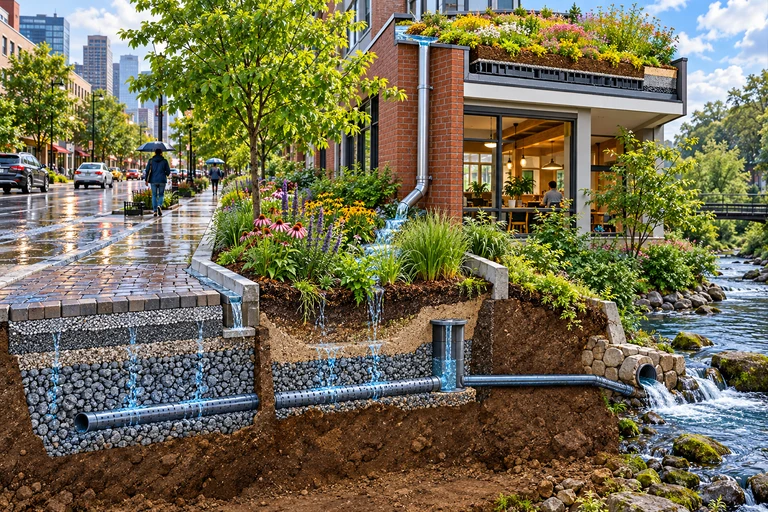 Green infrastructure redistributes stormwater through storage, infiltration, underdrains and overflow. A planted surface alone does not establish how much captured water reaches groundwater.
Stored water still needs a pathway
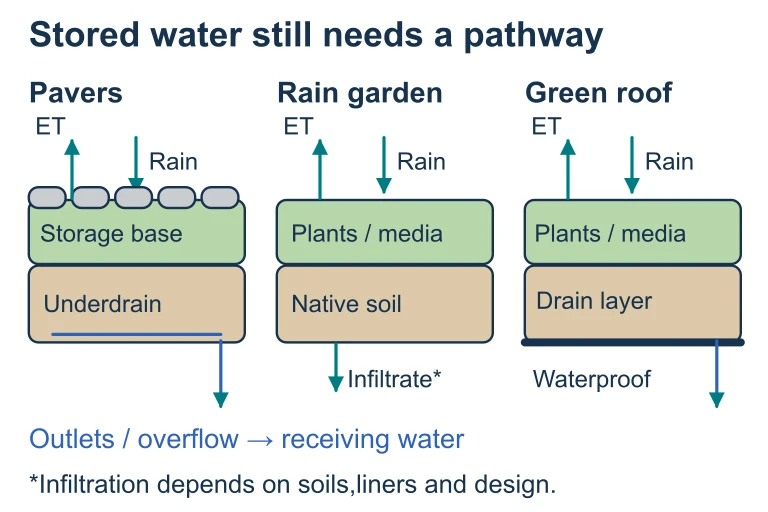 Green infrastructure redistributes stormwater through storage, infiltration, underdrains and overflow. A planted surface alone does not establish how much captured water reaches groundwater.
Quantifying Runoff: The Rational Method
Engineers use the Rational Method to estimate peak runoff flow. The formula is:
Green vs. Grey Infrastructure
| Green Infrastructure | Grey Infrastructure | |
|---|---|---|
| Approach | Mimics natural hydrology | Pipes and channels water away |
| Examples | Rain gardens, bioswales, green roofs | Storm sewers, concrete channels |
| Pollutant Removal | Filters contaminants naturally | Transfers pollution downstream |
| Flood Risk | Reduces peak flow at source | Can overwhelm at capacity |
| Co-benefits | Habitat, cooling, aesthetics | Minimal co-benefits |
| Cost Over Time | Lower long-term maintenance | Higher repair and replacement |
Key Methods at a Glance
How to Design a Runoff Reduction Plan
Example 1: Parking Lot Retrofit
A 2-acre parking lot (\(A = 2\) acres) with \(C = 0.90\) experiences rainfall intensity \(i = 2\) in/hr. What is the peak runoff?
The city installs permeable pavement on 50% of the lot, reducing the blended \(C\) to \(0.55\).
Example 2: Residential Block
A 5-acre residential block has a mix of surfaces. The blended runoff coefficient is \(C = 0.60\). Rainfall intensity during a design storm is \(i = 3\) in/hr.
The neighborhood adds rain gardens (capturing 20% of area), rain barrels on all homes, and tree planting. The new blended \(C\) drops to \(0.38\).
Example 3: Green Roof Analysis
A commercial building has a 10,000 sq ft roof. A conventional roof has \(C = 0.95\). An extensive green roof can achieve \(C = 0.40\).
Policy Strategies
Bioswales & Constructed Wetlands
Common Mistakes
Summary of Methods
| Method | Mechanism | Pollutant Removal | Scale |
|---|---|---|---|
| Permeable Pavement | Infiltration | Moderate | Lot / Street |
| Bioretention Cell | Filtration + Uptake | High | Lot / Block |
| Green Roof | Absorption | Low-Moderate | Building |
| Rain Barrel | Capture + Reuse | Low | Building |
| Bioswale | Filtration + Conveyance | High | Street / Block |
| Constructed Wetland | Phytoremediation | Very High | Neighborhood |
Question 1 of 5
Urban runoff is classified as which type of pollution?
Question 2 of 5
Using the Rational Method \(Q = C \times i \times A\), a 4-acre site with \(C = 0.70\) and \(i = 2.5\) in/hr produces a peak runoff of:
Question 3 of 5
Which of the following is a key advantage of green infrastructure over traditional grey infrastructure?
Question 4 of 5
A constructed wetland is most effective at removing which pollutant through phytoremediation?
Question 5 of 5
A city replaces 40% of a conventional parking lot (\(C = 0.90\)) with permeable pavement (\(C = 0.40\)). What is the new blended runoff coefficient?