Meat Production
Methods
Explore how conventional and sustainable meat production systems differ in their environmental impacts: land use, water consumption, greenhouse gas emissions, and ecosystem disruption.
What Is Meat Production?
Meat production encompasses all processes involved in raising, feeding, slaughtering, and distributing animals for human consumption. It is one of the most resource-intensive sectors of agriculture, accounting for significant portions of global land use, water withdrawal, and greenhouse gas emissions.
Key Terms to Know
Why Does It Matter?
The method of meat production directly determines its environmental footprint. As global meat demand is projected to increase by 70% by 2050, understanding these systems is critical for evaluating sustainability trade-offs.
Industrial Meat Production
Industrial systems, often centered around CAFOs, prioritize maximum output per unit cost. Animals are densely confined and fed grain-based diets supplemented with antibiotics and growth hormones to accelerate weight gain.
Pasture-Based Production
Pasture-based (grass-fed) systems allow animals to graze on open land. While they require more land per animal, they integrate with natural ecosystems and can improve soil health through managed rotational grazing.
Feed Conversion Ratios
The feed conversion ratio (FCR) measures how many kilograms of feed are needed to produce one kilogram of meat. Lower FCR means higher efficiency. This ratio is central to evaluating the resource cost of different protein sources.
CAFO vs. Pasture: Key Differences
| Factor | CAFO | Pasture-Based |
|---|---|---|
| Land per animal | Low (confined) | High (open grazing) |
| Water pollution risk | High: waste lagoon runoff | Lower: dispersed waste |
| Antibiotic use | Routine/preventive | Therapeutic only |
| GHG per kg meat | Lower (faster growth) | Higher (longer lifespan) |
| Biodiversity impact | Monoculture feed crops | Can support grassland species |
| Animal welfare | Limited movement | Natural behaviors |
Explain why manure concentration and management affect pollution pathways.
Use this illustration to explore the concept described in its caption.
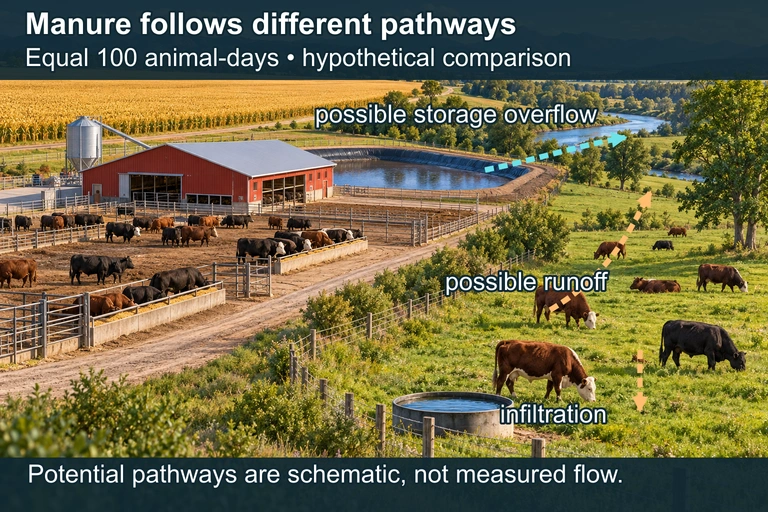
Environmental Impacts Pathway
How to Analyze on the AP Exam
Farm footprint and upstream feed footprint must share a boundary
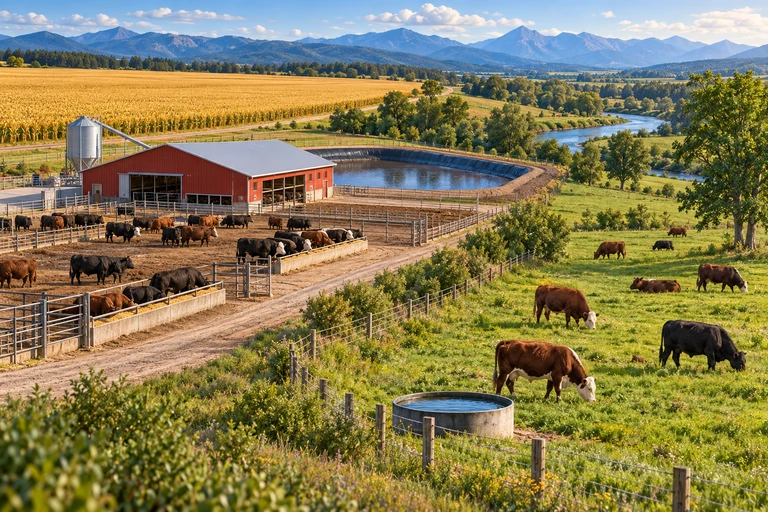 Compare cattle-production systems using the same product basis and system boundary. For a kilogram of edible protein, on-site land alone omits upstream feed production; lifecycle comparisons also consider water, energy, manure, methane and land conversion.
Farm versus lifecycle boundary
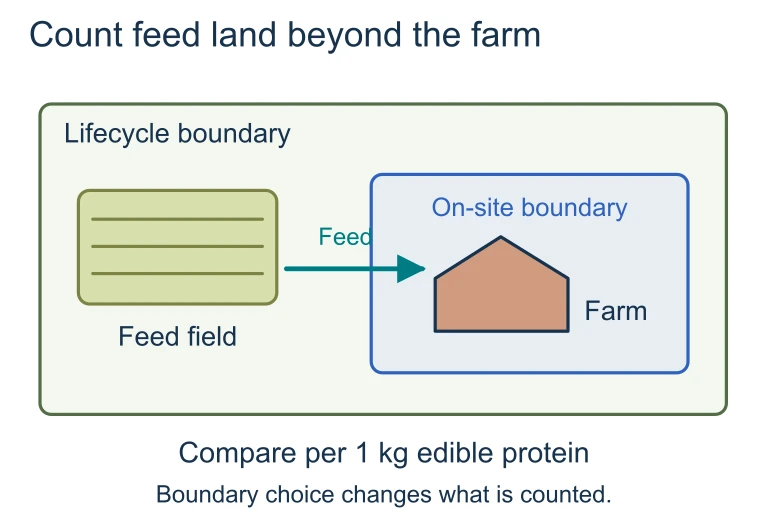 Compare cattle-production systems using the same product basis and system boundary. For a kilogram of edible protein, on-site land alone omits upstream feed production; lifecycle comparisons also consider water, energy, manure, methane and land conversion.
Example 1: Water Footprint
A CAFO producing 1 kg of beef requires approximately 15,400 liters of water (drinking, feed irrigation, processing). Compare this to 1 kg of poultry at approximately 4,300 liters.
Example 2: GHG Calculations
Beef production emits approximately \(27 \text{ kg } CO_2\text{e}\) per kg of meat. Poultry emits about \(6.9 \text{ kg } CO_2\text{e}\) per kg. A school cafeteria serves 500 meals per day, each containing 150 g of meat protein.
Example 3: Land Use Efficiency
Producing 1 kg of beef protein requires roughly \(164 \text{ m}^2\) of land (feed crops + grazing). Tofu requires about \(2.2 \text{ m}^2\) per kg of protein. A city of 1 million people consumes 50 g of protein/person/day.
Alternative Production Methods
Common Mistakes
Production Methods Summary
| Metric | Beef (CAFO) | Pork | Poultry | Aquaculture |
|---|---|---|---|---|
| FCR (kg feed:kg meat) | 6:1 | 3.5:1 | 1.6:1 | 1.5:1 |
| Water (L/kg meat) | 15,400 | 6,000 | 4,300 | 3,500 |
| GHG (kg \(CO_2\text{e}\)/kg) | 27 | 12 | 6.9 | 5–12 |
| Land (\(\text{m}^2\)/kg protein) | 164 | 11 | 7.1 | 3.7 |
Question 1 of 5
Which of the following best explains why beef has a higher environmental footprint than poultry?
Question 2 of 5
A CAFO produces 500,000 kg of beef annually. Using a water footprint of \( 15{,}400 \) L/kg, what is the approximate annual water consumption?
Question 3 of 5
Which environmental problem is most directly associated with nutrient runoff from concentrated animal waste?
Question 4 of 5
A student argues that switching from CAFO beef to grass-fed beef will always reduce greenhouse gas emissions per kilogram of meat. What is the flaw in this reasoning?
Question 5 of 5
Which of the following strategies would most effectively reduce the overall environmental impact of global meat production?