Island
Biogeography
Explore how island size and distance from the mainland determine species richness through the balance of immigration and extinction.
What Is Island Biogeography?
Island biogeography is the study of the distribution of species on islands and island-like habitats. Developed by ecologists Robert MacArthur and E.O. Wilson in 1967, this theory explains why some islands support many species while others support few.
Key Terms to Know
Why Does This Matter?
Island biogeography is one of the most influential theories in conservation biology. It helps scientists and policymakers decide:
The Equilibrium Model
The core idea: an island's species number reaches a dynamic equilibrium (\( \hat{S} \)) where the immigration rate equals the extinction rate.
An island keeps its species count while its cast changes
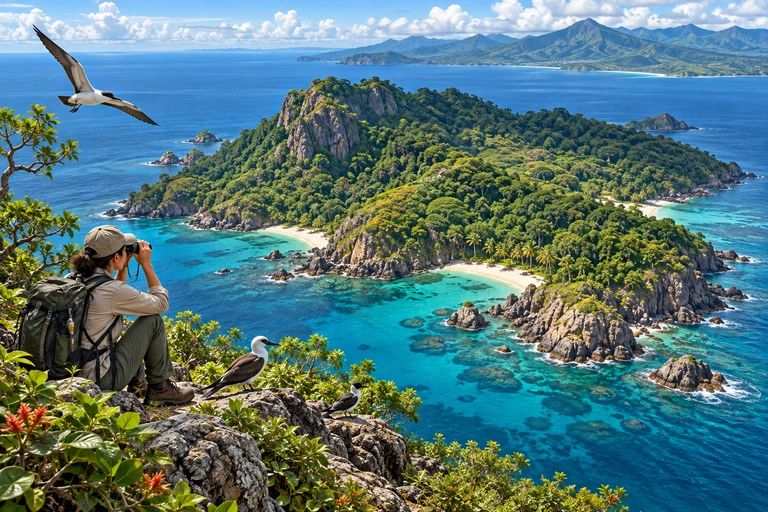 Species richness can stay the same across two snapshots even though one species disappears and another arrives. A stable count can therefore accompany continuing turnover.
Equilibrium does not freeze the cast
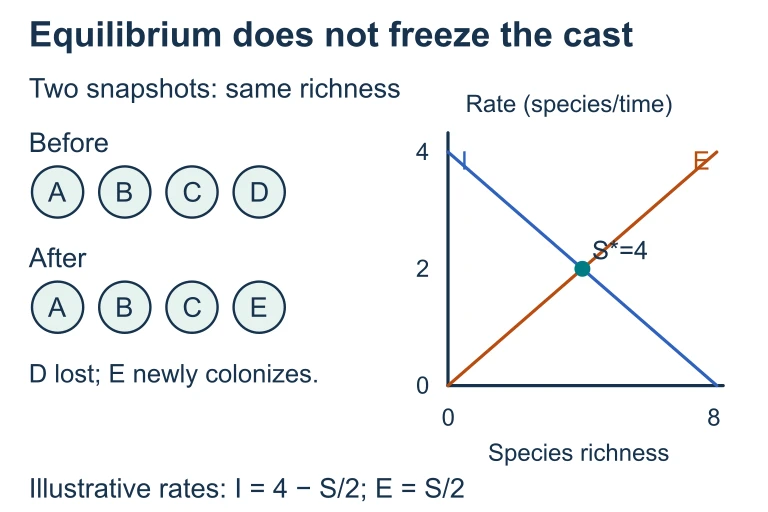 Species richness can stay the same across two snapshots even though one species disappears and another arrives. A stable count can therefore accompany continuing turnover.
Two Factors That Shift Equilibrium
Effect of Island Size
Effect of Distance from Mainland
The Species-Area Relationship
A mathematical model links island area to species richness. The power function model states:
Taking the logarithm of both sides gives a linear form:
Oceanic vs Habitat Islands
| Oceanic Islands | Habitat Islands | |
|---|---|---|
| Examples | Hawaii, Galapagos, Madagascar | Forest patches, lakes, mountaintops |
| Barrier | Ocean water | Roads, farmland, urban sprawl |
| Immigration source | Mainland continent | Surrounding intact habitat |
| Typical \( z \) value | 0.25 to 0.35 | 0.12 to 0.18 |
| Conservation use | Marine reserves, endemic species | Wildlife corridors, reserve design |
How to Apply the Theory
Example 1: Ranking Islands
Four islands exist off a mainland coast. Rank them from most to fewest species:
Example 2: Using \( S = cA^z \)
A biologist surveys bird species on Caribbean islands. The data yields \( c = 18 \) and \( z = 0.30 \). Predict species richness for an island of area \( A = 100 \text{ km}^2 \).
Example 3: Conservation Design
A national park must choose between two reserve designs. Which will support more species?
Habitat fragmentation, corridors and gene flow
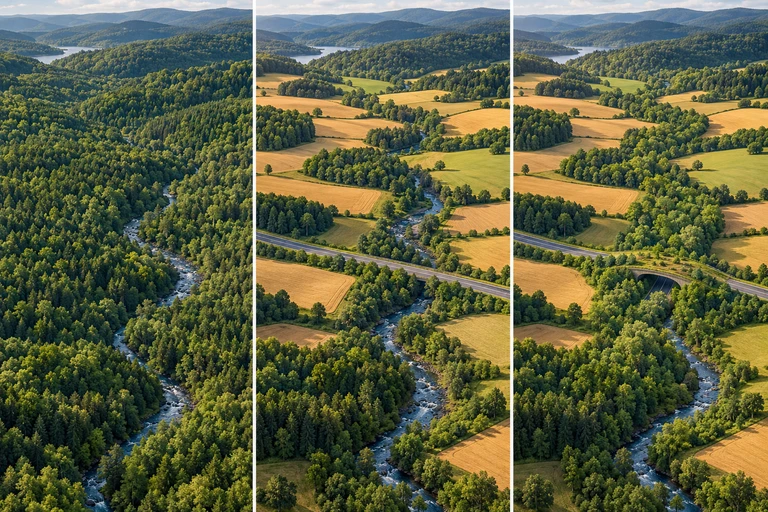 Equal total reserve area can conceal differences in core habitat. With a one-unit edge zone, one 10-by-10 square retains 64 square units of core, while four 5-by-5 squares retain 36 in total.
Equal area does not mean equal core
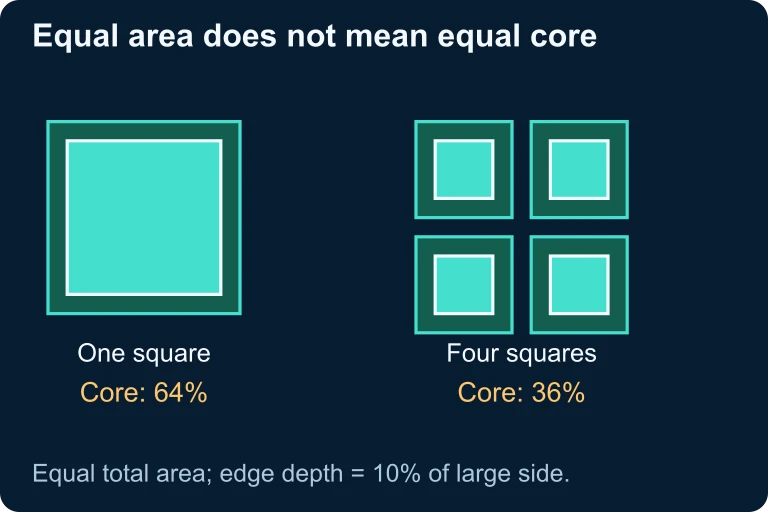 With a one-unit edge depth, one 10-by-10 square contains 64 square units of core. Four 5-by-5 squares have the same total area but only 36 square units of core.
The SLOSS Debate
Ecologists have debated: should we protect a Single Large or Several Small reserves? The answer depends on context:
Common Mistakes
Summary Table
| Factor | Effect on Immigration | Effect on Extinction | Effect on \( \hat{S} \) |
|---|---|---|---|
| Larger area | Slight increase (target effect) | Decreases | Increases |
| Smaller area | Slight decrease | Increases | Decreases |
| Closer to source | Increases | No direct effect | Increases |
| Farther from source | Decreases | No direct effect | Decreases |
Question 1 of 5
According to the theory of island biogeography, which island would have the highest species richness?
Question 2 of 5
In the equation \( S = cA^z \), what does the exponent \( z \) typically range between for oceanic islands?
Question 3 of 5
At the equilibrium point \( \hat{S} \) on MacArthur and Wilson's model, which statement is true?
Question 4 of 5
A forest is divided by a highway into two fragments. According to island biogeography, what is the most likely long-term effect on the fragments?
Question 5 of 5
If \( c = 20 \) and \( z = 0.25 \), what is the predicted number of species on an island with area \( A = 10{,}000 \text{ km}^2 \)?