Irrigation
Methods
Explore how different irrigation techniques affect water efficiency, crop yield, and environmental sustainability in modern agriculture.
What is Irrigation?
Irrigation is the artificial application of water to soil for the purpose of growing crops. About 70% of global freshwater withdrawals go to agriculture, making irrigation one of the most critical factors in both food security and water resource management.
Why Irrigation Matters
Essential Vocabulary
Four Major Irrigation Methods
Flood / Surface Irrigation
The oldest and most widespread method globally. Water is released onto the field surface and flows across the land by gravity. While simple and inexpensive, it is also the least efficient method.
Furrow Irrigation
A refinement of surface irrigation where water flows through narrow channels (furrows) between crop rows. This targets water more precisely than full-field flooding, reducing total water use.
Sprinkler Irrigation
Water is pumped through pipes and sprayed over crops through rotating nozzles. Center-pivot systems are the most common: a long arm rotates around a central point, creating those characteristic circular crop patterns visible from the air.
Drip / Micro-Irrigation
Water drips slowly through emitters directly to the root zone of each plant. Minimal evaporation, zero runoff, and precise control make this the most water-efficient method available.
Delivery geometry determines field-scale water pathways
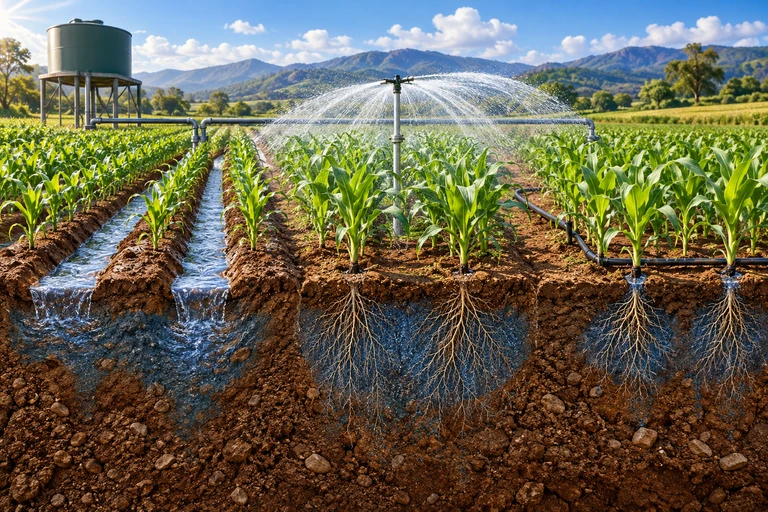 A crop can receive irrigation through surface channels, overhead spray or localized emitters. Delivery geometry changes the pathways and risks of runoff, evaporation, wind drift and deep percolation.
Delivery changes the wetting pattern
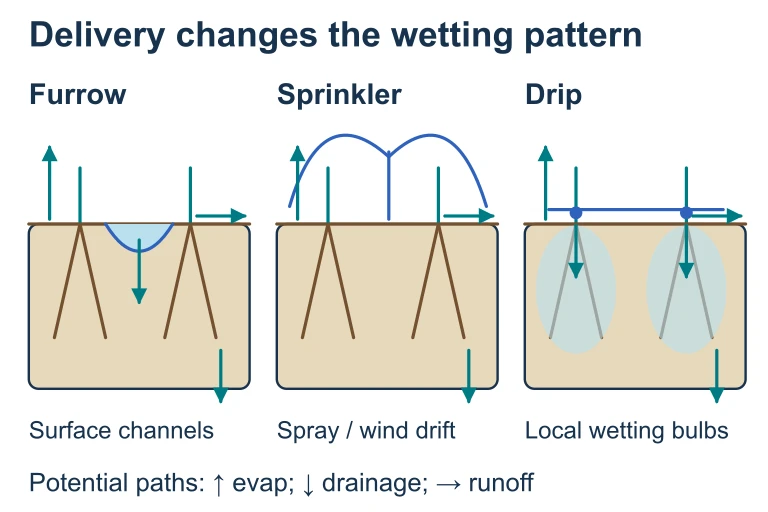 A crop can receive irrigation through surface channels, overhead spray or localized emitters. Delivery geometry changes the pathways and risks of runoff, evaporation, wind drift and deep percolation.
Gravity vs Pressurized Systems
| Gravity-Fed | Pressurized | |
|---|---|---|
| Methods | Flood, Furrow | Sprinkler, Drip |
| Energy Needed | Low / None | Moderate to High |
| Efficiency | 40-70% | 70-95% |
| Terrain | Flat, level fields | Any topography |
| Initial Cost | Low | High |
| Salinization Risk | High | Low (drip) |
The Irrigation Water Balance
Irrigation engineers use a simple water balance to determine how much water to apply:
This equation shows that as efficiency \( \eta \) increases (denominator grows), the total irrigation water I needed decreases. Switching from flood (\( \eta = 0.45 \)) to drip (\( \eta = 0.92 \)) can cut water use by more than half.
How to Choose a Method
Example: Calculating Water Savings
A farm needs \( ET - P_e = 500 \text{ mm} \) of water per growing season. Compare the total irrigation requirement using flood vs drip.
Example: Salinization Risk
A farmer in an arid region uses flood irrigation. Each year, \( 1{,}000 \text{ mm} \) is applied but only \( 450 \text{ mm} \) reaches crops. The remaining \( 550 \text{ mm} \) evaporates, leaving behind dissolved salts.
Irrigation can create waterlogging and salt accumulation by different routes
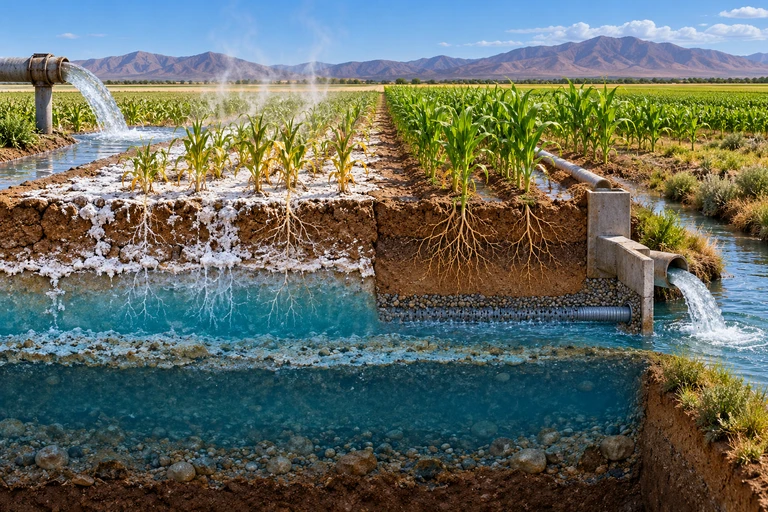 Waterlogging restricts root oxygen when pores remain saturated. Salinization concentrates salts already present in water or soil. These processes can occur together but have different mechanisms.
Waterlogging and salt stress differ
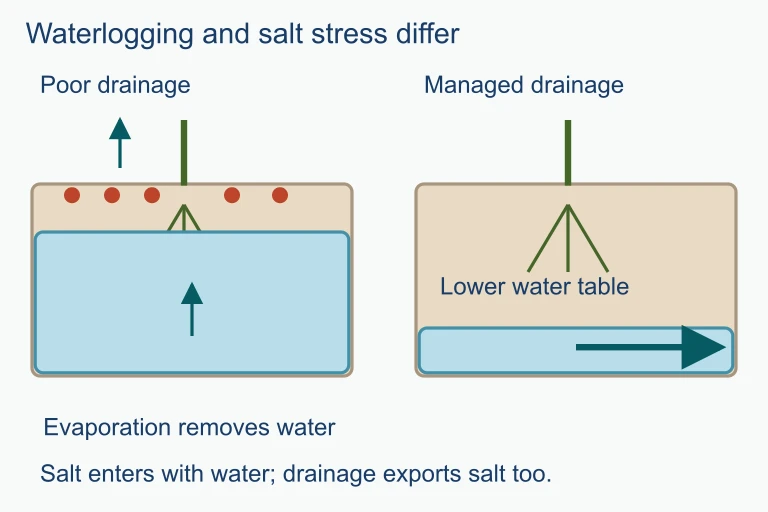 Waterlogging restricts root oxygen when pores remain saturated. Salinization concentrates salts already present in water or soil. These processes can occur together but have different mechanisms.
Example: Center-Pivot Coverage
A center-pivot sprinkler arm is 400 m long. How much area does it cover?
Standard U.S. quarter-sections (160 acres) often contain one center-pivot system, leaving the corners unirrigated (about 21% of the square). Some farms install corner extensions or use the corners for dryland crops.
Common Mistakes
Summary Comparison
| Method | Efficiency | Cost | Best For | Main Risk |
|---|---|---|---|---|
| Flood | 40-50% | Very Low | Rice paddies, flat land | Waterlogging, salinity |
| Furrow | 55-70% | Low | Row crops, gentle slopes | Runoff, erosion |
| Sprinkler | 70-85% | Moderate | Large-scale grain crops | Wind drift, energy use |
| Drip | 90-95% | High | High-value crops, arid zones | Clogging, maintenance |
Question 1 of 5
A farmer in an arid region with limited water from a deep well grows high-value tomatoes. Which irrigation method is most appropriate?
Question 2 of 5
Using the water balance equation \( I = \frac{ET - P_e}{\eta} \), if a crop needs 600 mm of net water and a sprinkler system has \( \eta = 0.80 \), how much total irrigation water is required?
Question 3 of 5
Which of the following is the primary environmental concern associated with flood irrigation in arid climates?
Question 4 of 5
Circular crop patterns visible from satellite imagery are most commonly associated with which irrigation system?
Question 5 of 5
A developing nation wants to maximize food production on flat terrain with abundant river water but has very limited capital. Which method is most practical?