Introduction to
Sustainability
Explore the principles of sustainable development, the balance between human needs and ecological limits, and why sustainability is central to environmental science.
What is Sustainability?
Sustainability means meeting the needs of the present generation without compromising the ability of future generations to meet their own needs. This definition comes from the 1987 Brundtland Report, Our Common Future.
The Three Pillars of Sustainability
Visualizing the Intersection
The overlapping region of all three circles represents true sustainability: solutions that are simultaneously bearable, viable, and equitable.
Renewable vs. Non-Renewable Resources
The Core Sustainability Principle
The IPAT Model
Environmental impact can be modeled using the IPAT equation:
$$ I = P \times A \times T $$
Sustainability vs. Conservation vs. Preservation
| Sustainability | Conservation | Preservation | |
|---|---|---|---|
| Goal | Balance human needs with ecological limits | Wise, efficient use of natural resources | Protect nature from human use entirely |
| Human Use? | Yes, within limits | Yes, managed carefully | Minimal to none |
| Scope | Environment + Economy + Society | Primarily natural resources | Wilderness and biodiversity |
| Example | Sustainable forestry rotation | Catch limits on fisheries | Wilderness Act of 1964 |
Measuring Impact: Ecological Footprint
The ecological footprint measures how much biologically productive land and water area a human population requires to produce the resources it consumes and absorb the waste it generates.
How to Apply Sustainability Thinking
Example: Sustainable Forestry
A forest produces \(500\) cubic meters of new wood growth per year. A logging company wants to harvest timber. What is the maximum sustainable harvest rate?
Example: IPAT in Action
Country X has a population \( P = 50 \text{ million} \), affluence \( A = 12{,}000 \text{ USD/capita} \), and technology factor \( T = 0.5 \text{ kg } CO_2 \text{ per USD} \). What is its total carbon impact?
Example: Overshoot Analysis
Earth's biocapacity is approximately \(1.6 \text{ gha/person}\). The average human ecological footprint is \(2.7 \text{ gha/person}\). Calculate the ecological overshoot in terms of 'number of Earths' needed.
Strategies for Sustainable Living
A repair bench opens the circular economy
 Repair and reuse return products to service. Recycling recovers materials for manufacturing. These processes require energy and can produce residual waste.
Keep products useful; recover materials later
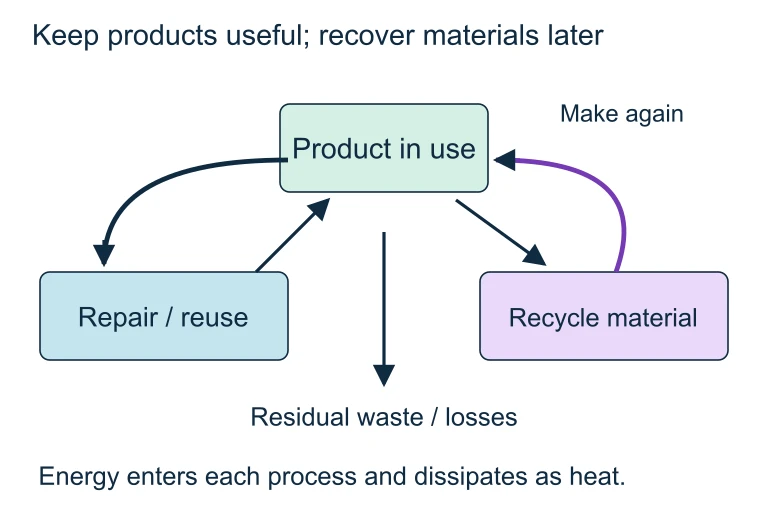 Repair and reuse return products to service. Recycling recovers materials for manufacturing. These processes require energy and can produce residual waste.
Common Mistakes
Summary of Key Concepts
| Concept | Definition | AP Exam Tip |
|---|---|---|
| Sustainability | Meeting present needs without compromising future generations | Always address all 3 pillars |
| IPAT Model | \( I = P \times A \times T \) | Know which variable each policy targets |
| Ecological Footprint | Land/water needed to support consumption | Compare footprint to biocapacity |
| Overshoot | Demand exceeds regeneration rate | Link to resource depletion |
| Maximum Sustainable Yield | Highest harvest rate without depletion | \(\text{Harvest} \le \text{Regeneration}\) |
Question 1 of 5
Which of the following best defines sustainability?
Question 2 of 5
In the IPAT model \( I = P \times A \times T \), a country that doubles its GDP per capita while keeping population and technology constant would see its environmental impact:
Question 3 of 5
A fishery can regenerate \(10{,}000\) tonnes of fish per year. Which harvest rate is sustainable?
Question 4 of 5
The three pillars of sustainability are environmental, economic, and social. Which scenario illustrates a failure to meet the social pillar?
Question 5 of 5
If the global ecological footprint is \(2.7\) gha per person and Earth's biocapacity is \(1.6\) gha per person, approximately how many Earths are we using?