Introduction to
Ecosystems
Explore how living organisms and their physical environment interact to form dynamic, interconnected systems that sustain life on Earth.
What Is an Ecosystem?
An ecosystem is a community of living organisms (biotic factors) interacting with their non-living environment (abiotic factors) as a functional unit. Ecosystems can be as small as a puddle or as vast as the Amazon rainforest.
Biotic vs Abiotic Factors
Levels of Ecological Organization
Energy Flow in Ecosystems
Energy enters most ecosystems as solar radiation and is converted to chemical energy by producers through photosynthesis. It then flows through trophic levels: from producers to primary consumers, secondary consumers, and beyond.
The Energy Pyramid
Nutrient Cycling: Matter is Recycled
Unlike energy, which flows one way through an ecosystem and is ultimately lost as heat, matter is recycled. Elements like carbon, nitrogen, and phosphorus move through biogeochemical cycles, passing between living organisms and the abiotic environment.
Sunlight passes through a living scene; nutrients return
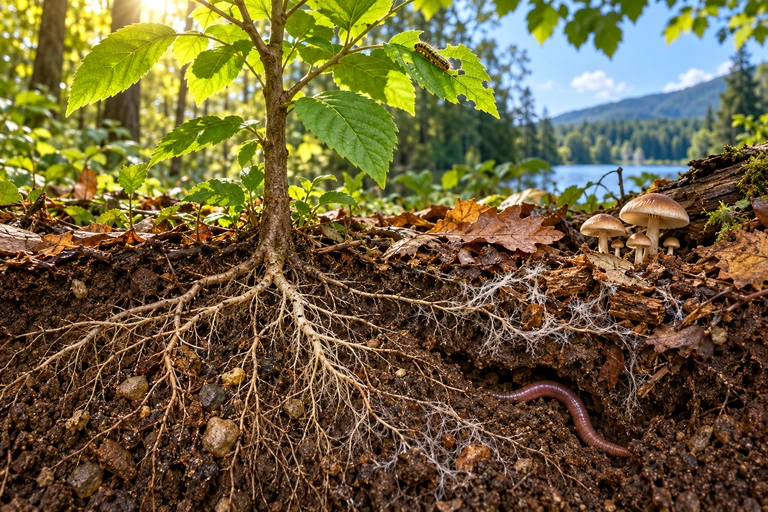 Energy enters organisms through sunlight and food, then dissipates as heat; decomposers also receive chemical energy from organic matter. Nutrient atoms can return through soil and other abiotic reservoirs as ecosystems exchange matter with their surroundings.
Separate energy and matter pathways
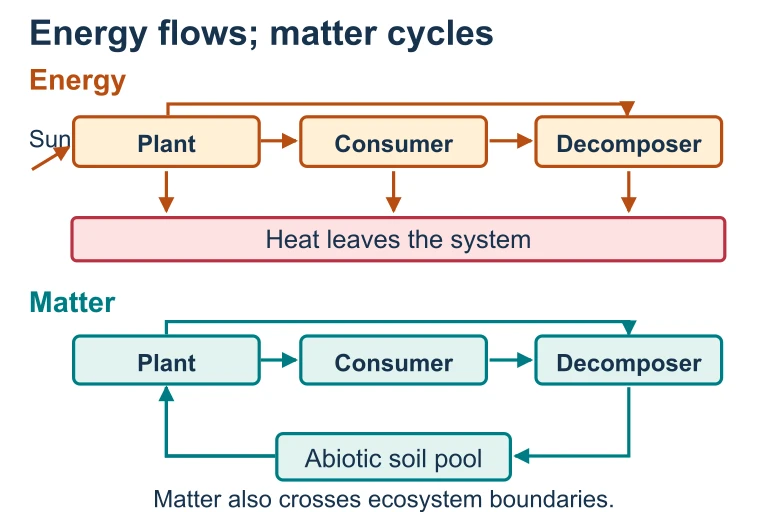 Energy enters organisms through sunlight and food, then dissipates as heat; decomposers also receive chemical energy from organic matter. Nutrient atoms can return through soil and other abiotic reservoirs as ecosystems exchange matter with their surroundings.
Energy Flow vs Nutrient Cycling
| Energy Flow | Nutrient Cycling | |
|---|---|---|
| Direction | One-way (linear) | Cyclical (recycled) |
| Source | Sun (solar radiation) | Earth's crust, atmosphere |
| Lost as | Heat (at every level) | Not lost, just relocated |
| Conservation | Degrades (2nd law of thermodynamics) | Conserved (law of conservation of matter) |
| Key Process | Photosynthesis → Respiration | Biogeochemical cycles |
Understanding Trophic Levels
Food Web vs Food Chain
How to Analyze an Ecosystem
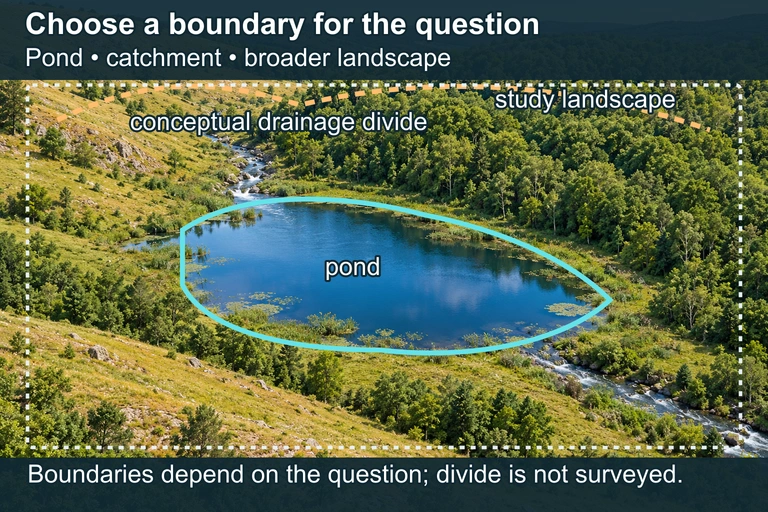
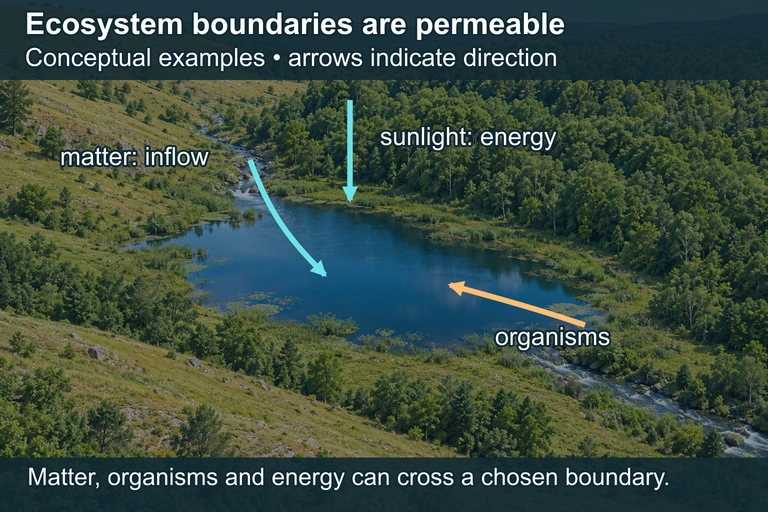
Example: A Pond Ecosystem
Explain why ecosystems exchange material across a chosen boundary.
Use this illustration to explore the concept described in its caption.
Applying the 10% Rule
A grassland ecosystem has producers with a total energy of \( 20{,}000 \text{ kcal/m}^2\text{/yr} \). Calculate the energy available at each trophic level.
Keystone Species and Ecosystem Stability
A keystone species has a disproportionately large effect on its ecosystem relative to its abundance. Removing it triggers a trophic cascade: a chain of effects through multiple trophic levels.
Common Mistakes
Ecosystem Summary
| Concept | Key Point | Example |
|---|---|---|
| Ecosystem | Biotic + abiotic interact | Pond, forest, desert |
| Energy Flow | One-way, 10% rule | Sun → grass → rabbit → hawk |
| Nutrient Cycling | Matter is recycled | Carbon, nitrogen, phosphorus |
| Food Web | Interconnected feeding | Multiple chains in one habitat |
| Keystone Species | Disproportionate impact | Wolves in Yellowstone |
| Trophic Cascade | Chain of effects across levels | Removing predators → overgrazing |
Question 1 of 5
Which of the following best describes the difference between energy flow and nutrient cycling in an ecosystem?
Question 2 of 5
A grassland ecosystem has producers with \( 50{,}000 \text{ kcal/m}^2\text{/yr} \) of energy. Using the 10% rule, approximately how much energy is available to secondary consumers?
Question 3 of 5
In a food web, a disease eliminates the frog population. Which of the following is the most likely immediate effect?
Question 4 of 5
Which of the following is an example of an abiotic factor in an ecosystem?
Question 5 of 5
A keystone species is best defined as an organism that: