01 / 21

Introduction to
Air Pollution

Explore the sources, types, and impacts of atmospheric contaminants that threaten human health and the environment.

AP Environmental Science

What Is Air Pollution?

Air pollution is the introduction of harmful substances into the atmosphere in quantities that damage human health, ecosystems, and the built environment. These substances can be gases, particulates, or biological molecules that alter the natural composition of the air.

Primary vs Secondary Pollutants

Primary Pollutants
Emitted directly from a source into the atmosphere. Examples: \(\text{CO}\), \(\text{SO}_2\), \(\text{NO}_x\), particulate matter (PM).
Secondary Pollutants
Formed in the atmosphere through chemical reactions involving primary pollutants. Examples: \(\text{O}_3\), \(\text{H}_2\text{SO}_4\), \(\text{HNO}_3\).

Sources of Air Pollution

Anthropogenic Fossil Fuel Combustion Industrial Processes Agriculture & Livestock Vehicle Emissions Natural Volcanic Eruptions Wildfires Dust Storms Biogenic Emissions (VOCs)

The Six Criteria Pollutants

Under the Clean Air Act, the EPA monitors six pollutants using the National Ambient Air Quality Standards (NAAQS). These are the most widespread threats to air quality.

\(\text{CO}\)
Carbon monoxide: colorless, odorless gas from incomplete combustion
\(\text{SO}_2\)
Sulfur dioxide: from burning coal and oil; causes acid rain
\(\text{NO}_2\)
Nitrogen dioxide: from vehicles and power plants; smog precursor
\(\text{O}_3\)
Ground-level ozone: a secondary pollutant formed by sunlight + VOCs + \(\text{NO}_x\)
\(\text{PM}\)
Particulate matter (\(\text{PM}_{2.5}\) and \(\text{PM}_{10}\)): tiny particles that penetrate lungs
\(\text{Pb}\)
Lead: historically from leaded gasoline; now from smelters and batteries

How Ground-Level Ozone Forms

\(\text{VOCs} + \text{NO}_x\)
from cars & industry + Sunlight (UV radiation)
\(\text{O}_3\)
Ground-level Ozone (Smog) Photochemical Reaction This is why smog is worst on hot, sunny, still days

Indoor vs Outdoor Pollution

Indoor Outdoor
Key Sources Cooking fuels, tobacco, radon, mold, asbestos, VOCs from paint Vehicles, power plants, factories, wildfires
Major Pollutants \(\text{CO}\), radon, formaldehyde, \(\text{PM}\) \(\text{SO}_2\), \(\text{NO}_x\), \(\text{O}_3\), \(\text{PM}\)
Health Impact Kills ~3.8 million/year globally (WHO) Kills ~4.2 million/year globally (WHO)
Worst In Developing nations (biomass stoves) Industrial cities, traffic corridors

The Air Quality Index (AQI)

The AQI translates pollutant concentrations into a standardized scale from 0 to 500. Higher values mean greater health concern. The EPA calculates AQI for each of the six criteria pollutants; the highest value determines the reported AQI.

0-50 Good 51-100 Moderate 101-150 Sensitive Groups 151-200 Unhealthy 201-300 Very Unhealthy 301+ Hazardous Increasing Health Risk

Acid Deposition and Its Chemistry

Acid deposition (acid rain) occurs when \(\text{SO}_2\) and \(\text{NO}_x\) react with water vapor in the atmosphere to form sulfuric acid and nitric acid:

1
Wet deposition: acids dissolved in rain, snow, or fog (pH < 5.6)
2
Dry deposition: acidic particles and gases settle directly on surfaces
3
Effects: damages forests, acidifies lakes, erodes buildings, harms aquatic life

How to Identify Pollutant Types

1
Identify the source. Is the substance released directly from a smokestack, tailpipe, or natural event? If yes, it is a primary pollutant.
2
Check for atmospheric reactions. Does the substance form through chemical reactions in the air (e.g., sunlight, moisture)? If yes, it is a secondary pollutant.
3
Watch for dual roles. Some pollutants like \(\text{NO}_2\) are both primary (emitted) AND contribute to forming secondary pollutants (\(\text{O}_3\)).
4
Apply the AQI context. Determine whether the question asks about concentration, health effects, or regulatory category.

Example: Classifying Pollutants

A coal-fired power plant emits \(\text{SO}_2\) into the atmosphere. Days later, rain downwind has a pH of 4.3. Identify the primary and secondary pollutants involved.

Example: Thermal Inversions

Ground Level (City) Trapped Cool Air + Pollutants Warm Inversion Layer (Lid) Normal Air (rising convection blocked)

Industrial vs Photochemical Smog

Industrial (London) Smog Photochemical (LA) Smog
Primary Cause Burning coal (\(\text{SO}_2\) + \(\text{PM}\)) Vehicle exhaust (\(\text{NO}_x\) + \(\text{VOCs}\))
Key Pollutant \(\text{SO}_2\), sulfate particles \(\text{O}_3\) (secondary)
Color Grey / black (soot) Brown / hazy
Season Winter (cold, damp) Summer (hot, sunny)
Climate Cool, humid cities Warm, sunny cities

Health and Environmental Effects

Human Health
Respiratory disease, cardiovascular damage, cancer risk, neurological harm from lead and mercury exposure
Ecosystems
Acid rain damages forests and acidifies waterways; ground-level ozone reduces crop yields by up to 15%
Built Environment
Acid deposition corrodes stone, metal, and paint; PM deposits reduce visibility and solar panel efficiency

Legislation and Solutions

1
Clean Air Act (1970): Established NAAQS, required EPA to regulate criteria pollutants; amended in 1990 to address acid rain and ozone depletion.
2
Cap-and-Trade: Market-based approach where polluters receive emission allowances they can trade; successfully reduced \(\text{SO}_2\) by over 80%.
3
Catalytic Converters: Required on all vehicles since 1975; convert \(\text{CO}\), \(\text{NO}_x\), and hydrocarbons into less harmful \(\text{CO}_2\), \(\text{N}_2\), and \(\text{H}_2\text{O}\).
4
Scrubbers and Filters: Electrostatic precipitators and wet scrubbers remove \(\text{PM}\) and \(\text{SO}_2\) from smokestack emissions at power plants.

Control devices remove different pollutants through distinct mechanisms
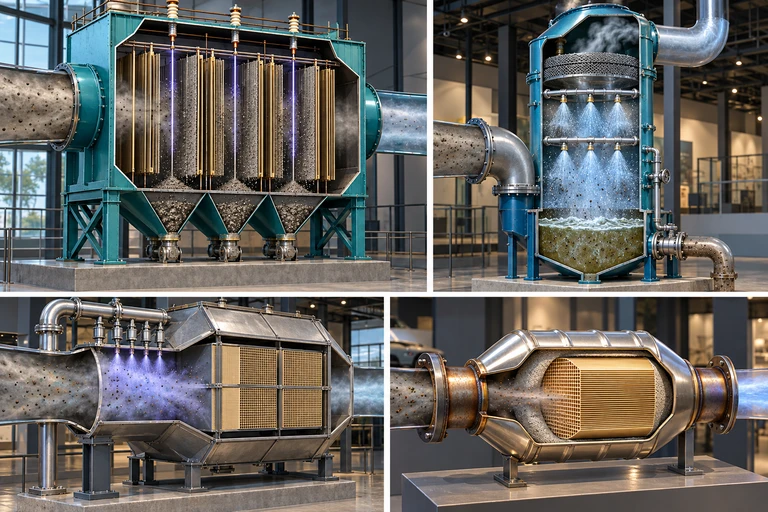
Four industrial cutaways show particle-collection plates,a spray scrubber,a catalyst reactor and a vehicle honeycomb converter.Electrostatic collection transfers particles to collected ash. Alkaline scrubbing transfers sulfur species into a managed liquid or solid waste stream. Different pollutants require different removal mechanisms.

Control devices remove different pollutants through distinct mechanisms
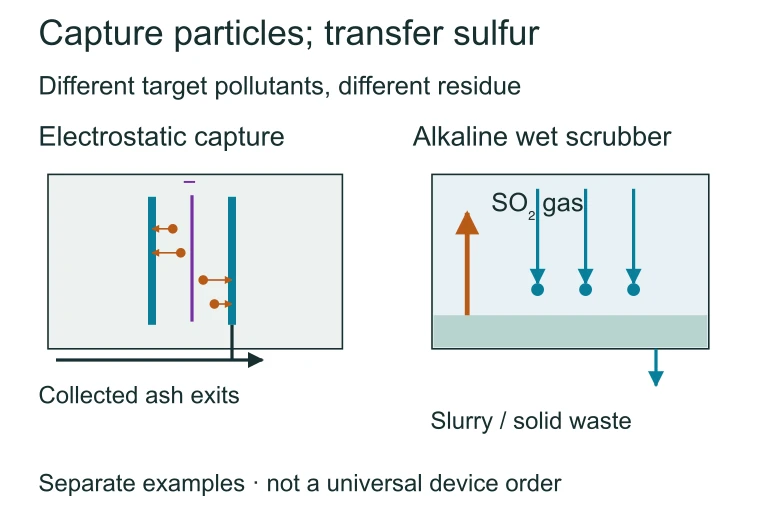
Control devices remove different pollutants through distinct mechanisms. Electrostatic collection transfers particles to collected ash. Alkaline scrubbing transfers sulfur species into a managed liquid or solid waste stream. Different pollutants require different removal mechanisms.Electrostatic collection transfers particles to collected ash. Alkaline scrubbing transfers sulfur species into a managed liquid or solid waste stream. Different pollutants require different removal mechanisms.

Fabric filtration
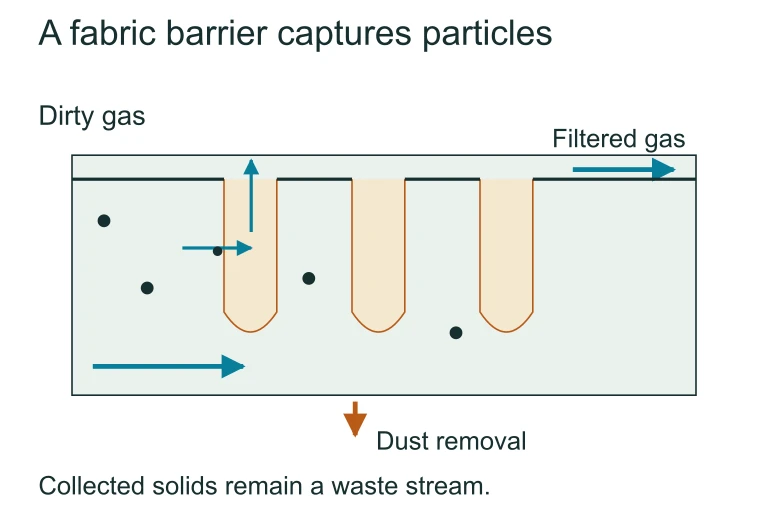
Fabric filtration. Fabric filtration captures particles in a dust layer while cleaned gas passes through. Collected solids leave as a separate waste stream.Fabric filtration captures particles in a dust layer while cleaned gas passes through. Collected solids leave as a separate waste stream.

Vehicle catalyst honeycomb
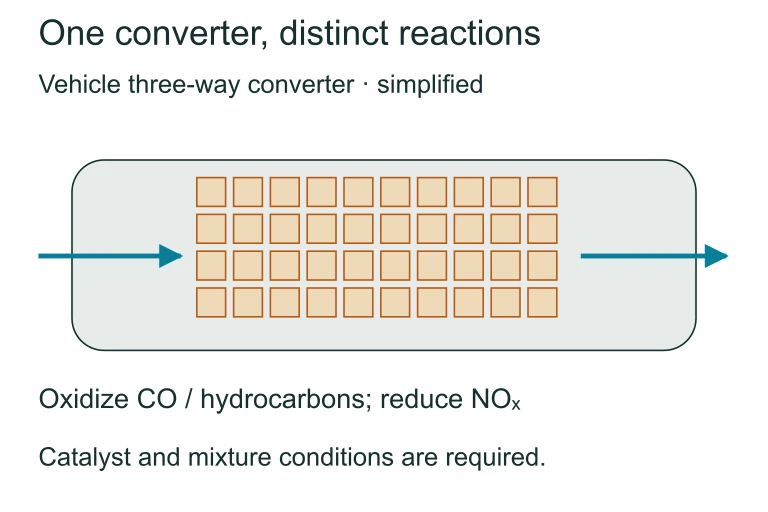
Vehicle catalyst honeycomb. A vehicle catalytic converter promotes oxidation of carbon monoxide and hydrocarbons and reduction of nitrogen oxides. These reactions target different pollutants through different catalytic pathways.A vehicle catalytic converter promotes oxidation of carbon monoxide and hydrocarbons and reduction of nitrogen oxides. These reactions target different pollutants through different catalytic pathways.

Common Mistakes

✕ Ozone Confusion
Mixing up stratospheric ozone (protective layer) with ground-level ozone (harmful smog). They are the same molecule but in different locations.
✕ Primary vs Secondary
Calling \(\text{O}_3\) a primary pollutant. Ground-level ozone is always secondary: it forms from reactions, never from direct emission.
✕ Ignoring Indoor Pollution
Forgetting that indoor air can be 2-5x worse than outdoor air. Radon, CO from stoves, and VOCs from household products are major indoor threats.

Question 1 of 5

Which of the following is a secondary air pollutant?

Question 2 of 5

A thermal inversion traps pollutants near the ground because:

Question 3 of 5

Photochemical smog is most likely to form under which conditions?

Question 4 of 5

Which legislation established the cap-and-trade system that successfully reduced \(\text{SO}_2\) emissions in the United States?

Question 5 of 5

An AQI reading of 175 would fall into which category, and what does it mean?