Integrated Pest
Management
A sustainable, science-based approach to controlling pests that minimizes environmental harm while maintaining effective crop protection.
What Is a Pest?
A pest is any organism that causes economic damage, transmits disease, or competes with humans for resources. Pests include insects, weeds, fungi, rodents, and microorganisms. Not every organism in an ecosystem is a pest: the label depends on context and threshold levels.
The Problem with Pesticides
Conventional pest control relies heavily on synthetic chemical pesticides. While effective in the short term, overuse creates serious environmental and health consequences that accumulate over time.
What Is Integrated Pest Management?
Integrated Pest Management (IPM) is a sustainable, ecosystem-based strategy that combines multiple control methods to manage pest populations below economically damaging levels while minimizing risks to people, property, and the environment.
The Economic Threshold
Two critical concepts drive IPM decision-making: the Economic Injury Level (EIL) and the Economic Threshold (ET).
The IPM Control Pyramid
Cultural Controls
Cultural controls modify the growing environment to make it less favorable for pests. These are preventive, low-cost, and foundational to any IPM program.
Biological Controls
Biological control uses living organisms to suppress pest populations. It leverages natural predator-prey and parasite-host relationships already present in ecosystems.
Mechanical & Chemical Controls
Control methods act at different points in pest ecology
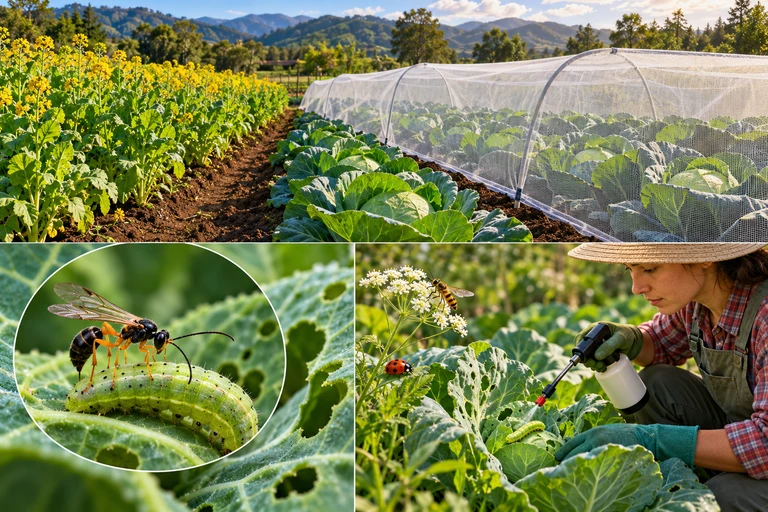 Pest controls can interrupt host availability, exclude pests physically, use natural enemies, or apply a directed treatment. Effective choices depend on the pest, host, timing and non-target effects.
Pest controls target different mechanisms
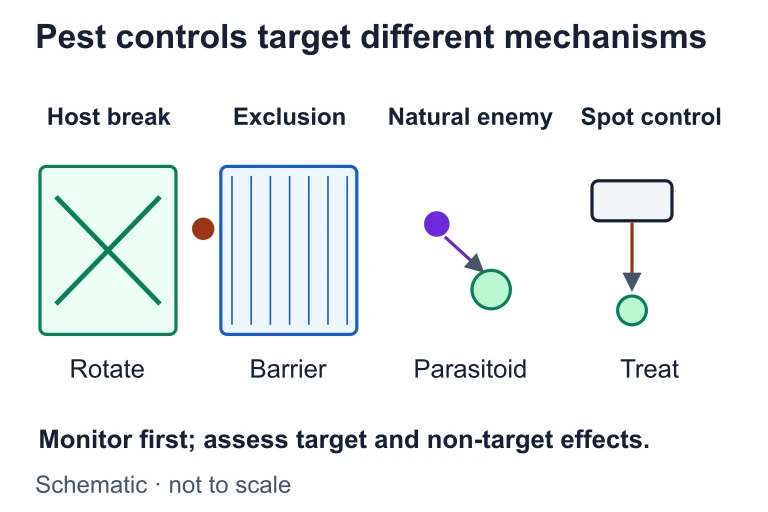 Pest controls can interrupt host availability, exclude pests physically, use natural enemies, or apply a directed treatment. Effective choices depend on the pest, host, timing and non-target effects.
IPM vs. Conventional Pest Control
| IPM | Conventional | |
|---|---|---|
| Goal | Manage below economic threshold | Eliminate all pests |
| Primary tool | Multiple integrated methods | Chemical pesticides |
| Timing | Action at ET | Calendar-based spraying |
| Environmental impact | Low | High |
| Resistance risk | Low (varied tactics) | High (single-mode selection) |
| Cost over time | Decreases | Increases (pesticide treadmill) |
How to Apply IPM: Step by Step
Example: Apple Orchard IPM
An apple grower notices codling moth larvae damaging fruit. Let's walk through the IPM decision process.
Example: Rice Paddy IPM in Southeast Asia
Brown planthoppers (Nilaparvata lugens) are devastating rice crops. Farmers had been spraying broad-spectrum insecticides, which killed natural predators and caused pest resurgence.
Why IPM Matters: Bioaccumulation
Persistent pesticides bioaccumulate through food chains. At each trophic level, the concentration increases by a biomagnification factor.
Common Mistakes on the AP Exam
IPM Control Methods Summary
| Method | Examples | Advantages | Limitations |
|---|---|---|---|
| Cultural | Crop rotation, resistant varieties | Low cost, preventive | Slow, requires planning |
| Biological | Ladybugs, parasitoid wasps, Bt | Self-sustaining, specific | Slow to establish, variable |
| Mechanical | Traps, barriers, hand-picking | No chemicals, immediate | Labor-intensive, small scale |
| Chemical | Targeted, narrow-spectrum pesticides | Fast, effective | Resistance, non-target harm |
Question 1 of 5
What is the primary goal of Integrated Pest Management?
Question 2 of 5
A farmer notices aphid populations in her lettuce field. She releases ladybugs to prey on the aphids. Which type of IPM control is she using?
Question 3 of 5
What is the relationship between the Economic Threshold (ET) and the Economic Injury Level (EIL)?
Question 4 of 5
If a pesticide enters a lake at 0.005 ppm and biomagnifies by a factor of \( \times 10 \) at each of three trophic levels, what is the concentration in a tertiary consumer?
Question 5 of 5
Which of the following best explains why broad-spectrum pesticides can cause pest resurgence?