01 / 22

Indoor Air
Pollutants

Explore the hidden contaminants found inside buildings, their sources, health effects, and strategies for reducing exposure in the built environment.

AP Environmental Science

What Is Indoor Air Pollution?

Indoor air pollution refers to the contamination of air within enclosed spaces by chemical, biological, or physical agents. Because people in industrialized nations spend roughly 90% of their time indoors, exposure to indoor pollutants can exceed outdoor exposure by 2 to 5 times.

Why Indoor Air Matters

Exposure Time
Humans spend approximately 90% of their lives indoors: homes, offices, schools, and vehicles.
Sealed Buildings
Energy-efficient construction reduces ventilation, trapping pollutants and increasing their concentration over time.
Health Impact
Indoor air pollutants cause respiratory disease, cancer, and neurological damage: roughly 3.2 million deaths per year globally (WHO).

Categories of Indoor Pollutants

Indoor Pollutants Chemical Biological Combustion Particulate Formaldehyde, VOCs, Radon, Pesticides Mold, Dust Mites, Pet Dander, Pollen
\( \text{CO, NO}_2, \text{SO}_2, \)
Tobacco Smoke Asbestos, Lead Paint,
\( \text{PM}_{2.5} \) from Cooking

Key Chemical Pollutants

1
Radon (\( \text{Rn-222} \)): Radioactive gas from uranium decay in soil and rock. Seeps through foundation cracks. Second leading cause of lung cancer in the U.S.
2
Formaldehyde (\( \text{CH}_2\text{O} \)): Off-gasses from plywood, particle board, adhesives, and furniture. Causes eye irritation and is classified as a known human carcinogen.
3
Volatile Organic Compounds (VOCs): Emitted by paints, solvents, cleaning products, and air fresheners. Include benzene and toluene: linked to liver, kidney, and CNS damage.
4
Pesticides: Used indoors for pest control. Residues persist on surfaces and become airborne particulate matter.

Combustion Pollutants

Carbon Monoxide
Colorless, odorless gas from incomplete combustion. Binds to hemoglobin \( \sim\!200\times \) more readily than \( \text{O}_2 \), causing oxygen deprivation.
Nitrogen Dioxide
\( \text{NO}_2 \) produced by gas stoves and heaters. Irritates airways, worsens asthma, and increases susceptibility to respiratory infections.

Biological Pollutants

Biological pollutants are living organisms or their byproducts that contaminate indoor air. They thrive in warm, humid environments and are a primary trigger for allergies and asthma.

Mold
Fungi that grow on damp surfaces. Release spores and mycotoxins into air, causing allergic reactions and respiratory illness.
Dust Mites
Microscopic arachnids found in bedding, carpets, and upholstery. Their fecal pellets are potent allergens.
Pet Dander
Tiny skin flakes shed by animals. Remain airborne for hours and penetrate deep into lungs.

Radon: The Invisible Threat

Soil & Rock (Uranium Decay) Crack Rn Rn Rn Indoor Space Rn-222 seeps through foundation cracks, pipes, and sumps

Asbestos & Lead

Asbestos
Naturally occurring mineral fiber used in insulation, tiles, and roofing before the 1980s. Inhaled fibers cause mesothelioma and asbestosis. Danger is highest when materials are disturbed or deteriorating.
Lead Paint
Homes built before 1978 may contain lead-based paint. Peeling or sanding creates lead dust. Children are especially vulnerable: leads to neurological damage, lowered IQ, and developmental delays.

Indoor vs. Outdoor Pollution

Indoor Outdoor
Primary Sources Building materials, combustion appliances, biological agents Vehicles, factories, power plants
Key Pollutants Radon, \( \text{CO} \), formaldehyde, mold Ozone, \(\text{SO}_2\), \(\text{PM}_{2.5}\), \(\text{NO}_x\)
Regulation Minimal direct regulation (EPA guidelines only) Clean Air Act, NAAQS standards
Exposure Duration ~90% of time ~10% of time
Ventilation Effect Poor ventilation increases concentration Atmospheric mixing dilutes pollutants

Sick Building Syndrome

Sick Building Syndrome (SBS) describes a condition where occupants experience acute health effects: headaches, dizziness, nausea, eye and throat irritation: that appear to be linked to time spent in a building but no specific illness or cause can be identified.

Symptoms
Headache, fatigue, difficulty concentrating, irritation of eyes, nose, and throat. Symptoms improve after leaving the building.
Causes
Inadequate ventilation, VOC off-gassing, biological contaminants, and poor HVAC maintenance.
Distinction
Unlike Building-Related Illness (BRI), SBS has no identifiable pathogen. BRI has diagnosable conditions like Legionnaires' disease.

How to Reduce Indoor Pollutants

1
Source Control: Remove or reduce the pollutant at its origin. Use low-VOC paints, ban indoor smoking, fix leaks that promote mold growth.
2
Ventilation Improvement: Increase outdoor air exchange. Open windows, use exhaust fans, maintain HVAC systems to dilute indoor pollutants.
3
Air Cleaning: Use HEPA filters and activated carbon filters to remove particulates and some gases. Effective for allergens and fine particles.
4
Testing: Test for radon with home kits. Monitor CO with alarms. Professional testing for asbestos and lead in older buildings.

Source control and ventilation address different indoor pathways

House cutaway shows indoor sources, ducts and below-slab plumbing context. The illustration alone does not identify or validate a radon system; the explicit authored route supplies that distinction.Source removal, appropriate ventilation and pollutant-specific treatment address different indoor exposure pathways. Matching the intervention to the pollutant and its entry route improves control.

Control sources; route clean and dirty air
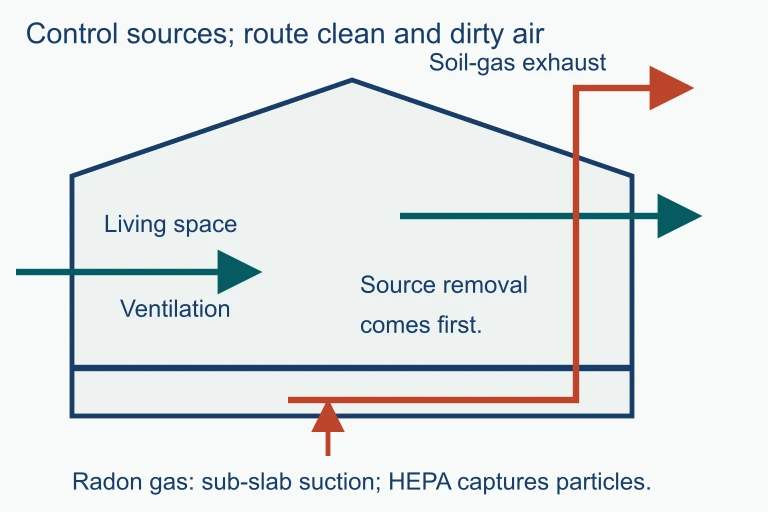
Control sources; route clean and dirty air. Source removal, appropriate ventilation and pollutant-specific treatment address different indoor exposure pathways. Matching the intervention to the pollutant and its entry route improves control.Source removal, appropriate ventilation and pollutant-specific treatment address different indoor exposure pathways. Matching the intervention to the pollutant and its entry route improves control.

Example: Radon in a Home

A homeowner in the Appalachian region tests their basement and finds a radon level of \( 8.2 \; \text{pCi/L} \). The EPA action level is \( 4 \; \text{pCi/L} \).

1
Identify the source: Radon seeps from uranium-rich bedrock through foundation cracks and gaps around pipes.
2
Compare to standard: \( 8.2 \; \text{pCi/L} > 4 \; \text{pCi/L} \): this exceeds the EPA action level by more than double.
3
Recommend mitigation: Install a sub-slab depressurization system: a pipe and fan that vents radon from beneath the foundation to the outdoors.

Example: Carbon Monoxide Exposure

A family reports persistent headaches and dizziness during winter. Their home has a gas furnace and an attached garage where a car idles each morning.

1
Identify the source: Incomplete combustion from the gas furnace and vehicle exhaust from the garage. \( \text{CO} \) is colorless and odorless.
2
Explain the mechanism: \( \text{CO} \) binds to hemoglobin forming carboxyhemoglobin, reducing blood oxygen transport. Even low-level chronic exposure causes symptoms.
3
Recommend solutions: Install CO detectors. Service the furnace annually. Never idle vehicles in an attached garage. Ensure proper venting of all combustion appliances.

Explain why an invisible gas can impair oxygen delivery.

Use this illustration to explore the concept described in its caption.
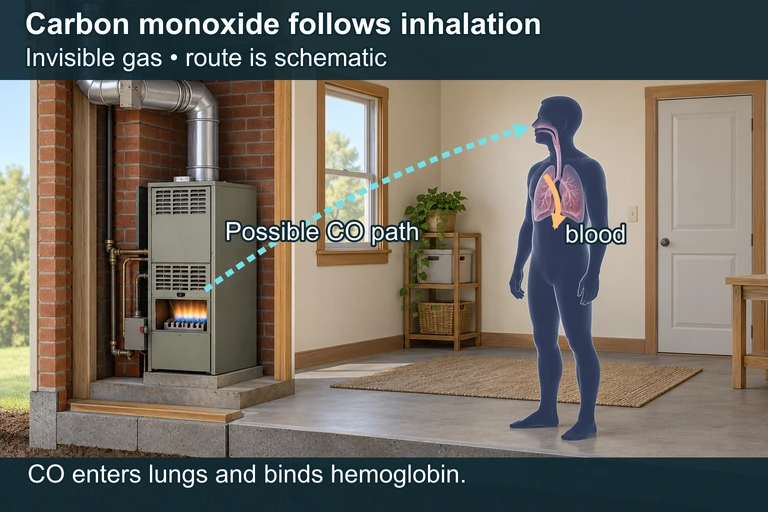
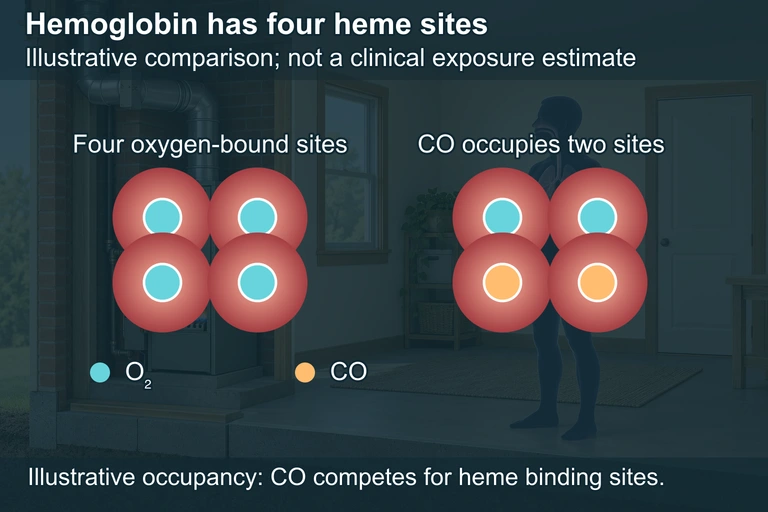
An illustrative combustion appliance, person and schematic path show inhalation and transport into blood; a companion compares four heme binding sites.
Invisible carbon monoxide can reach the breathing zone and interfere with oxygen transport after inhalation. The pathway is schematic and gives no clinical dose threshold.
Two four-site hemoglobin symbols compare four oxygen-occupied sites with two oxygen and two carbon-monoxide occupied sites.
Schematic occupancy only: CO competes with oxygen and also impairs oxygen unloading. No clinical concentration or threshold is shown.

Example: Biomass Burning in Developing Nations

Traditional Cookstove Wood / Dung Fuel → Improved Cookstove Chimney Vent Exhaust
\( \text{PM}_{2.5} \) exposure: HIGH
\( \text{PM}_{2.5} \) reduced ~60%

Common Mistakes

✕ Confusing SBS and BRI
Sick Building Syndrome has no identifiable cause. Building-Related Illness (BRI) involves a diagnosed condition like Legionnaires' disease. They are not interchangeable.
✕ Thinking Radon Is Only Outdoor
Radon is the #1 indoor radioactive pollutant. It accumulates inside sealed buildings: outdoor levels are far lower due to atmospheric dilution.
✕ Ignoring Developing Nations
AP exams frequently test biomass burning as the leading indoor air pollutant source globally: not formaldehyde or VOCs (which dominate in industrialized nations).

Summary of Major Pollutants

Pollutant Source Health Effect Mitigation
Radon Soil / rock decay Lung cancer Sub-slab ventilation
\( \text{CO} \) Combustion appliances Oxygen deprivation Detectors, venting
Formaldehyde Pressed wood, adhesives Cancer, irritation Low-VOC materials
Asbestos Old insulation, tiles Mesothelioma Encapsulation / removal
Lead Pre-1978 paint Neurological damage Abatement, enclosure
Mold Moisture / humidity Allergies, asthma Dehumidify, fix leaks

Question 1 of 5

Which indoor air pollutant is the second leading cause of lung cancer in the United States?

Question 2 of 5

A building's occupants report headaches and fatigue that resolve when they leave the building, but no specific pathogen is found. This is best described as:

Question 3 of 5

Which strategy does the EPA rank as most effective for reducing indoor air pollution?

Question 4 of 5

In developing nations, the primary source of indoor air pollution affecting approximately 3 billion people is:

Question 5 of 5

Carbon monoxide is dangerous primarily because it: