Impacts of
Urbanization
Explore how urban growth transforms land, water, air, and biodiversity: from the urban heat island effect to stormwater runoff and habitat fragmentation.
What Is Urbanization?
Urbanization is the increasing concentration of human populations in cities and metropolitan areas. Today, over 55% of the world's population lives in urban areas, and that figure is projected to reach 68% by 2050.
Key Terms to Know
Why Urbanization Matters
Cities cover only about 3% of Earth's land surface, yet they consume over 75% of natural resources and produce roughly 70% of global \(\text{CO}_2\) emissions.
Land Use Transformation
When cities expand, they convert forests, wetlands, and farmland into impervious surfaces. This triggers cascading ecological effects.
The Urban Heat Island Effect
Urban heat depends on surface energy balance and measurement context
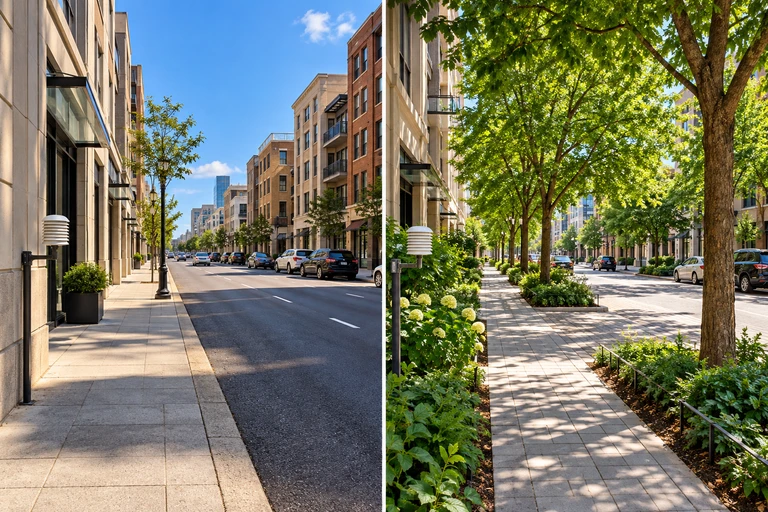
Dark paving can absorb and store solar energy, while vegetation provides shade and evapotranspiration when water is available. Air temperature, surface temperature and thermal comfort measure different aspects of heat exposure.Urban heat depends on surface energy balance and measurement context.
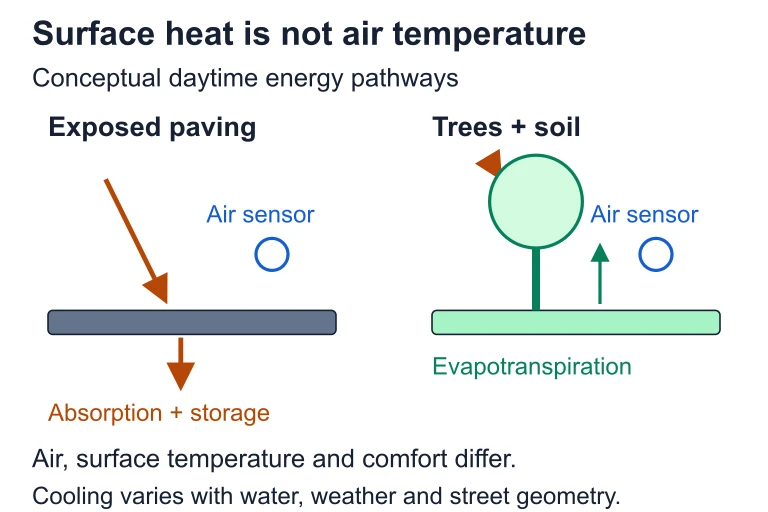
Dark paving can absorb and store solar energy, while vegetation provides shade and evapotranspiration when water is available. Air temperature, surface temperature and thermal comfort measure different aspects of heat exposure.Stormwater Runoff & Water Quality
Impervious cover changes water partitioning and storm response
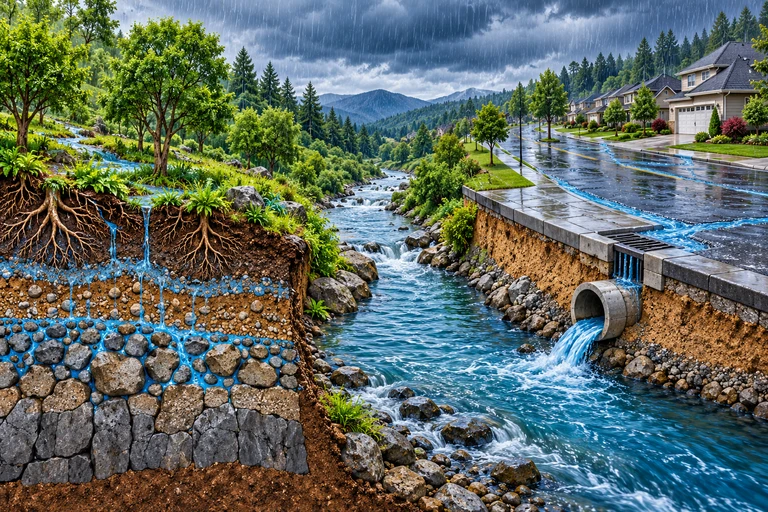
Impervious cover can change both runoff timing and volume. Storm conditions, soils and drainage control the response; infiltrated water may enter storage, evapotranspiration or later streamflow.Connected impervious surfaces can concentrate runoff into a sharper storm response.
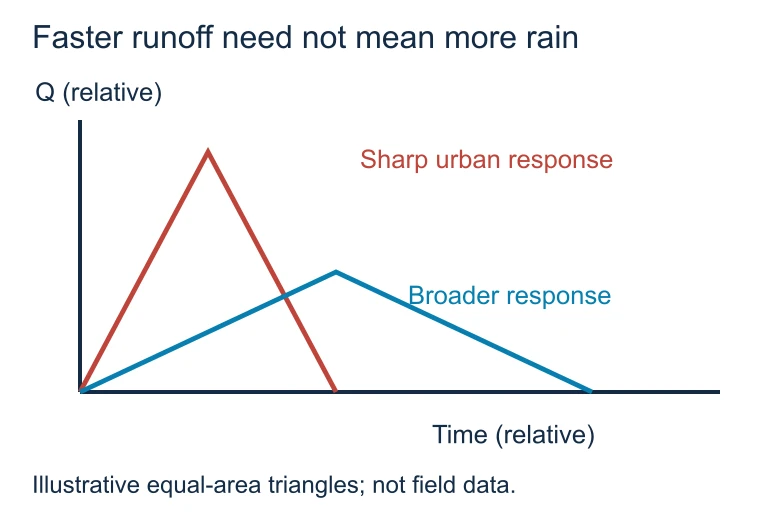
Impervious cover can change both runoff timing and volume. Storm conditions, soils and drainage control the response; infiltrated water may enter storage, evapotranspiration or later streamflow.Air Quality & Emissions
Sprawl vs. Smart Growth
| Urban Sprawl | Smart Growth | |
|---|---|---|
| Density | Low-density, spread out | High-density, compact |
| Transport | Car-dependent | Public transit, walkable |
| Land Use | Single-use zoning | Mixed-use development |
| Green Space | Fragmented or absent | Preserved, integrated parks |
| Ecological Impact | High: habitat loss, runoff | Lower: reduced footprint |
Explain how settlement configuration changes land demand and travel opportunities.
Use this illustration to explore the concept described in its caption.
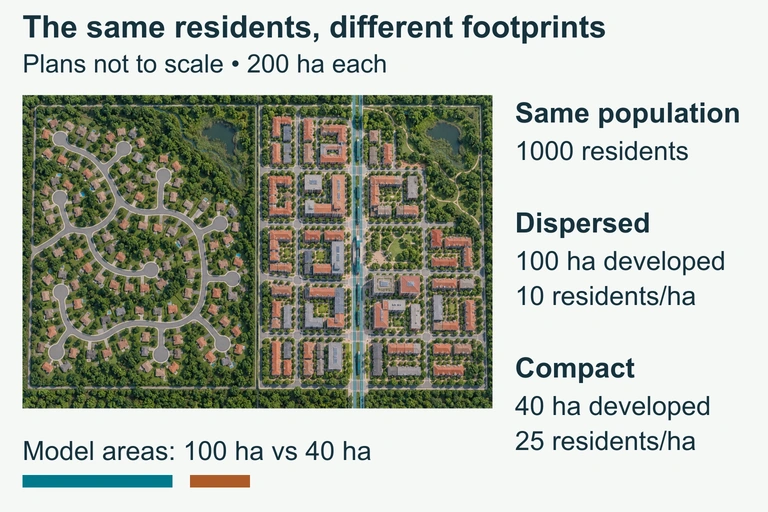
Measuring Ecological Footprint
The ecological footprint quantifies the demand human activity places on ecosystems. Urbanization intensifies per-area footprint while potentially reducing per-capita footprint through shared infrastructure.
Biodiversity Impacts
How to Analyze Urbanization Impacts
Example: Runoff Calculation
A city replaces 10 hectares of grassland with an impervious parking lot. Before development, the runoff coefficient was 0.15. After paving, it becomes 0.90. During a storm delivering 5 cm of rain, how much additional runoff is generated?
Example: Heat Island Temperature
A rural area records an average summer temperature of \(28\,{}^\circ\text{C}\). The nearby city center is measured at \(33\,{}^\circ\text{C}\). Calculate the urban heat island intensity (UHI).
Example: Ecological Footprint Comparison
Compare per-capita resource consumption between a suburban community and a dense urban neighborhood.
| Suburban | Dense Urban | |
|---|---|---|
| Avg. commute | 45 min (car) | 25 min (transit) |
| \(\text{CO}_2\) / capita / yr | 8.5 tonnes | 4.2 tonnes |
| Land per household | 0.15 ha | 0.02 ha |
| Water use / capita / day | 350 L | 200 L |
Common Mistakes
Question 1 of 5
Which of the following is the primary cause of the urban heat island effect?
Question 2 of 5
A 10-hectare forested area (runoff coefficient = 0.10) is developed into a commercial district (runoff coefficient = 0.85). During a 4 cm rainfall event, how much additional runoff is generated?
Question 3 of 5
Which strategy is most characteristic of smart growth principles?
Question 4 of 5
Habitat fragmentation caused by urbanization most directly leads to which of the following?
Question 5 of 5
A city installs green roofs on 20% of its downtown buildings. Which combination of benefits is most likely to result?