Impacts of
Agricultural Practices
Explore how modern farming reshapes soil, water, and ecosystems: from nutrient cycles and irrigation to pesticide runoff and sustainable solutions.
What Is Agriculture's Environmental Footprint?
Agriculture occupies roughly 40% of Earth's ice-free land surface and accounts for about 70% of global freshwater withdrawals. Every farming decision: what to plant, how to fertilize, and how to irrigate: sends ripple effects through soil chemistry, water quality, atmospheric composition, and biodiversity.
Essential Vocabulary
The Nutrient Cycle in Agriculture
How Soil Degradation Happens
Irrigation and Salinization
Irrigation can create waterlogging and salt accumulation by different routes
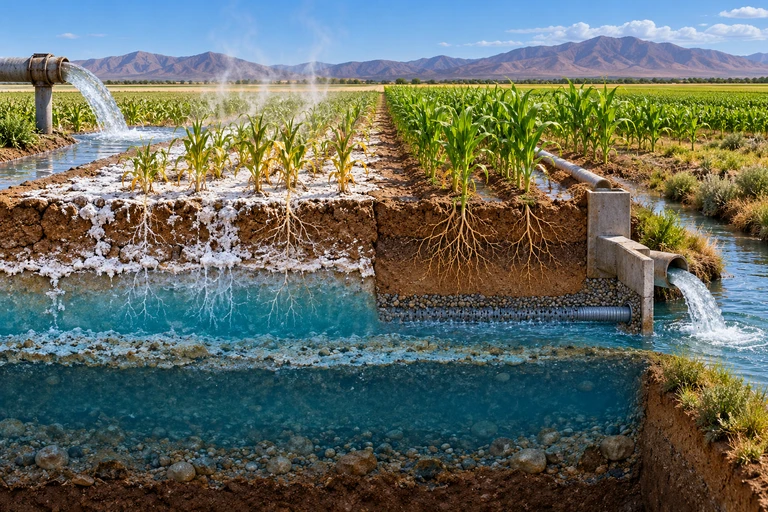 Waterlogging restricts root oxygen when pores remain saturated. Salinization concentrates salts already present in water or soil. These processes can occur together but have different mechanisms.
Waterlogging and salt stress differ
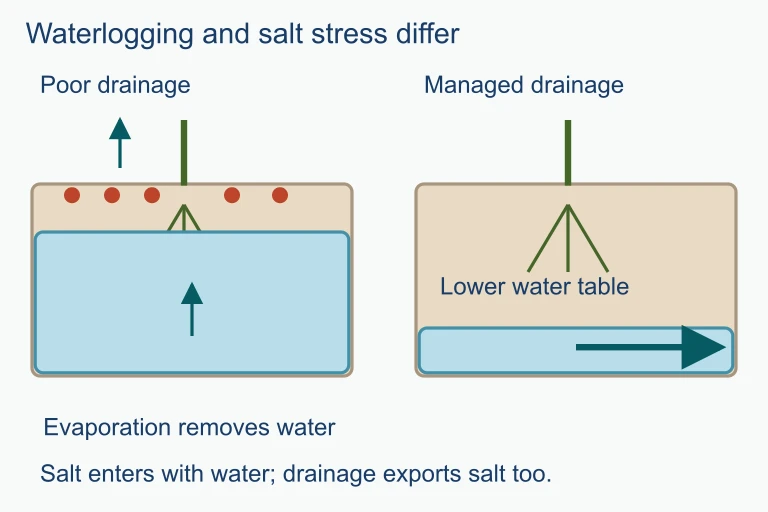 Waterlogging restricts root oxygen when pores remain saturated. Salinization concentrates salts already present in water or soil. These processes can occur together but have different mechanisms.
Pesticides and Biomagnification
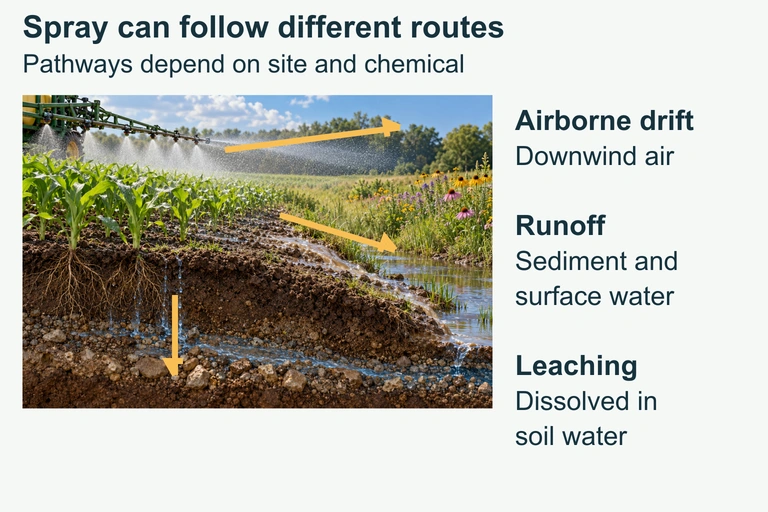
Identify why target application is not equivalent to target-only exposure.
Use this illustration to explore the concept described in its caption.
Conventional vs. Sustainable Agriculture
| Conventional | Sustainable | |
|---|---|---|
| Pest Control | Synthetic pesticides (broad spectrum) | IPM: biological + targeted chemical |
| Fertilizer | Synthetic N-P-K (high application rates) | Compost, manure, cover crops |
| Soil Health | Intensive tilling, monoculture | No-till, crop rotation, polyculture |
| Water Use | Flood / sprinkler irrigation | Drip irrigation, rainwater harvesting |
| Biodiversity | Low: monoculture reduces habitat | Higher: hedgerows, intercropping |
| Short-Term Yield | Higher | Moderate |
| Long-Term Viability | Declining soil fertility | Self-sustaining |
How to Analyze an Agricultural Impact
Example: Fertilizer Runoff
Scenario: A corn farmer in Iowa applies synthetic nitrogen fertilizer at \( 200 \; \text{kg N/ha} \). Heavy spring rains wash excess nitrogen into a nearby stream that flows into the Mississippi River.
Example: Overgrazing in the Sahel
Scenario: Pastoral herders in sub-Saharan Africa increase cattle density beyond the carrying capacity of semi-arid grasslands. Vegetation is consumed faster than it can regenerate.
Example: The Aral Sea Disaster
Scenario: Soviet-era irrigation projects diverted the Amu Darya and Syr Darya rivers to grow cotton in Uzbekistan. By the 1990s, the Aral Sea had shrunk to 10% of its original area.
Agriculture and Greenhouse Gases
Sustainable Solutions
Common Mistakes
Impact Summary Table
| Practice | Environmental Impact | Sustainable Alternative |
|---|---|---|
| Synthetic Fertilizers | Eutrophication, dead zones | Cover crops, compost, buffer strips |
| Pesticide Overuse | Bioaccumulation, pollinator decline | IPM, biological control |
| Flood Irrigation | Salinization, aquifer depletion | Drip irrigation, rainwater capture |
| Intensive Tilling | Topsoil erosion, carbon release | No-till, contour plowing |
| Monoculture | Biodiversity loss, pest vulnerability | Crop rotation, polyculture |
| Overgrazing | Desertification | Rotational grazing |
| Deforestation for Farms | \( \text{CO}_2 \) release, habitat destruction | Agroforestry, land-use planning |
Question 1 of 5
A large algal bloom forms in a lake downstream from agricultural fields. Which process is the most direct cause of the bloom?
Question 2 of 5
Which sustainable practice is most effective at reducing soil erosion on sloped farmland?
Question 3 of 5
DDT concentrations are lowest in phytoplankton and highest in bald eagles. This pattern is best explained by:
Question 4 of 5
A farmer in an arid region notices white salt crusts forming on the soil surface after several years of irrigation. What is the primary cause?
Question 5 of 5
Which of the following agricultural practices contributes most significantly to methane (\( \text{CH}_4 \)) emissions?