Hydrogen
Fuel Cells
Discover how hydrogen gas is converted into electrical energy through electrochemistry: the reaction \( 2\text{H}_2 + \text{O}_2 \rightarrow 2\text{H}_2\text{O} + \text{energy} \).
What Is a Fuel Cell?
A fuel cell is an electrochemical device that converts the chemical energy stored in a fuel directly into electrical energy and heat. Unlike a battery, a fuel cell does not run down or need recharging: it produces energy as long as fuel is supplied.
Why Hydrogen?
Environmental Significance
Burning fossil fuels releases greenhouse gases (primarily \( \text{CO}_2 \)) that drive climate change. Hydrogen fuel cells offer a pathway to decarbonize transportation, power generation, and industrial processes.
The Core Reaction
Inside a Proton Exchange Membrane (PEM) fuel cell, the overall electrochemical reaction is:
This is split into two half-reactions occurring at separate electrodes:
Inside a PEM Fuel Cell
Open a bus side panel to reveal separated charge paths
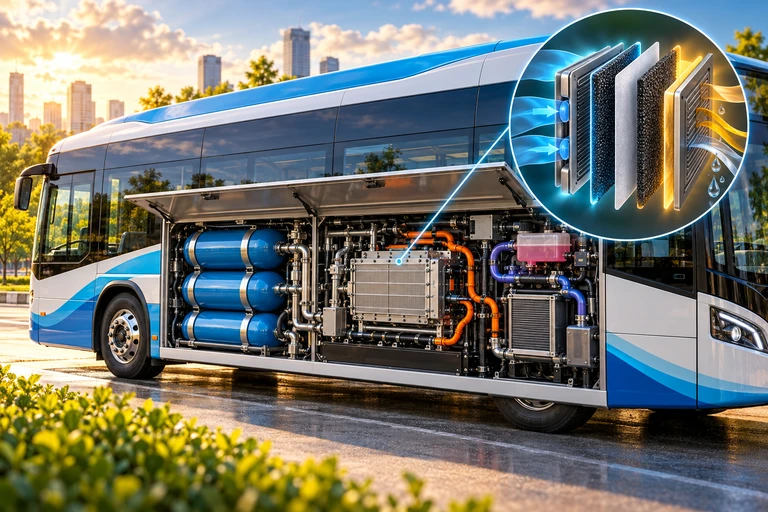 A PEM fuel cell sends protons through the membrane and electrons through an external load. Hydrogen and oxygen combine into water; the separated charge routes permit useful electrical work.
A PEM cell separates proton and electron routes
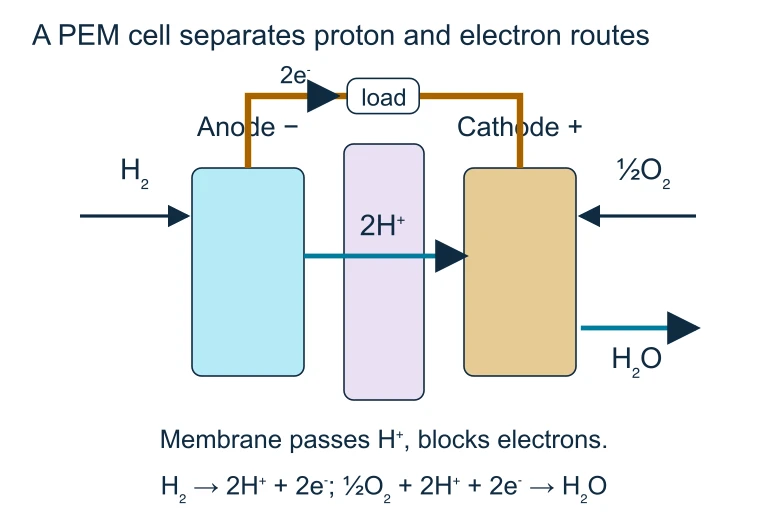 A PEM fuel cell sends protons through the membrane and electrons through an external load. Hydrogen and oxygen combine into water; the separated charge routes permit useful electrical work.
Fuel Cells vs. Batteries vs. Combustion
| Fuel Cell | Battery | Combustion Engine | |
|---|---|---|---|
| Energy Source | External fuel (\( \text{H}_2 \)) | Stored chemicals | Fossil fuels |
| Conversion | Chemical → Electrical | Chemical → Electrical | Chemical → Thermal → Mechanical |
| Byproduct | \( \text{H}_2\text{O} \) only | None (closed) | \( \text{CO}_2, \text{NO}_\text{x}, \text{PM} \) |
| Efficiency | 40-60% | 80-95% | 20-35% |
| Recharge | Refuel in minutes | Hours to charge | Refuel in minutes |
Types of Fuel Cells
How Is Hydrogen Produced?
Efficiency: Numbers That Matter
How to Evaluate Hydrogen Solutions
Example 1: Emissions Comparison
A gasoline car emits approximately 8.9 kg \( \text{CO}_2 \) per gallon burned. A hydrogen FCEV using green hydrogen emits 0 kg \( \text{CO}_2 \) at both production and tailpipe. How much \( \text{CO}_2 \) is saved over 12,000 miles if the gasoline car averages 30 mpg?
Example 2: Electrolysis Energy
Producing 1 kg of hydrogen by electrolysis requires approximately 55 kWh of electricity. A solar farm generates 1,200 kWh per day. How many kilograms of green hydrogen can it produce daily?
Example 3: Grey vs. Green Lifecycle
Grey hydrogen production emits approximately 10 kg \( \text{CO}_2 \) per kg \( \text{H}_2 \). A city bus fleet uses 50 kg \( \text{H}_2 \) per day. Compare annual emissions using grey vs. green hydrogen.
Common Mistakes
Summary of Key Concepts
| Concept | Key Detail | AP Connection |
|---|---|---|
| Overall Reaction | \( 2\text{H}_2 + \text{O}_2 \rightarrow 2\text{H}_2\text{O} \) | Energy conversion |
| Byproduct | Water vapor and heat | Zero tailpipe emissions |
| Efficiency | 40-60% (PEM) | 2x combustion engines |
| Green Hydrogen | Electrolysis + renewables | Sustainable energy systems |
| Lifecycle Analysis | Source matters (grey vs. green) | Environmental tradeoffs |
Question 1 of 5
What is the only byproduct emitted at the tailpipe of a hydrogen fuel cell vehicle?
Question 2 of 5
Which hydrogen production method has the lowest lifecycle carbon emissions?
Question 3 of 5
In a PEM fuel cell, what happens at the anode?
Question 4 of 5
A fleet of 10 buses each uses 50 kg of grey hydrogen daily (\( 10 \text{ kg CO}_2 \) per kg \( \text{H}_2 \)). What are the fleet's annual \( \text{CO}_2 \) emissions?
Question 5 of 5
Which statement best explains why fuel cells are more efficient than internal combustion engines?